
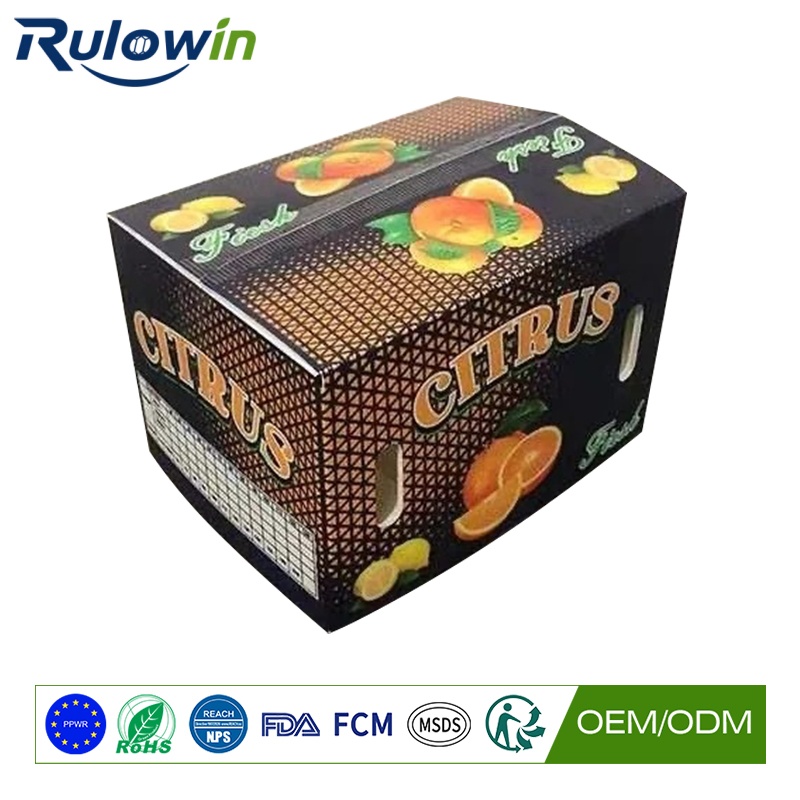
Produce picked warm carries field heat, and how fast that heat leaves determines shelf life more than almost anything else that happens afterwards. In forced-air pre-cooling the crate is part of the heat exchanger: air has to get through it, around the produce, and out the other side.
Side vents matter more than floor vents
In a forced-air tunnel, air is pulled through the stack, usually vertically. That means the path goes through the floor and the lid – but the resistance is dominated by the smallest openings in the path, and on most crates that is the side wall area presented to the airflow.
Crates designed for pre-cooling have generous side vent area and a floor pattern that does not block it. A crate that looks well ventilated in a photograph may be poorly ventilated in the direction that matters.
Alignment through the stack
Vents in consecutive crates have to line up, or the air path is blocked at every layer. Crates that stack in a fixed orientation – not rotated – give a continuous path. Crates that allow rotation may not.
If your crates can be stacked two ways, the pre-cooling performance depends on which way the operator happened to put them. That is worth knowing, and it argues for a crate that only stacks one way.
Time, which is the real constraint
Pre-cooling is a race. Produce that reaches temperature in four hours keeps considerably longer than produce that takes twelve. So a crate that halves the cooling time is worth more than a crate that is marginally stronger.
This is the specification priority that most crate buying gets backwards – durability is easy to value and cooling rate is not, but the cooling rate is what determines what the customer receives.
What not to do
Do not over-wrap. A pallet wrapped for stability before pre-cooling blocks the air path almost entirely – the wrap has to go on after cooling, or the pallet has to be cooled un-wrapped and then wrapped.
And do not stack too high in the tunnel. Air takes the path of least resistance, and a tall stack with a poor seal means the air bypasses the produce at the edges.
Trade-offs worth naming
More vent area means faster cooling and slightly more bruising risk on soft fruit. There is no way around it; the resolution is many small openings rather than a few large ones, and a floor that lifts the fruit off the openings. That is discussed in best crate type for ventilated produce transport.
What to measure
Put a temperature probe in the middle of the load – not at the edge, where cooling happens first – and record how long it takes to reach target. That single number tells you whether your crate and stack pattern are working, and it is the number to optimise against.
Then change one thing at a time: vent alignment, stack height, tunnel seal. Each change shows up in the cooling curve within a day, and you will find the configuration that suits your setup much faster than by reasoning about it.
Most operations are surprised by how much the stack pattern alone matters. It is free to change and it is frequently the largest single factor.
What we can do
We make PP crates for fruit and vegetables with vent geometry specified for the cooling method, not just for the crop. Tell us whether you force-air, hydro-cool or room-cool, and we will specify – including when a standard crate already suits.