
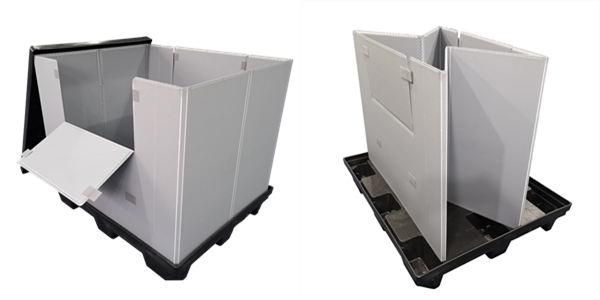
A cardboard pallet box – the heavy-duty corrugated octabin type – is the default for bulk parts because it is cheap, it stores flat, and it is disposable. It fails in three predictable ways, and if any of those describes your situation, it is worth changing.
Failure one: the bottom
Heavy parts concentrate load at the base of the box, and the base of a cardboard box is its weakest point, particularly where the side walls meet the floor panel. Wet or humid conditions accelerate it sharply. The failure is a box that splits at the bottom seam and empties its contents.
Once you have seen it happen, you will recognise the warning: the box bulges slightly at the base before it goes.
Failure two: humidity
Corrugated board softens as it absorbs moisture. A box that was adequate when packed is not adequate three weeks later in a humid warehouse or a container. For anything with a long transit or a damp destination, cardboard is a gamble on the weather.
Failure three: reuse
A cardboard pallet box is nominally single-trip. In practice people reuse them, and the second trip is where they fail. If your operation is quietly reusing them because the budget assumes it, that is worth surfacing – the failure rate is higher than anyone is admitting.
Option one: a pallet sleeve box
The direct substitute for a closed or semi-closed loop. Much stronger at the base, indifferent to moisture, collapses for return. Costs more per unit and lasts many trips. The base is the part that wears and it is replaceable separately.
Where it loses: sharp, heavy parts will work through a sleeve wall. If your product has edges, you need a liner, and that is real cost.
Option two: a moulded plastic pallet box
Rigid, very strong, nests or stacks, and takes abuse that would destroy either of the others. Also expensive, heavy when empty, and it does not collapse – so the return volume is poor.
These suit dense, abrasive, high-value parts on a short lane. They do not suit long return legs.
Option three: keep cardboard, change the spec
Sometimes the honest answer. A higher-grade board with a reinforced base, specified for the actual weight and stored dry, may be entirely adequate and is far cheaper than anything above. Worth exhausting before switching – particularly if the failures are occasional rather than systematic.
If you do switch, sizing matters. We covered it in what to measure before ordering a pallet sleeve box.
How to tell which failure you have
Look at where the box failed. A split at the bottom seam is a load problem – the base cannot carry the weight. A soft, deformed wall partway up is a humidity problem. A puncture is a handling problem, and no material change fixes it.
Each has a different answer, and treating a humidity failure by buying a stronger box does not work, because the stronger box absorbs water too.
If the failures are occasional, look at the outliers rather than the average – one heavy product, one damp destination, one customer who stores outdoors. Fixing the specific case is usually far cheaper than changing the whole specification.
What we can do
We supply heavy-duty pallet sleeve boxes and will compare them against the octabins you use now. Tell us the part weight, the base area and the lane, and we will tell you what the sleeve needs to be – including when a better grade of cardboard is the cheaper fix.