
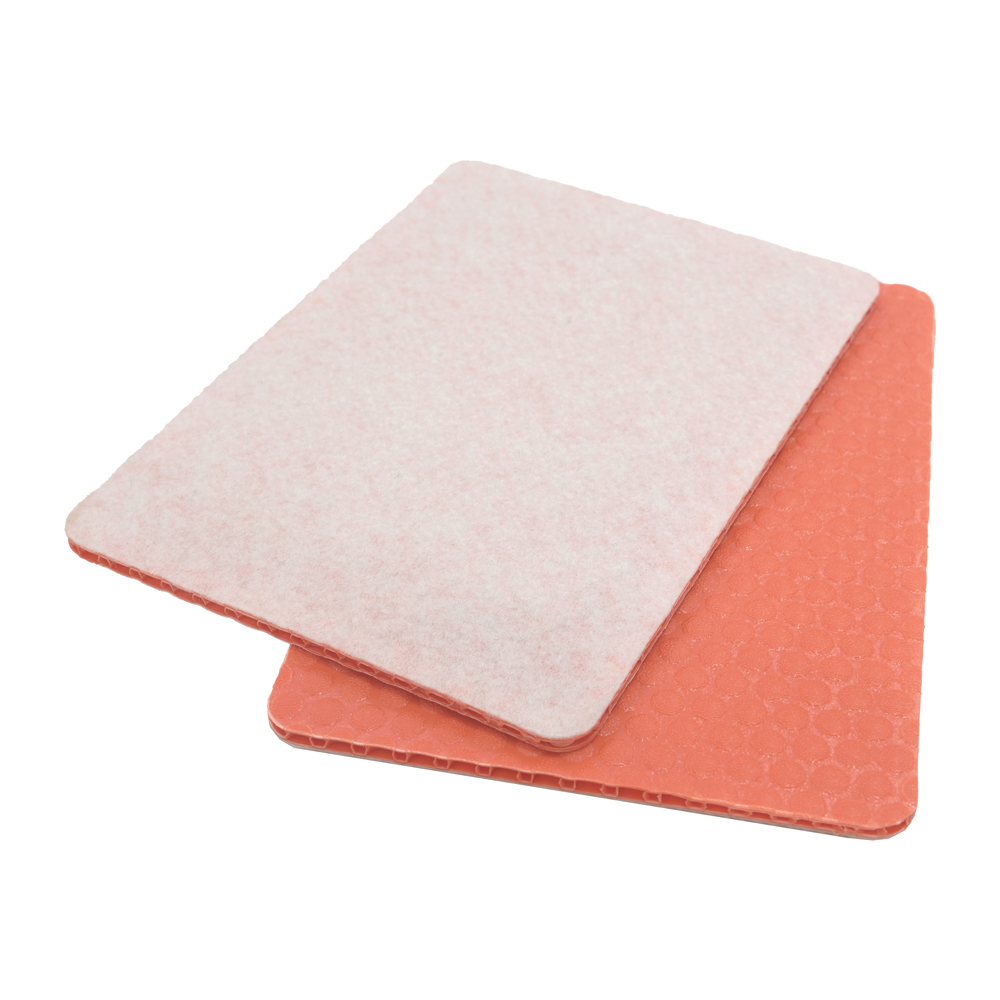
A PP honeycomb panel is a sandwich: two flat polypropylene faces with a core of hexagonal cells between them, bonded together. The core is what makes it behave the way it does. It holds the faces apart, and because bending stiffness depends on how far apart the faces are, a thick panel of very little material is much stiffer than a solid sheet of the same weight.
Why anyone bothers
Weight and stiffness. A honeycomb panel gives you a flat, rigid surface at a fraction of the weight of a solid sheet of the same thickness. For packaging that matters twice: the panel does its job, and it does not eat into your freight weight.
It also resists crushing through the thickness well, because the cells stand up under compression. That is what makes it useful as a layer pad under something heavy and concentrated.
How it is made, briefly
The core is extruded and expanded into the hexagonal structure, then the faces are bonded to it. Polypropylene throughout, which is the point – a single-polymer panel can be recycled without separating anything, and it welds and cuts with ordinary equipment.
Thickness, cell size and face weight are independent variables. Two panels of the same overall thickness can behave differently, which is why quoting a thickness alone is not a specification.
What it is not
It is not a structural building panel, and it is not a replacement for plywood in anything that takes a fastener or a long-term load. Polypropylene creeps – it slowly deforms under sustained load, and faster when warm. A panel that holds a load for an hour will sag if it holds it for a month.
It is also not very good in bending across a short radius. Honeycomb does not fold. If the part needs a bent corner, you want corrugated sheet instead.
When it is the wrong choice
Two common cases. First, a continuous flat deck with a distributed load – a corrugated sheet does that job for much less money, and the honeycomb buys you nothing. We set that out in honeycomb panel versus corrugated sheet.
Second, anything one-way. A panel’s economics depend on it coming back and being used again. Ship it out once to a customer and you have bought an expensive layer pad.
When it is clearly right
Spanning a gap, carrying a concentrated load, surviving a return loop with washing, and anywhere a sheet has to be both light and flat. Also where the alternative is a heavier solid sheet and the freight saving pays for the difference.
How it is finished, and why edges matter
Panels come either with raw cut edges or with sealed edges. A raw edge exposes the core cells, which lets water and dust in and gives delamination somewhere to start. A sealed edge closes the cells and makes the panel washable and much more tolerant of rough handling.
Sealing costs a little and is worth specifying whenever panels get washed, stored outside, or handled by people who will drag them. For an indoor loop on a clean pallet it is optional.
Also worth specifying: trim tolerance. A panel that arrives a couple of millimetres oversize will not drop into a jig or onto a pallet lip, and trimming fifty panels by hand is nobody’s idea of a good afternoon.
What we can do
We supply PP honeycomb panels in a range of thicknesses and face weights, and we will size one from span and load rather than sell you a thickness. Tell us what it has to carry and whether it comes back, and we will say plainly whether honeycomb is the right answer – including when it is not.