
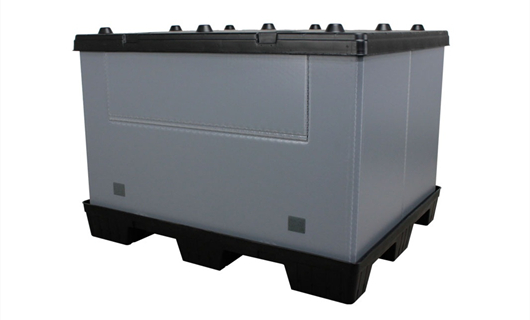
A pallet sleeve box is three parts that age at three different speeds, and treating them as one item is the most common way people conclude that sleeve systems do not last. The sleeve itself is the longest-lived part. The base is the shortest. Anyone budgeting replacement should be budgeting bases.
The sleeve
The sleeve is a folded sheet with corner creases. What ends it is a crease that has lost its stiffness – the sleeve stops holding square and becomes a parallelogram – or a wall that has been punctured. Neither is common in a controlled loop, and creases in polypropylene take a very large number of folds.
The thing that does shorten sleeve life is storage. Sleeves stacked leaning against a wall, or collapsed flat under weight for months, take a set. Store them flat on a level surface or on edge in a rack.
The base, which goes first
The base takes the forklift, the pallet deck and the dragging. It fails at corners and where it has been slid across concrete under load. In most operations the base needs replacing several times over the life of the sleeve.
This is worth knowing before you buy, because it changes the economics considerably and favourably: you are not replacing a set, you are replacing a base. If you sized the original order as sets, you have been overbuying.
The lid
The lid lives longer than the base and dies differently – crushed, because something was stacked on a box whose load did not reach the lid. A lid with nothing under its middle is carrying the pallet above on a span it was not built for. That is a loading discipline problem rather than a wear problem.
Whether you need a lid at all depends on whether boxes are stacked, which we went through in do you need a lid on a pallet sleeve box.
What actually kills the economics
Not wear – loss. Sleeves that do not come back. The same point applies here as to any returnable system: if there is no return lane, the trip count is one and the cost per trip is the purchase price. Every durability argument assumes the empty comes back, and it is worth checking that before anything else.
The economics of the whole thing against crates are set out in pallet sleeve box versus wooden crate, cost per trip.
What to inspect on the return leg
The return leg is the only moment the whole set is handled at once, and it is the cheapest inspection opportunity you will get. Two checks, both quick.
Bases: look at the corners and at the underside where they have been dragged. A base that has worn through at a corner will keep wearing and will eventually let the sleeve drop. Bases are cheap relative to the system and should be culled generously.
Sleeves: fold flat and reopen. A sleeve that springs back to square is fine. One that needs persuading has a crease going, and it is better to pull it now than to discover it in a loaded stack.
What we can do
We supply industrial returnable pallet sleeve systems and we sell bases separately, because that is what wears. Tell us the footprint, load and how many turns a year, and we will tell you what to expect – including a base replacement schedule, which is the number worth budgeting for.