
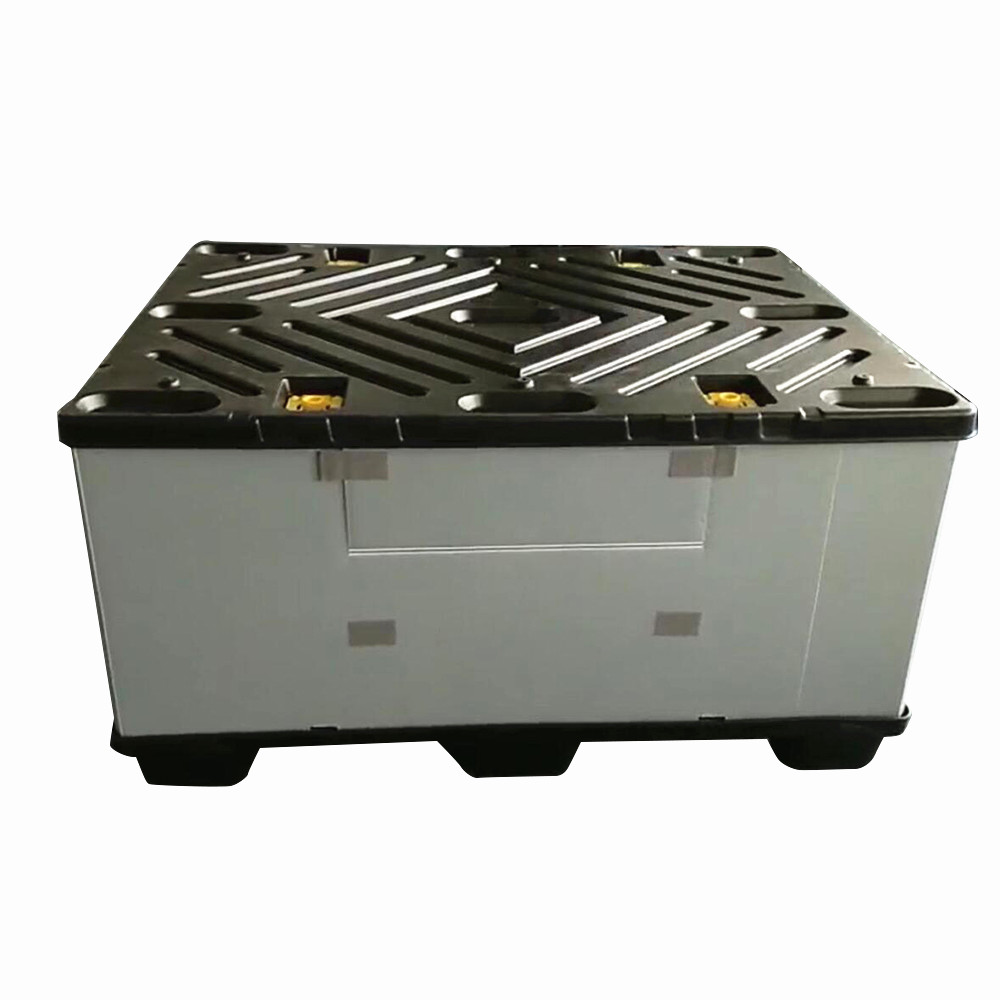
The comparison everyone wants is unit price, and unit price is misleading here in a specific way: a wooden crate is a one-off purchase that keeps costing money in freight and handling, while a sleeve box is a system whose cost is spread across trips. Whether the sleeve wins depends almost entirely on one operational question.
The question: do the empties come back?
A sleeve box returns folded flat. A stack of fifty collapsed sleeves occupies roughly the space of a few assembled boxes. That is the whole economic argument, and it only works if there is a return leg.
If your boxes go out to customers and stay there, a sleeve system does not pay. Buy crates or cartons. If your boxes run between your own sites, or between you and a customer who ships back on the same lane, the return leg exists and the arithmetic changes completely.
What the crate costs that the invoice does not show
Weight, first. A wooden crate is heavy and that weight is freight on every outbound leg and on every empty return, if there is one. Then assembly: crates need tools, fasteners and labour. Then repair: crate boards split, and a crate with a split board gets one more trip before it is scrap.
And disposal. A crate at the end of its life is a bulky item that somebody has to deal with, and in a lot of places that now costs money.
What the sleeve costs that the invoice does not show
Return logistics. Someone has to collect, collapse, stack and ship the empties. If that does not happen reliably, you will be buying sleeves continuously and the whole argument collapses.
And bases. Bases wear faster than sleeves. A sleeve system needs base replacement planned for, and anyone who buys a set and assumes all three parts last equally is in for a surprise in year two.
Roughly where it lands
We are reluctant to give a break-even figure because it moves with freight rates and lane length, but in the loops we have seen it is usually under ten trips – and on long lanes with high freight costs it can be as few as three or four. The largest single variable is the freight rate, which is why the same system pays back in one operation and not in another.
For a sense of how many trips the sleeve itself survives, see how many times you can reuse a pallet sleeve box.
What a sleeve box does badly
Sharp and abrasive loads. A crate with a damaged liner takes sharp metal parts that would work through a plastic sleeve wall. If your product has edges, a sleeve needs a liner or a dunnage layer, and that is cost and handling that the crate does not have.
Very heavy single items. Sleeve boxes are built for distributed load; a concentrated mass sitting on one part of the base will deform it. And rough handling by people who do not own the box – a crate absorbs a level of abuse that a sleeve system is not designed for, and in an open pool that matters more than any cost-per-trip figure.
What we can do
We supply pallet sleeve boxes for warehouse and supply loops and we will build the comparison with your actual freight numbers rather than a generic table. Send us the lane, the freight rate and the crate price you pay today, and we will tell you whether it pays – including when it does not.