
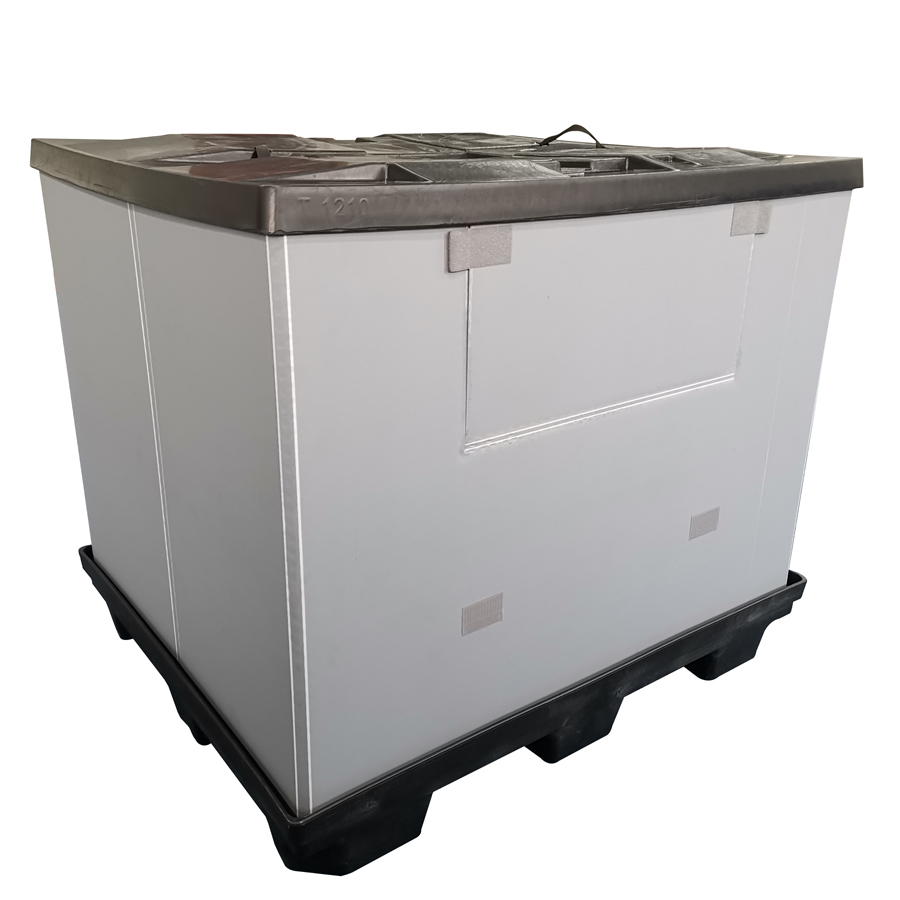
When a loaded sleeve box stands on a warehouse floor and leans, the instinct is to blame the sleeve. The sleeve is the part you can see. In practice the sleeve is a rectangle of folded sheet with no structural ambition beyond holding its own shape, and it leans because something underneath it is not level or something inside it is not distributed.
Check the pallet first
Most of these are pallets. A pallet with a broken board, a missing block, or deck boards of uneven thickness gives the base nothing level to sit on, and the whole assembly follows. Put a spirit level on the pallet deck before anything else. If it is out, the sleeve box is innocent.
This is more common than people expect in mixed pallet pools, where a good pallet and a repaired pallet look the same from three metres and behave nothing alike under a full load.
Then the base
The base is what locates the sleeve. If the base has a cracked corner or has been dragged so one side is worn through, the sleeve sits proud on that side and the box leans. Bases are the consumable part of a sleeve box system – they take the forklift and the floor – and a base that has visibly deformed should be swapped rather than shimmed.
A useful habit: when a box comes back from a loop, look at the base before it goes back into service. It takes seconds and it catches most of this.
Load distribution
Heavy product loaded to one side will pull a sleeve box over even with a perfect base, because the walls have very little resistance to a leaning load. Boxes of parts, castings, anything dense – load them centred and in layers. A single heavy item resting against one wall puts a lateral force on a surface designed for vertical load only.
If the load genuinely cannot be centred, the answer is usually a divider or a dunnage layer inside the sleeve rather than a heavier sleeve.
When it is the sleeve after all
A sleeve will lean if a corner crease has gone – if one corner has lost its stiffness, the box becomes a parallelogram rather than a rectangle. Check by folding the sleeve flat and reopening it; a failed crease shows up as a corner that does not return to square. That sleeve is at the end of its life and should be pulled.
How long that takes depends on the loop. We went into it in how many times you can reuse a pallet sleeve box.
Repair, or replace
Bases are worth repairing only if the damage is a clean split away from a corner. A weld or a patch plate will hold a straight split for a while. A cracked corner is not worth repairing – that corner carries the load path from the sleeve into the pallet, and a repair there fails quickly and unpredictably.
Sleeves with a failed crease should be replaced, not repaired. There is no sensible way to restore stiffness to a crease that has gone soft, and a sleeve that will not hold square leans no matter what you do to the base.
What we can do
We supply heavy-duty pallet sleeve boxes with bases built for forklift handling and sleeves with reinforced corner creases. Tell us the footprint, load weight and how many turns a year the set makes, and we will specify base and sleeve separately – because they wear at different rates and replacing both together is usually waste.