
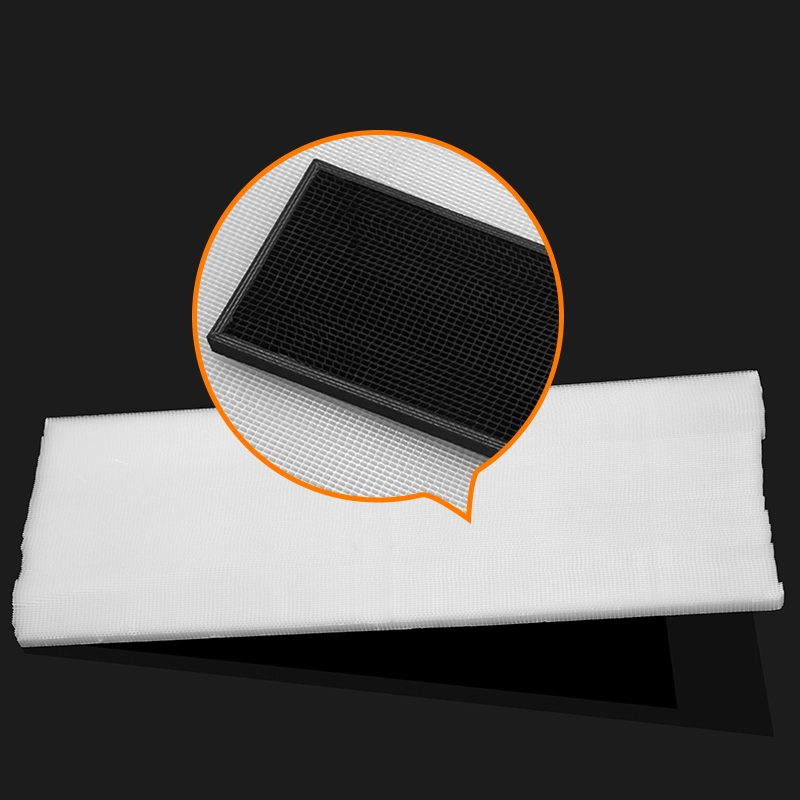
A honeycomb filter screen looks like a grid of holes, which invites the question of how a grid with holes in it filters anything. The answer is that two different parts of the structure do two different jobs, and separating them is what makes the geometry useful.
The two jobs
The cells – the through-holes – are the flow path. Air goes straight through them, and because they are aligned with the flow rather than across it, they offer very little resistance. This is why a honeycomb screen at a coarse stage can be considerably more open than a mesh of comparable strength.
The cell walls are the capture surface. Air moving along them carries particles that contact the wall and stay there. The wall surface area in a honeycomb panel is large relative to its face area, which is what gives it useful capture despite the open face.
Why it does not clog like a mat
In a fibrous mat, captured material occupies the voids that air flows through, so resistance climbs from the first loading. In a honeycomb structure, captured material builds on the walls while the cells remain open. The flow path narrows gradually rather than filling.
That difference shows up as a flatter loading curve: resistance rises more slowly for a given amount of captured material. In service it means longer intervals between cleaning and a lower average pressure cost across the interval.
What it cannot do
The mechanism depends on particles contacting a wall. Large particles do this readily – they have enough inertia to deviate from the airflow and hit the wall. Fine particles follow the air and go straight through the cell.
So the geometry is genuinely good at coarse material and genuinely poor below a certain size. That is not a limitation to be engineered away; it is the reason these screens are specified as pre-filters, with a fine stage behind them doing the work the geometry cannot.
For what that geometry does to resistance as the screen loads, see open cell geometry and low resistance.
Through-holes, not pockets
The cells in a filter honeycomb run straight through the panel, which is the detail that matters. If they were pockets – closed at one end – air would have to reverse direction within each cell, and the resistance would rise sharply. Straight-through cells let air pass with very little disturbance while still presenting wall surface along the way.
This is also why a honeycomb filter should not be confused with honeycomb used as a flow straightener, which is the same geometry serving a different purpose. In filtration the wall surface is doing the work; in flow conditioning it is the alignment of the cells.
At higher velocity
Capture by contact with the walls improves as velocity rises, because particles have more inertia and deviate from the airflow more readily. Resistance also rises, and it rises faster. There is a velocity range where the trade is favourable and beyond which it is not – which is why face area, not velocity, is the variable to change when a screen is struggling.
What we can do
We supply PP honeycomb filter screens and panels in several cell sizes and thicknesses. Tell us the airflow and what the air carries and we will recommend a geometry – and if what you need to catch is below what a coarse cell holds, we will say so rather than sell you the wrong screen.