
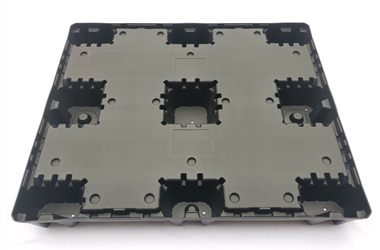
A sleeve box system is three or four parts that wear at very different rates. The base takes the handling, the sleeve takes the folding, the lid takes the stacking. Treating the system as a single unit means replacing good parts along with worn ones – which is most of the cost.
What wears, and how fast
Bases. The fastest-wearing part by a wide margin. Fork entry damage, dragging, and impact at corners. A base that has lost its location features will not hold the sleeve properly, and that is the point at which it has to go.
Sleeves. Wear shows at the folds and at the corners. A sleeve in a collapsing design has a finite fold life, and once a hinge cracks it is finished – a cracked hinge will not hold the sleeve square.
Lids. Usually the longest-lived part, since they take stacking load in a fairly uniform way. They fail through UV exposure if stored outdoors, or through stacking misalignment that cracks a corner.
Bands and straps. Consumable. Worth tracking separately because a worn strap that fails in transit can drop a load.
An inspection that takes a minute per unit
- Base: is the sleeve location intact? Is the deck flat? Are the entry edges intact or split?
- Sleeve: do the folds close cleanly? Any whitening or cracking at a hinge? Do the corners sit square when erected?
- Lid: does it locate properly? Any cracks at the corners?
- All parts: cleanliness, and whether identification is still readable.
The key question for each part is not “is it damaged” but “can it still do its job”. A scuffed base is fine; a base that no longer locates the sleeve is not.
Refurbishment that makes sense
Replacing individual parts. The main saving, and the reason to buy systems where parts are available separately rather than as a sealed unit.
Replacing straps and bands. Cheap, and it restores the restraint function that keeps a sleeve from bulging.
Welded repair of sleeve corners. Worth doing where the material is sound. Not worth doing where the fold hinge has gone, because a repaired hinge will not fold reliably.
Re-marking. Where identification has worn, re-marking restores traceability at almost no cost – but only if the marking method allows it.
What should not be refurbished
A split base. It carries the whole load, it is hard to weld soundly, and its failure mode is dropping the contents. A sleeve whose hinge has cracked through. Anything repaired with tape or wire, which introduces a foreign body risk and fails unpredictably.
The rule should be written down with photographs, so that it is applied consistently rather than by whoever is on shift.
What it is worth
Refurbishment converts a fleet replacement into a maintenance budget. Where parts are replaceable individually, the cost of keeping a fleet in service is a fraction of replacing whole systems – often a small fraction, because the base is the only part that wears quickly and it is the cheapest part to make.
That is worth checking at specification stage. A system where the base cannot be replaced separately will cost considerably more over its life.
What we can do
We supply sleeve box systems with bases, sleeves and lids available as individual parts, and we will help you write an inspection and retirement rule for each. Tell us your handling environment and we will tell you which part is likely to wear first – that is the one to keep in stock.