
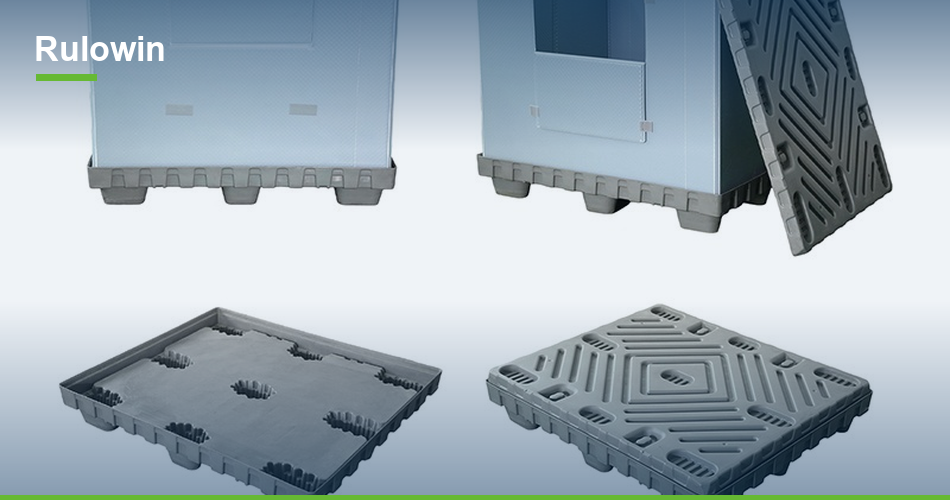
Both hold a pallet-sized load. A sleeve system collapses and a rigid container does not, and that single difference drives almost every other trade-off between them.
Where a sleeve system wins
Empty return volume. This is the main argument. A sleeve that collapses to a fraction of its built height lets you return many empties in the space one loaded unit would take. Where empties are shipped any distance at all, that is decisive.
Storage of empties. The same property means an empty fleet takes a fraction of the floor space, which matters in a busy warehouse.
Height flexibility. Sleeve height is the variable part, so a system can be adapted to different load heights by changing the sleeve rather than the whole container.
Cost per unit is usually lower than a rigid container of similar capacity, and parts are individually replaceable.
Where a rigid container wins
Handling. A rigid container can be lifted, tipped, emptied and stacked by equipment without any assembly step. A sleeve system has to be built and unbuilt around the load.
Speed of turnaround. Assembling a base, sleeve and lid takes time. At high throughput that labour is a real cost, and it is the most commonly underestimated part of a sleeve business case.
Rigidity. A rigid container does not bulge, does not need restraint, and holds its shape with loose or uneven contents.
Automation. Rigid containers are simply easier to handle automatically, because there is no assembly step and no partial-engagement risk.
Durability under rough handling. A moulded container takes fork damage that would destroy a sleeve system’s base location.
The questions that decide it
- Do the empties travel? If yes, the collapsed ratio usually decides it.
- How much labour is available for assembly? If turnaround is tight, a rigid container may be cheaper overall despite costing more.
- What are the contents? Loose or dense contents push toward rigid; uniform, self-supporting contents suit a sleeve.
- Is handling manual or automated? Automated handling favours rigid.
- Where are empties stored? If space is tight, the sleeve’s advantage is larger.
The hybrid answer
Some operations use both: sleeve systems for the routes where empties travel long distances, rigid containers for short internal loops where the return leg is cheap and turnaround speed matters more. That is a reasonable resolution of two genuinely different requirements, and it is more common than a single answer.
The number most often missed
Assembly and disassembly labour. It is easy to compare purchase prices and collapsed ratios and never cost the twenty minutes a shift spent building and unbuilding sleeves. Where throughput is high, that figure can outweigh the return-leg saving entirely.
Measure it before deciding. Time a realistic build and unbuild cycle, multiply by the number of cycles, and put it next to the freight saving on empties. It takes half an hour and it usually settles the question.
The return leg, in numbers
The collapse argument is real but it is not universal, and it depends entirely on what your freight is charged against.
Take a typical 1200 by 800 sleeve. Collapsed, the walls fold down to a fraction of the assembled height, and a stack of twenty five collapsed units occupies roughly what five assembled ones did. If your return movement is charged on volume – groupage, part loads, anything priced per cubic metre – that reduction is money, and it is often larger than the difference in unit price between the two container types.
If your return movement is a dedicated truck charged per trip, and the truck leaves half full either way, the collapse saves you nothing on transport. You have paid for trailer space you were not using anyway. The sleeve may still win on storage space at either end, or on handling, or on repairability – but the headline transport saving disappears, and the case has to be made on its own terms.
Three numbers sort it out: assembled and collapsed height per unit, your cost per return trip and what it is charged on, and how much space empties occupy at each end of the loop. We ask for these before recommending one because without them the answer is a coin toss dressed up as advice.
What we can do
We supply pallet sleeve boxes and will ask about your return leg and your turnaround before recommending one. If your loop is short and your handling automated, we would rather tell you that a rigid container serves you better – a sleeve sold into the wrong application comes back as a complaint.