
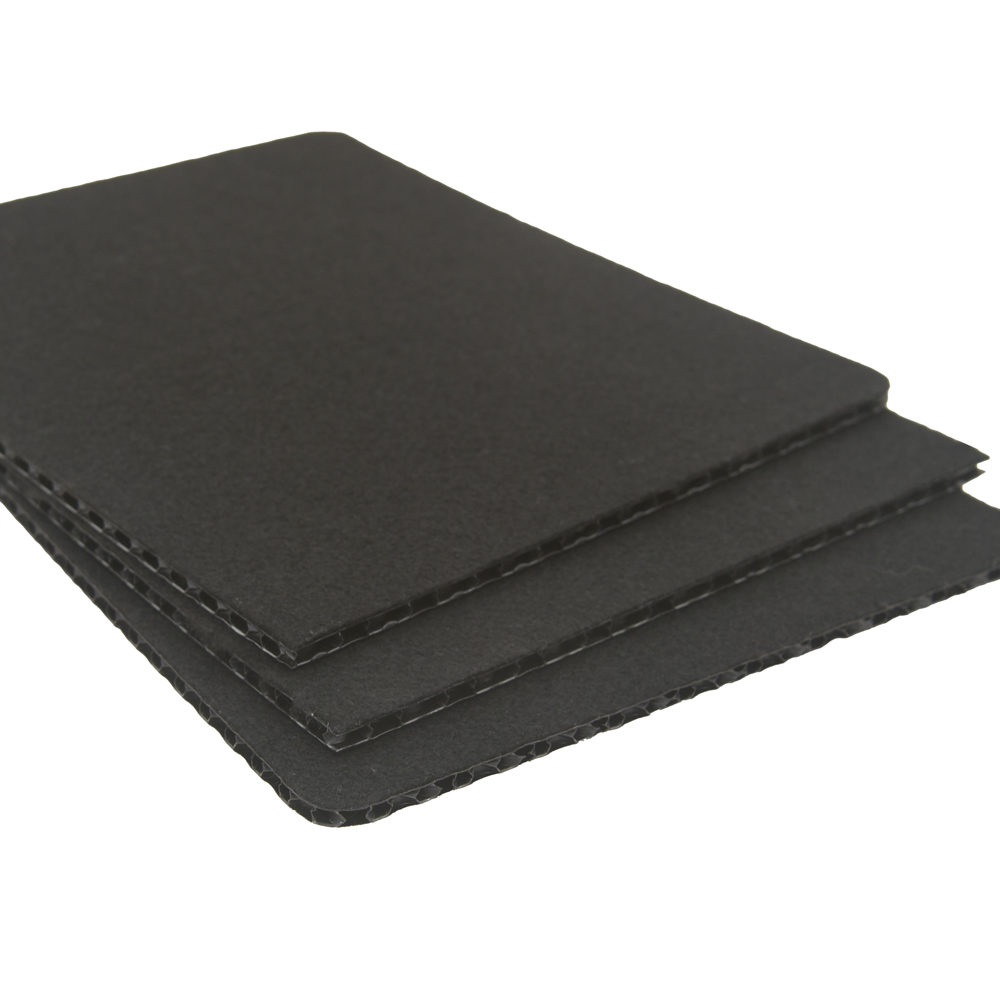
Honeycomb board arrives as a stack that looks fine. The variables that matter – skin gauge, cell geometry, bond quality, thickness – are inside it or under a surface that looks acceptable. Five checks will find the significant problems without turning goods-in into a laboratory.
One: thickness in several places
Measure with a calliper at several points across a sheet and on several sheets in the delivery. Board carries a thickness tolerance, so the reading will not be constant, but it should sit in a consistent band.
Two things to look for. A stack that reads consistently below the nominal figure is a material saving that nobody agreed to. And a wide spread between sheets – more than the tolerance you were quoted – suggests a batch that was not controlled.
Two: gram weight on a known area
Cut or take a piece of known area, weigh it, and compare with the specification. This is the single most effective check, because gram weight is what you are paying for and it is easy to reduce without changing anything visible.
Any kitchen scale and a ruler will do it. If the figure is consistently low, the panel is lighter and weaker than specified even though the thickness matches.
Three: skin gauge on a cut edge
Take an offcut or sacrifice one sheet and measure the skin thickness with a calliper on a clean cut. The skins carry the bending load, so a thin skin changes how the panel behaves in a way that no external inspection reveals.
This is worth doing on the first delivery from any new source, and periodically afterwards.
Four: bond quality
Try to peel the skin from the core on an offcut. A well-bonded panel will not come apart by hand; a poorly bonded one will lift at the edge and can be worked apart.
Less destructive: tap the surface with a coin or a fingernail across the sheet. A well-bonded area sounds consistent and fairly bright; a debonded area sounds dull. It takes a minute across a full sheet and it finds the large defects.
Five: flatness and visible damage
Lay a sheet on a flat surface and see whether it rocks or bridges. Store it flat for a day and re-check, since some movement in transit relaxes. Look for creases, whitened lines and dents – a whitened line in PP is damaged material, not a mark.
What to record
- Delivery, batch or lot reference so a later problem can be traced
- Thickness range measured, not just a single figure
- Gram weight measured against specification
- Skin gauge measured on a cut edge
- Any bond or flatness finding, with a photograph
Four lines in a log. After a few deliveries you will know whether your supplier is stable, and you will have evidence if it is not.
Where inspection does not help
Incoming inspection cannot tell you how a panel will perform in your application. It only confirms that what arrived matches what you ordered. If the panel is genuinely unsuitable for the job, all five checks will pass and the application will still fail.
That is a specification problem rather than a supply problem, and it is settled by testing a sample in the real service condition – warm, loaded, wet, whatever your case is.
Taking those two measurements reliably is a job in itself, so we cover it separately: verifying thickness and gram weight on delivery.
What we can do
We quote PP honeycomb panels with thickness, skin gauge and gram weight stated together, and we will supply a sample with the figures marked so you can verify the method before you rely on it. If a delivery does not match, we would rather hear about it than not.