
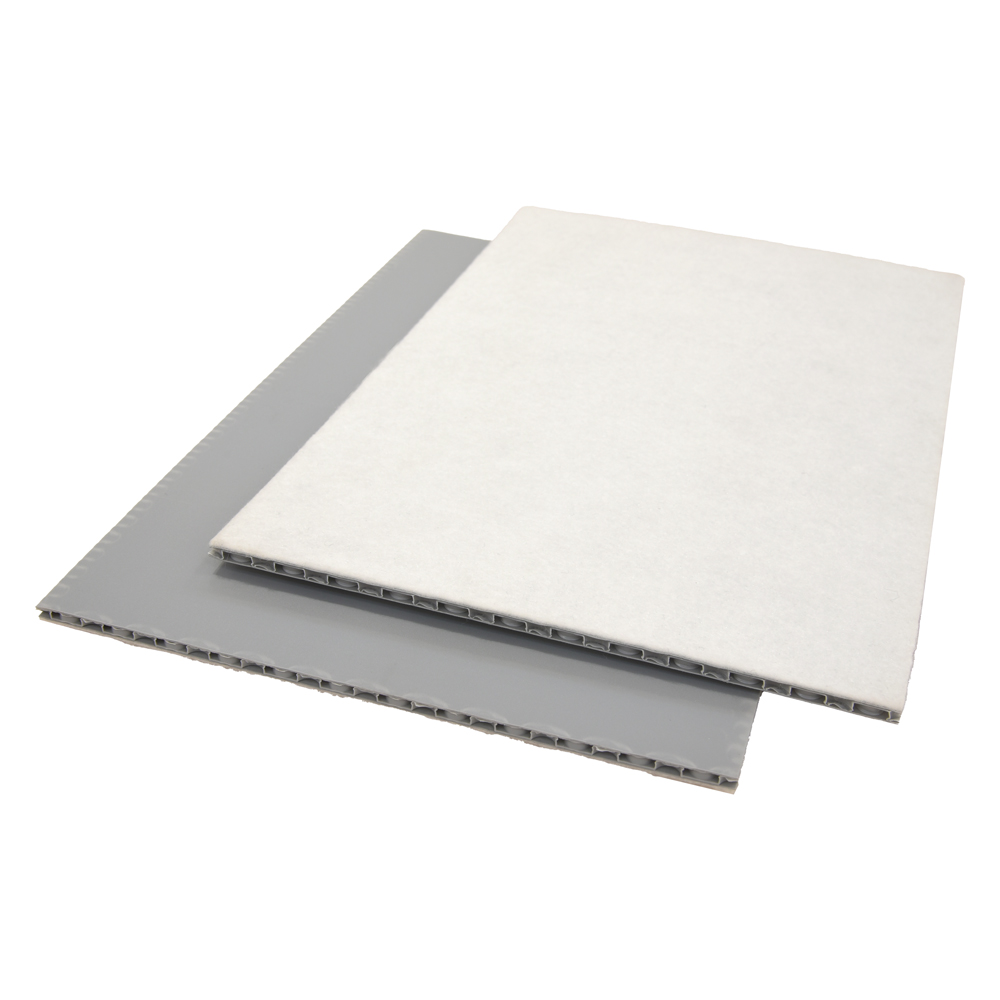
Two deliveries of the same coloured PP board will not match exactly. This is normal for pigmented polymer, it happens with every supplier, and it becomes a problem only when the application makes it one.
Why colour moves
Pigment is a minor ingredient dispersed in a large volume of polymer, and small variations in dose, dispersion and processing temperature all shift the result slightly. Recycled content shifts it more, which is one reason recycled board tends to be less consistent in colour than virgin.
Additives complicate it further: UV stabilisers and fire retardants both affect colour, and where they are used the palette available narrows.
What is reasonable to expect
Supplier and customer should agree a reference sample and a tolerance around it. The tolerance is usually expressed as a colour difference figure measured on a spectrophotometer, or – far more commonly, and often more workably – as “visually acceptable against this retained sample”.
The practical point is that a limit has to be agreed before the order, because afterwards the argument is about perception. If the application is a visible panel in a finished product, agree a sample. If it is a shelf or an internal divider, a generous tolerance is fine and costs nothing.
Managing it in an assembly
- Keep batch together. Where a visible assembly uses several panels, make them from one batch and one cutting run. This solves most colour complaints for nothing.
- Do not mix deliveries in one assembly. The most common cause of a colour complaint is two batches sitting side by side.
- Store with batch references. So that when a replacement is needed, you can ask for a match to the original.
- Consider a colour that hides variation. Mid-tone greys and darker colours hide batch drift better than white, which shows every shift.
Other things that vary between batches
Colour is the visible one, and a few others matter as much:
- Thickness distribution. A batch can sit at the top or bottom of the tolerance band and still be in specification.
- Surface finish. Gloss level varies slightly and shows up under different lighting.
- Odour. Some batches carry more residual smell than others, which matters for enclosed applications and for anything near food.
- Warp. Residual stress varies, so flatness can differ between batches even when dimensions match.
If any of these matter for your application, say so at specification stage rather than complaining after the second delivery.
What to do when a batch is out
First compare against the retained reference sample, not against memory, and not against a previously installed panel that has been in sunlight for a year – PP fades, so an old sample is a poor reference.
Then decide whether it matters. A colour difference that is unacceptable in a shop display may be entirely irrelevant on a warehouse shelf, and rejecting a batch for appearance when function is unaffected is a cost with no benefit.
Agreeing the tolerance while nobody is arguing
The moment to settle what counts as a match is before the first batch ships, not after a rejected one. Four things go into that agreement, and all four are quick to write down.
First, a physical reference retained on both sides – one piece kept by you, one by us, dated and marked. Screens drift and memories differ; two pieces of plastic settle arguments faster than any correspondence. Second, how the comparison is judged: side by side at arm’s length, in daylight if you can manage it, because two panels can match under warehouse lighting and differ noticeably outside. Third, which surface is judged – the textured face and the smooth face of the same sheet read differently. Fourth, what happens on a miss: replacement, credit, or acceptance at a reduced price. Deciding that in advance is what keeps a colour problem from becoming a relationship problem.
One caution on precision: a tighter tolerance costs money, and it costs more on small runs than people expect because the line has to be brought onto shade with material that gets scrapped. If panels sit inside a machine all their lives, buying that precision is wasted spend. If they are the visible outer face of a product, it is not. Tell us which, and we will quote accordingly.
What we can do
We supply PP honeycomb panels in a range of colours and will retain a reference sample of your agreed shade so that future batches can be compared against it. Tell us whether the panel is a visible finished surface or a hidden structural element – it changes how much the colour needs to be controlled and what that costs.