
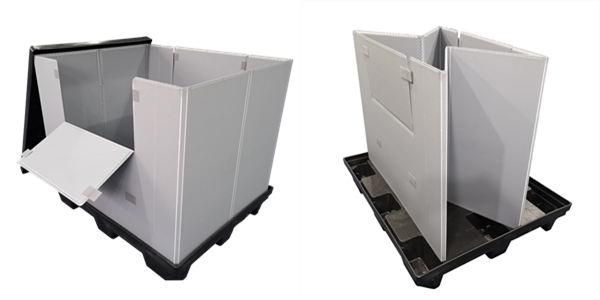
Pallet sleeve boxes work beautifully with uniform, boxed, self-supporting contents. They are frequently bought for loose or irregular product, where the load behaves quite differently and the standard design assumptions no longer hold.
Why loose loads are different
A stack of cartons is essentially rigid and loads the sleeve only where it leans. Loose contents behave more like a fluid: they press outward on all four walls, and the pressure increases with depth. They also settle during transit, which changes the load and can leave the top of the sleeve unsupported.
Two consequences follow. The walls see much higher outward load, and the load is not transferred to the corners the way a rigid stack is.
What tends to go wrong
- Wall bulge, which is the obvious one and is covered in more detail in our article on why sleeves bulge
- Settlement, leaving a gap at the top that lets the sleeve move and the lid rattle
- Point loading from irregular items pressing on one spot in the wall
- Spillage at the top if the contents are fine and the lid does not seal
- Difficulty emptying, which nobody thinks about until the first cycle
What helps
An internal liner. A bag or liner contained by the sleeve removes most of the outward pressure problem and makes filling and emptying far easier. For granular or powdered product this is usually the right answer, and it is cheaper than a heavier sleeve.
Horizontal restraint at the right height. Cheap and effective, as with any bulging problem.
Filling to the correct level and accounting for settlement – overfill slightly, or use a lid that comes down onto the load rather than sitting on the sleeve.
A heavier base because loose loads concentrate weight differently from cartons, and the base sees more of it.
Wall protection where irregular items have sharp edges or corners that will work against the sleeve.
Discharge is the forgotten requirement
How does it come out? Tipping a full sleeve box is not usually practical. A liner with a discharge spout, a base with a hatch, or simply accepting that it gets scooped out by hand – decide this before choosing the system, because it constrains the base design more than anything else.
When a sleeve box is the wrong answer
Very dense loose product, where the outward pressure is high enough that the wall needs to be genuinely structural. Free-flowing fine powder, which needs a sealed system rather than a sleeve. Anything that has to be discharged quickly and repeatedly under gravity. In those cases a rigid container or an intermediate bulk container is the better tool, and it is worth saying so.
Filling is part of the design
How a sleeve box gets filled determines how it behaves. Dropped from a height, loose product compacts and settles more than it would if it were flowed in gently, and the difference changes both the fill level and the outward load on the walls.
If you can control the fill method, do – a chute or a spout that distributes the load beats a single-point drop, and it reduces the settlement that causes most top-of-sleeve problems.
It is also worth deciding whether the box is filled on the pallet it will ship on. Double handling a full sleeve box is where damage happens, and filling in place avoids it entirely.
What we supply
We build pallet sleeve boxes for loose and irregular loads with liner provisions, restraint points and heavier bases. Tell us the bulk density, how it fills and how it empties, and we will tell you whether the sleeve is the right container – and sometimes it is not.