
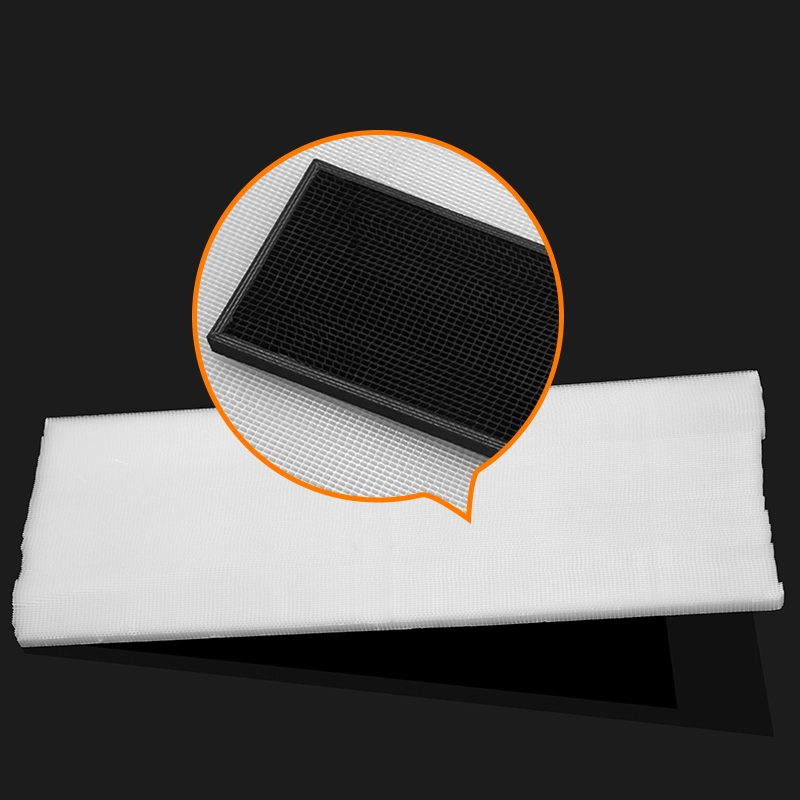
Mesh count is the first number on most filter screen enquiries and frequently the only one. On its own it tells you surprisingly little, because it describes the wire count and not the opening you actually care about.
What mesh count is
Mesh count is the number of openings per linear inch, counted from the centre of one wire. A 20 mesh screen has twenty openings per inch. That is a statement about spacing, not about aperture.
Why that matters: the same mesh count can be produced with different wire diameters, and the wire diameter is what is left over after the opening. Twenty mesh with thick wire has small holes; twenty mesh with thin wire has large ones. Both are correctly called 20 mesh.
Hole size is the number that filters
The aperture – the actual opening – is what determines what passes through. When you are selecting a screen for a separation, the aperture is the specification, and mesh count is just a convenient way to describe it once the wire diameter is fixed.
If you inherited a specification written as a mesh count, it is worth finding out what wire diameter went with it. Otherwise a like-for-like order can arrive with a very different aperture.
Open area is the number that governs flow
Open area is the percentage of the screen surface that is actually hole rather than wire. It drives flow rate and pressure drop more than anything else, and two screens with identical mesh counts can differ substantially.
A screen with fine wire has high open area, flows well, and is fragile. A screen with thick wire has low open area, restricts flow, and lasts. That trade-off is the central one in screen selection, and it is invisible if you only ever look at mesh count.
Micron ratings and what they really mean
A micron rating sounds precise and is usually a nominal figure rather than an absolute one. A screen rated at 100 microns will pass some particles larger than 100 microns, because the apertures are not perfectly uniform and because particles are not spheres. If your process genuinely needs absolute retention, a woven screen may be the wrong technology, and it is worth saying so before the order rather than after.
What to specify instead
- Aperture in millimetres or microns, as the primary specification
- Wire diameter, so the mesh count is unambiguous
- Open area, if flow or pressure drop matters – which it usually does
- Material, because PP is not the answer to every fluid
- Wire orientation relative to the flow and the frame, which affects strength
A note on woven versus welded
Woven mesh has wires interlaced, which gives good dimensional stability and fine apertures. Welded mesh has wires joined at the crossings, which is stronger in some directions and handles coarser wire better. The choice affects how the screen behaves under load and how it can be framed.
Aperture tolerance is wider than you think
Woven mesh has a manufacturing tolerance on its aperture, and it is not trivial. A nominal aperture can vary by a meaningful percentage across a single screen, and the variation matters when the separation is critical.
The practical consequence is that a screen should not be specified to the exact size of the particle you are trying to retain. If you need to hold particles above a certain size, specify an aperture comfortably below it, because the largest apertures in the screen are the ones that set the performance.
If your process genuinely cannot tolerate that variation, a woven screen may be the wrong technology and it is worth discussing alternatives rather than tightening a tolerance that the process cannot hold economically.
What we supply
We produce PP filter screens to aperture and wire specifications rather than mesh count alone, which avoids most of the confusion above. If all you have is a mesh number, send us a sample or the flow requirement and we can usually work out what you actually need.