
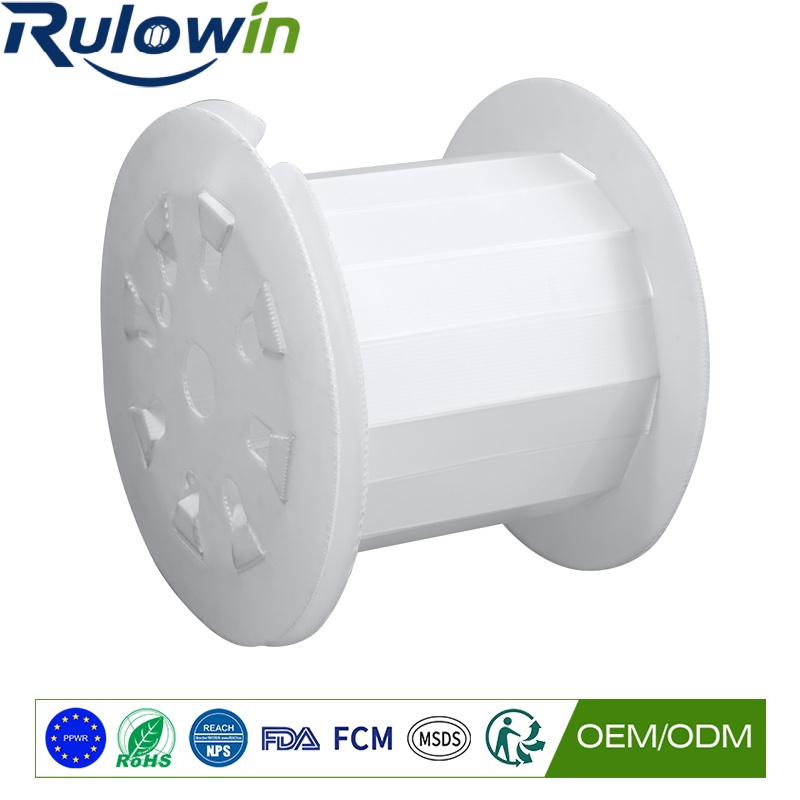
Wind 200 kg of product onto a core at one constant tension and the pack you get is not uniform. The layers near the core are compressed by everything above them; the layers near the outside are barely compressed at all. Same winding tension, very different conditions inside the pack.
Tension taper exists to compensate for this. Whether it is worth setting up is a separate question.
What actually happens in a constant-tension pack
The outer layers are under roughly the tension they were wound at. The inner layers carry that tension plus the weight and radial pressure of everything wound on top. So:
- The core regions are compressed hardest. Soft products can be crushed there, or pressed into any anchor feature.
- The outer regions are loose relative to the inner ones, which leaves them free to shift during transit.
- The tension gradient is not linear, and it depends on the number of layers and the product’s compressibility.
This explains a pattern many operators have noticed and few have had explained: the pack that behaved perfectly on the machine behaves differently after a truck journey. Transit shakes the loosely-held outer layers and leaves the tightly-held inner ones alone.
What taper does
Reduce winding tension progressively as diameter increases. Wind the inner layers firmer, the outer layers lighter, and the pack ends up more uniformly compressed.
How much taper is a product question, not a spool question. Stiff product barely compresses and therefore barely needs taper. Soft product compresses a lot and benefits substantially. Anything that will undergo settling benefits from getting it right.
Too much taper
Over-taper the outer layers and you get all the problems associated with loose winding: turns that can migrate, outer layers that shift, and exactly the dig-in failure described in our article on layer collapse and dig-in.
The outer layers of a spool are also the ones most exposed during transit, so making them the loosest is working against yourself if you go too far.
Too little taper
Core crush, product distortion at the core, and in extreme cases damage to the core itself. If you have ever unwound a spool and found the innermost layers creased or flattened, that is under-taper (or product wound too tight generally).
What it means for the spool
The spool sees whatever the pack does to it:
- Heavy radial compression at the core if taper is too low
- Full hoop load at the flange if the outer layers stay tight
- Moving loads if the pack is inconsistent and shifts
From the spool’s point of view, a uniform pack is a predictable pack. Anything that makes loads vary around the circumference — discussed in the context of stiffness measurement in our deflection test article — shortens spool life.
Is it worth setting up?
Honestly, for some operations it is not. If you are winding stiff product to modest depth at moderate tension, taper will change very little and the effort of tuning it is better spent elsewhere.
It earns attention when:
- The product is soft, compressible, or easily marked
- Packs are deep — many layers, high radial pressure difference
- You are seeing core crush or inner-layer damage
- Spools travel long distances and arrive with shifted outer layers
- The product is valuable enough that a damaged metre is expensive
How to approach it
Change one thing at a time and unwind to inspect. That is the only way to see inside a pack, and it is worth doing deliberately a few times: wind a spool, leave it a day, unwind slowly, and look at what the inner and outer layers actually look like.
Most people who do this once find something. It is not a sophisticated exercise — it just rarely happens, because unwinding a good spool to look at it feels wasteful.
A caution
Taper settings that work for one product will be wrong for another, and they interact with everything else covered across this series — including the fill height and traverse decisions. Change one variable, note it, and go again.