
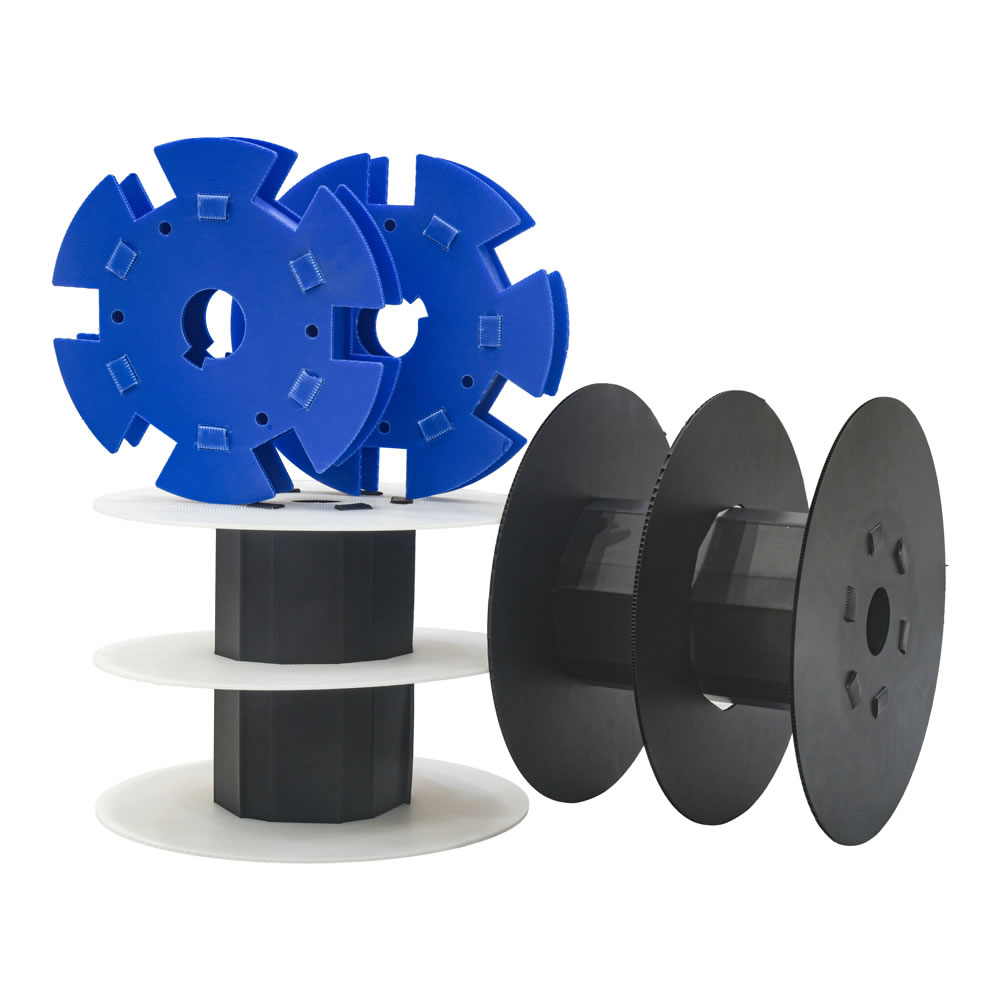
Most spool enquiries land somewhere between three constructions. They are not interchangeable, and the right one depends much more on your volume and your duty than on which sounds better.
Injection-moulded plastic
Where it wins: high volume, consistent geometry, tight tolerances, good surface finish. If you need tens of thousands of identical spools and can amortise the tooling, moulding gives you repeatability that fabricated construction cannot match.
Where it loses: tooling cost is substantial and has to be justified by volume. Size is limited by machine capacity — large flanges get expensive fast. And design changes after tooling are painful, which matters if you are still working out what you want.
Typical fit: small spools, consumer or single-use packaging, high-volume wire and filament.
Fabricated PP hollow board
Where it wins: moderate volumes, larger diameters, and anything where the design is still moving. Tooling cost is low because the flanges are cut and formed rather than moulded, so a tooling change is not a financial event. Large flanges are comparatively cheap, and wall thickness can be varied without retooling.
Where it loses: dimensional consistency is not moulding-grade — if your process needs very tight tolerance on every spool, this is not the construction. Surface finish is functional rather than pretty. Unit cost at very high volume will not beat an amortised mould.
Typical fit: cable, rope, hose, returnable industrial packaging in the hundreds to low thousands, and anything large.
Steel
Where it wins: heavy product, high tension, punishing environments, and applications where the spool is effectively machine tooling. Nothing in plastic matches steel for stiffness at temperature or for abuse tolerance.
Where it loses: weight, which is a freight and handling cost on every trip. Corrosion, unless it is treated and maintained. Noise. And cost — steel spools are expensive enough that the loss rate matters, which pushes you towards a tightly controlled closed loop.
Typical fit: steel wire rope, large power cable, high-tension processes.
The comparison people forget: return freight
Weight matters twice on a returnable spool — once on the outbound trip and once on the empty return. A plastic spool that is a third of the weight of its steel equivalent saves money on every cycle, and over a few dozen trips that can outweigh a higher purchase price.
This is the part of the business case that gets left out when the comparison is done on unit price alone, and it is often where hollow board wins.
Where hollow board is genuinely the wrong answer
We sell it, so it is worth being clear about this:
- Very high volume with a frozen design. Once you are past the point where tooling amortises, moulding will beat us on unit cost and consistency. We will tell you when we think that is your situation.
- Tight-tolerance driven applications at speed. If your process needs every spool within a few tenths of a millimetre, fabricated construction is the wrong choice and no amount of care changes that.
- High-temperature environments. Polypropylene is not a high-temperature material. Above roughly the boil, look elsewhere.
- Heavy product at high tension. There is a load range where plastic flanges are simply not the right answer, and forcing it is how spools fail.
Plywood, which did not make the list
Plywood reels are still common and are cheap to buy. Their problem is service life in wet or humid conditions, and the ISPM 15 treatment requirement on export — both of which are covered elsewhere in this series. They remain reasonable for one-way export where the reel is not coming back and the paperwork is already being handled.
How to choose
Work backwards from two numbers: how many spools you need per year, and how many trips each one has to survive. Low volume plus many trips points at fabricated plastic. High volume plus one trip points at moulding or plywood. High load points at steel. Ambiguous cases in the middle are worth a conversation.
Send us your product, your weight, and your annual volume and we will tell you which of these we would build — and if the honest answer is a moulded spool we do not make, we will say that too. You can see where our hollow board spools sit, and our PP hollow board sheet is the material the flanges are cut from, if you want to understand the construction.