
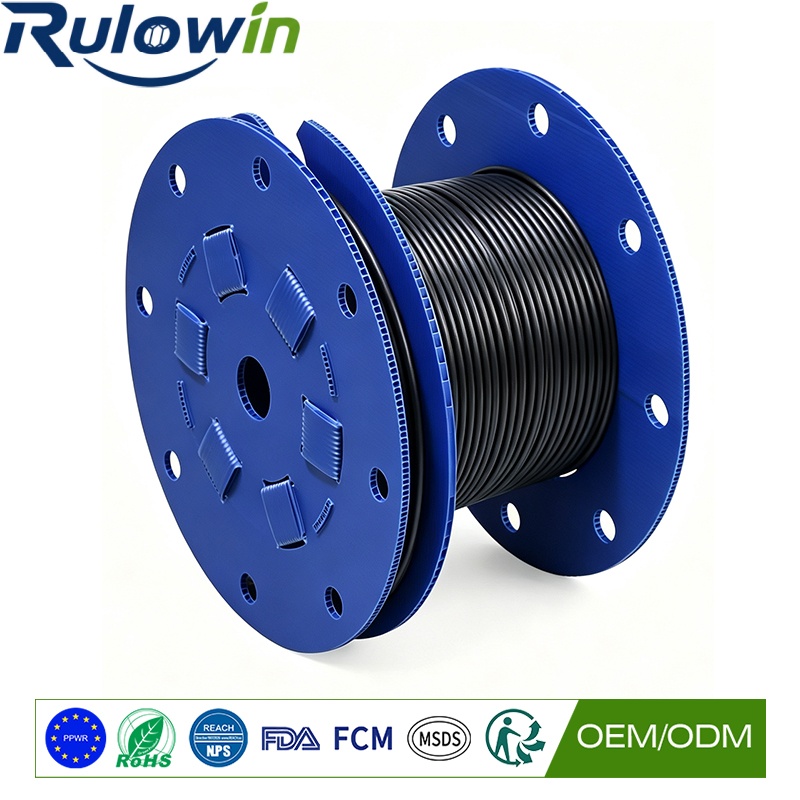
The business case for a reusable spool is entirely dependent on getting the spool back. A spool rated for a hundred trips that is lost after six has the unit economics of a single-use reel with extra steps — which is why so many reusable programmes look good on a spreadsheet and disappointing in practice.
Decide who owns them
Three models, and the choice should be explicit rather than assumed:
- Customer-owned. You own the fleet, you capture the full life, you also carry the tracking and the loss. Best where the benefit of durability accrues to you.
- Supplier-owned. The supplier buys and owns the spools. Lower capital for you, and a real risk that the cheapest compliant spool gets bought at the next reorder.
- Pooled. A third party owns and manages. Removes capital and administration, costs a per-trip fee, and constrains you to standard sizes.
Whichever it is, write it into the agreement — along with who pays return freight, which is the question that quietly decides whether the loop works.
Set a return trigger
Empties pile up until somebody needs the space, and then they are shipped back in a hurry, loosely, on whatever transport is available. That is where most damage and most loss happens.
A trigger fixes it: when N empties accumulate, or on a fixed day each fortnight, or whenever a vehicle is going that way anyway. The trigger has to be somebody’s named responsibility, not a general expectation.
Define condition on return
Without a standard, every damaged spool becomes a negotiation. With one, most of them are routine.
One page with photographs is enough: what counts as normal wear, what counts as damage, and what happens to a spool in each category. Agree it with the other party before the first shipment, not after the first disagreement.
Mark everything
An unmarked spool is free goods in everyone’s mind. An owner code and a serial number — moulded in, embossed, or a durable label — make it possible to track which spools are going missing and where.
The data is what makes the rest work. Loss clustered at one customer points at a process; loss spread evenly points at the handling; loss rising over time points at the packaging. Without serials you get none of that.
Four rules that prevent most of it
- Ownership and return obligation in the contract, including freight
- A written condition-on-return standard with photographs
- Permanent marking on every spool
- Quarterly counts — small and regular catches leakage early, an annual count just documents it
What kills loops
Loss at the boundaries is the big one: spools that go to a subcontractor of your customer and never come back. Then specification drift — replacement spools bought on price rather than to the original specification. Then, quietly, the absence of a repair capability, so a spool with a damaged rim goes into a corner and then into a skip when a fifteen-minute repair would have kept it working.
Set the repair question up front. A fleet with a repair path behaves completely differently from one without, and it is usually the difference between a programme that reaches its trip target and one that does not.
If you are setting up a loop and want an opinion on what the spool specification should be given your volumes and ownership model, send us the flow and we will tell you where we think it will leak first.