
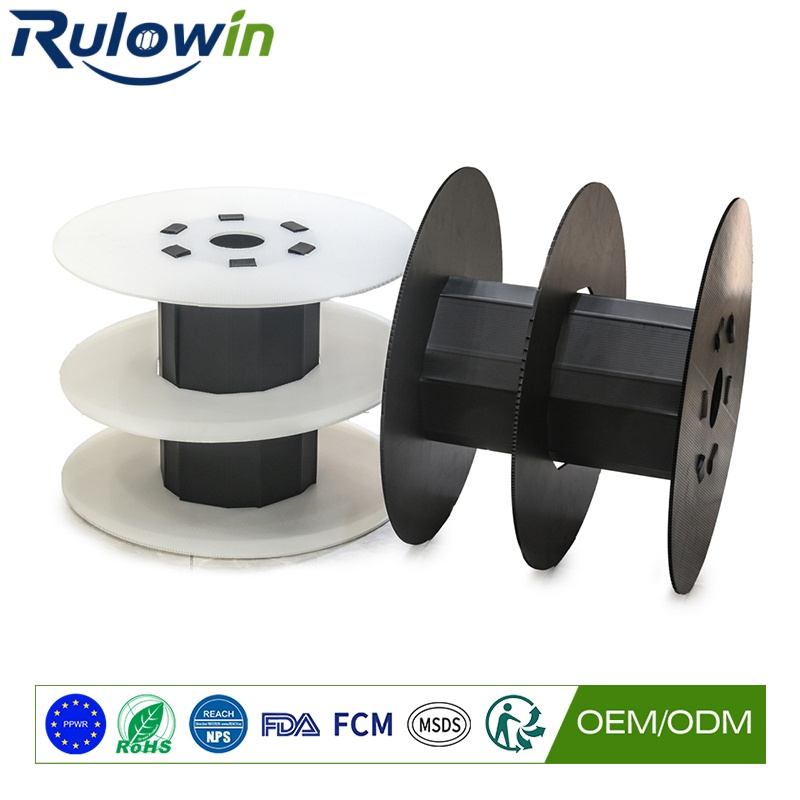
A container full of spools is a container full of circles, and circles roll. Everything about loading spools well comes back to that, plus one more thing: the load path through the flange is not the load path the flange was designed for.
Orientation first
Two options, and they behave very differently.
Axis vertical — spools lying flat, stacked on top of each other. Load goes through the flange faces, which is the weak direction. Tall stacks compress the bottom spool’s flanges, and this is the most common cause of a container arriving with a pallet of distorted spools at the bottom.
Axis horizontal — spools standing like wheels, on their rims. Load goes through the rim, which is much stronger, but the spools can roll, and the whole arrangement needs blocking.
For anything beyond a couple of layers high, horizontal on the rim with proper blocking beats vertical stacking. Where customers or pallets demand vertical, put a separation sheet between every spool so the load spreads across the flange face instead of concentrating at the rim.
Blocking is not optional
Every spool needs to be prevented from starting to move. Once one shifts, its neighbour takes an impact, and the failure cascades through the container over a two-week voyage.
Three ways, in order of reliability: chocks or wedges nailed to the deck, a purpose-built stillage or frame, and tight loading with dunnage filling every void. Strapping alone is not enough — strap stretches, and once it has stretched, the load is free.
Weight distribution
Containers have axle weight limits and a practical expectation of reasonably even distribution. A container loaded with all the heavy spools at one end is a problem at the port, and some operators will refuse it.
Distribute by weight across the length, and keep the centre of gravity low. Heavy spools at the bottom, always, and never heavy on top of light — the crushing damage from that is immediate rather than gradual.
Palletised or floor-loaded
Palletised is faster to load and unload and easier to secure, and it wastes some volume. Floor-loaded uses the cube better and takes longer, with more opportunity for something to be missed.
For spools specifically, pallets have another advantage: they keep the bottom layer off the container floor, which is where condensation collects. A spool sitting in an inch of water for a fortnight is a problem whether it is plastic or wood, because the packaging around it will fail even if the spool does not.
Moisture and the product
Container rain is routine on humid routes. The spool does not care, but the product on it often does, and the cartons or labels certainly do. Desiccant sized to the route and a container liner are cheap relative to the cargo and have saved more shipments than any packaging upgrade.
Before you close the doors
- Photograph the load. Claims are settled on photographs taken before the doors close.
- Check that nothing moves when pushed. If you can rock it by hand, it will move in transit.
- Count and record. A short shipment discovered at destination is an argument; a count recorded at loading is evidence.
Ten minutes at loading prevents the conversation you do not want to have in six weeks.
Securing the load
A pattern that packs well but shifts in transit is worse than one that packs slightly worse and arrives intact. Spools are round, which means they want to roll, and a container is a long way from a static environment.
- Chock or block the bottom layer so nothing can start rolling. Once one spool moves, the ones above follow.
- Strap or lash across the top layer, not just around the pallet base.
- Fill the void at the container walls. An unfilled gap is where movement starts.
- Check the weight distribution against the container’s limits — concentrated heavy spools over a short length is a real problem, not a theoretical one.
If you are loading both spools and palletised goods together, load the spools first and against the headboard. They are the least forgiving item you have.