
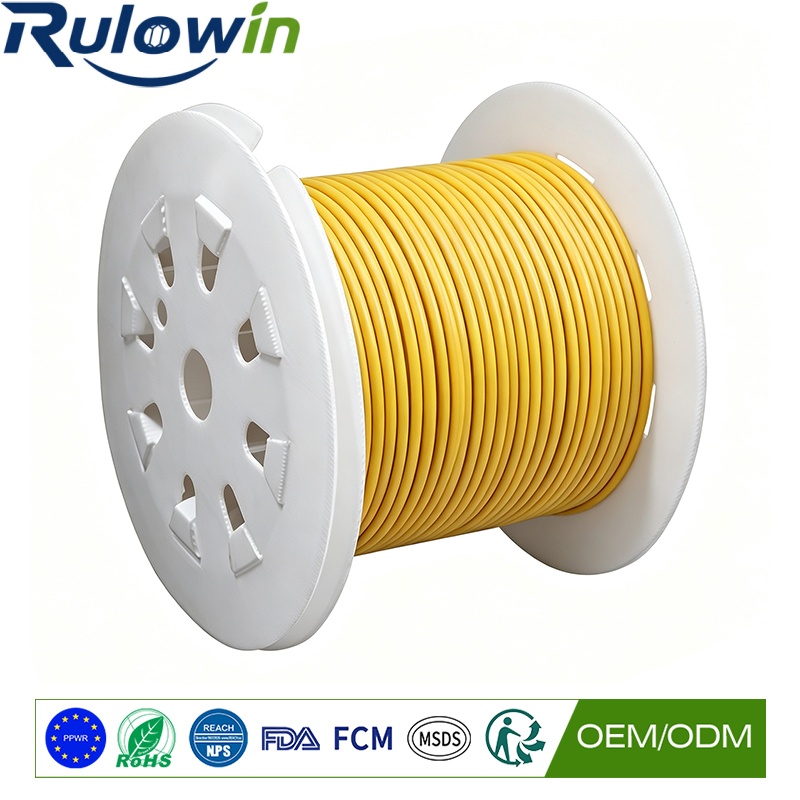
There is a temptation, when a spool is nearly full and the order is nearly complete, to keep winding. A few more metres fit. The product sits level with the flange edge, which looks tidy, and the order closes without a second spool.
Then it goes on a truck, and the outer layer takes every knock that the flange does not.
What the flange is for
The flange exists to contain the pack and to protect it. That protection only works if the flange extends beyond the product — once the product is level with the rim, the flange stops protecting anything and the outermost layer becomes the contact surface.
Everything the spool meets in service then meets the product directly: adjacent spools in a container, the side of a pallet, a strap, the corner of a stillage, the floor when somebody sets it down harder than they meant to.
The four damages
- Crushing. The outer layer is compressed against whatever it is touching. On soft-jacketed cable this is a permanent flat spot; on fibre, it is a length you will scrap.
- Abrasion. Any relative movement rubs the jacket. This is the one that shows up as a cosmetic complaint that turns into an electrical one.
- Contamination. The outer layer picks up whatever is on the surfaces it touches — dust, oil, water.
- Snagging. Product at the rim can catch on the flange edge of an adjacent spool during handling, and pull a loop loose.
How much margin
A working rule is one to two product diameters below the flange rim, with more for anything soft, easily marked, or expensive. That is not a standard — it is what tends to work — and the right number depends on what the spool will meet.
A spool that goes straight from the winder into a sealed box needs less margin than one that will be stacked three high in a container and strapped. Tell the supplier how it ships and they can tell you what margin makes sense.
The cost of the margin
Capacity. Real capacity, on every spool, forever. That is why the temptation exists and why it is worth putting the number in the calculation rather than feeling it.
Take the capacity at your proposed fill height and at a safe one, and multiply the difference by your annual spool count. Then compare that against your current rate of outer-layer damage. In most operations the comparison is not close, and it is worth doing once so that the decision does not get relitigated every time a spool is nearly full.
How to enforce it
A mark on the winder is more reliable than a rule in a procedure. A physical stop, a painted line at the safe diameter, or a length counter set to stop before the limit — any of these removes the decision from the operator, which is what you want, because the operator is being asked to leave capacity on the table in order to prevent a problem they will not see.
If the winder cannot be set up that way, consider a smaller flange. It sounds backwards, but a spool dimensioned so that a full pack is necessarily below the rim solves the problem permanently and removes the temptation entirely.
One exception
Where the spool ships in a close-fitting carton or a moulded outer that takes the load, winding closer to the flange is defensible, because the packaging is doing the protecting. It is worth checking that the packaging actually does that rather than assuming it — a carton that is crushed provides no protection at all.
If you tell us the product, the shipping method and the stacking arrangement, we can suggest a fill height and a flange diameter that make the safe choice also the natural one.