
The metallised shielding bag is the default answer to ESD transport, and it is a good one — for what it does. It screens the contents from external fields and drains triboelectric charge from its own surface. What it does not do is protect against mechanical damage, and the box you put it in is usually an ordinary cardboard box that carries its own charge and shares none of the benefits.
For anything beyond a single board in a drawer, the packaging has to be designed as a system: a dissipative outer box, an insert that locates the product, and cushioning that does not undo the electrical work.
The outer box
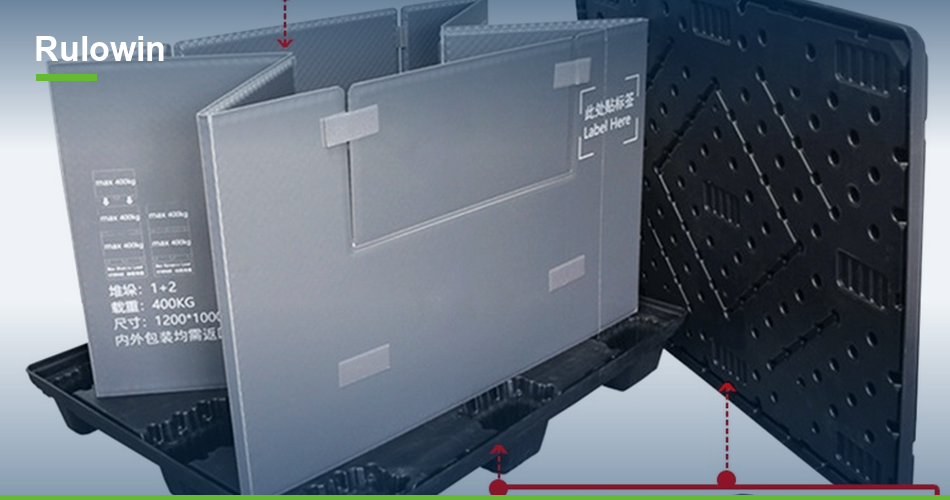
Corrugated PP in a dissipative grade gives you three things a plain carton does not:
- A surface that drains charge instead of isolating it, so the box can sit on a grounded bench without floating
- Dimensional stability — it does not soften in a humid container or shed fibres onto the product
- Durability, so the same box makes a hundred trips instead of one
The specification point that matters is whether the dissipative property is compounded through the material or applied as a surface treatment. A treated surface loses the property with washing and abrasion; a compounded one does not. For a box intended to be reusable, this is the single question that determines whether it is still ESD packaging in a year.
The insert
The insert does the mechanical work: it stops boards sliding, face-to-face contact, and edge loading on connectors. In an ESD context it also has to be dissipative or conductive itself, because an ordinary foam insert is an insulator and defeats the purpose of everything around it.
Common options and their trade-offs:
- Corrugated PP partitions. Cheap, die-cut to fit, and easily replaced. Good for flat product in quantity — panels, boards, plates. Less good for irregular shapes.
- Dissipative polyurethane or PE foam. Cushions as well as locates. The risks are compression set over time and particle shedding in a cleanroom. Specify by density and by whether it must be low-outgassing.
- Conductive corrugated or honeycomb trays. Rigid, washable, and the standard for high-volume board handling. More expensive per unit, amortised over many trips.
Cushioning: where good packaging gets undone
The classic failure is a well-specified ESD box with standard pink-tinted or clear polyethylene bubble wrap inside, chosen because it was in the storeroom. Bubble wrap is an insulator; it isolates the product from the dissipative path and generates charge of its own when it moves.
If the product needs cushioning, the cushion needs to be dissipative too, and it needs to be in contact with something that drains. A dissipative foam layer between product and box wall, sized for the drop height the box will actually see, does the job without the contradiction.
The inner bag: still worth it
For sensitive components, keep the shielding bag. The bag screens, the box carries, the insert locates. They are not alternatives; they do different jobs, and the combination is the standard for a reason. What matters is that everything inside the box — bag, insert, cushion, documentation sleeve — meets the same electrical requirement, because one insulating item inside a dissipative box is enough to float the assembly.
A short audit list
- Is the box dissipative through the material or by treatment, and will it survive your wash and reuse cycle?
- Is every item inside the box — inserts, foam, bags, labels, paperwork wallets — dissipative or conductive?
- Does the insert actually locate the product, or does it merely reduce the space it can move in?
- Has the cushioning been specified for a drop height, or inherited from the last project?
- When was the assembled box last tested, rather than the component parts?
If you send us the product, its sensitivity and the handling route, we can propose a box, insert and cushioning combination — and tell you which parts of your current packaging are doing no electrical work at all.