
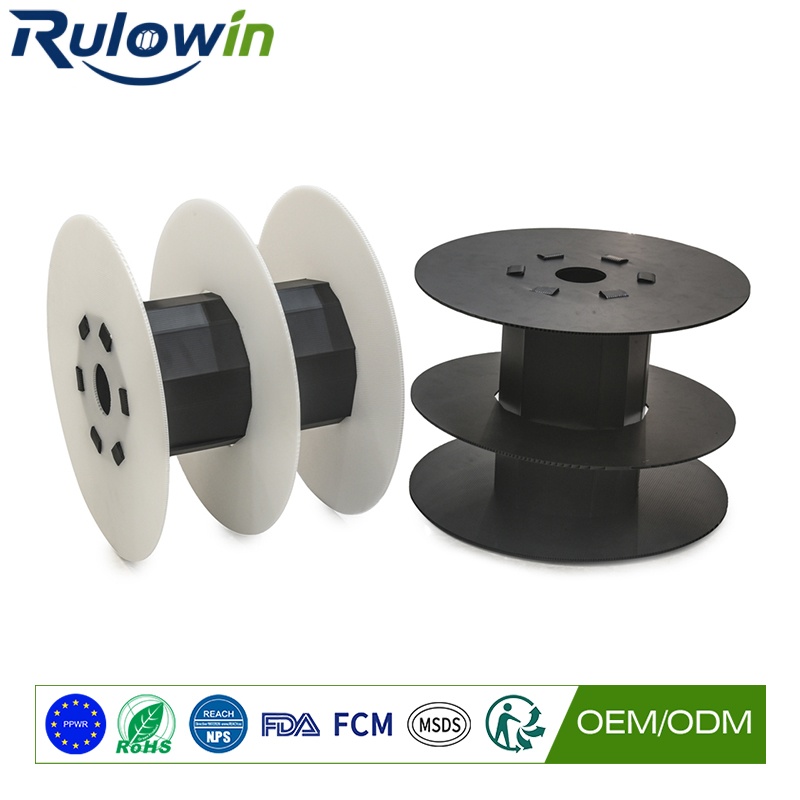
Extruded product leaves the line hot. Usually it gets cooled before winding, and usually that is deliberate. When it does not — because the line is running fast, the cooling is marginal, or it is summer and the water is warm — the product keeps cooling after it has been wound, and it shrinks while it is on the spool.
What contraction does inside a pack
A wrap laid on at temperature is slightly larger than the same wrap at ambient. As it cools it tries to get smaller, and it cannot, because it is constrained by the core beneath it and the layers around it.
The result is that the pack tightens. Not gradually and not evenly:
- The innermost layers tighten first and most, because they were wound earliest and have had longest to cool
- The outer layers are still contracting while the inner ones have already done so, which creates a compression gradient through the pack
- The total effect is a pack significantly tighter than the winding tension suggests
People measure winding tension, get a sensible number, and wonder why the pack behaves like it was wound much tighter. This is usually why.
What it does to the product
Contraction under constraint is what causes:
- Core crush on soft product, because the inner layers are being pulled inward onto the core
- Distortion of anything with a profile that has to stay true
- Marking where layers press harder than expected
- Difficulty at payoff — layers that have contracted onto each other are harder to separate
What it does to the spool
The load on the flange increases. Not dramatically in most cases, but on top of whatever was already there, and on the core it can be more significant because the inward pull is concentrated there.
There is also a spool material consideration. Polypropylene has a coefficient of thermal expansion notably higher than steel, and a spool that arrives cold in a warm building will expand slightly. If product is wound warm onto a cold spool, the spool is expanding while the product contracts for a while — two effects in opposite directions, briefly.
In practice the product effect dominates, and the spool expansion is usually not worth worrying about. It is worth knowing it is there if you are chasing an unexplained dimensional issue.
How warm is too warm
There is no universal number, because it depends on the product’s expansion behaviour, its stiffness at temperature, and how quickly it cools in a wound pack — which is slow, because a wound pack is a fairly good insulator.
The practical test is simpler than calculating: wind a spool, let it stand overnight, and compare the pack tightness and the inner layers against a spool wound from fully cooled product. If the difference is visible, you have a cooling problem rather than a tension problem, and no amount of tension adjustment will fix it.
What actually helps
- Cool the product before winding. The direct fix, and usually cheaper than dealing with the consequences.
- Reduce winding tension if you cannot cool adequately, accepting that the pack will tighten later anyway.
- Do not wrap or cover warm spools. It slows cooling further and concentrates the effect.
- Do not stack warm spools. Covered in the doffing article, and the reasoning is the same — heat plus pressure plus time.
- Leave a conditioning gap before anything that depends on pack dimensions, if your process allows it.
The related but different problem
Winding warm is not the same as storing warm. A pack wound cool and then stored somewhere hot expands, which is a different mechanism with similar consequences. That one is discussed as part of our article on long-term wound storage, and the mitigation is entirely about where you put the spool rather than about how you wound it.
What to tell us
If your product arrives at the spool above ambient, say so when you specify. It changes what we would recommend for the core, because the core is what takes the inward pull on our hollow board spools. Most people do not mention it, and it is often the missing variable in a pack that behaves worse than the settings suggest it should.