
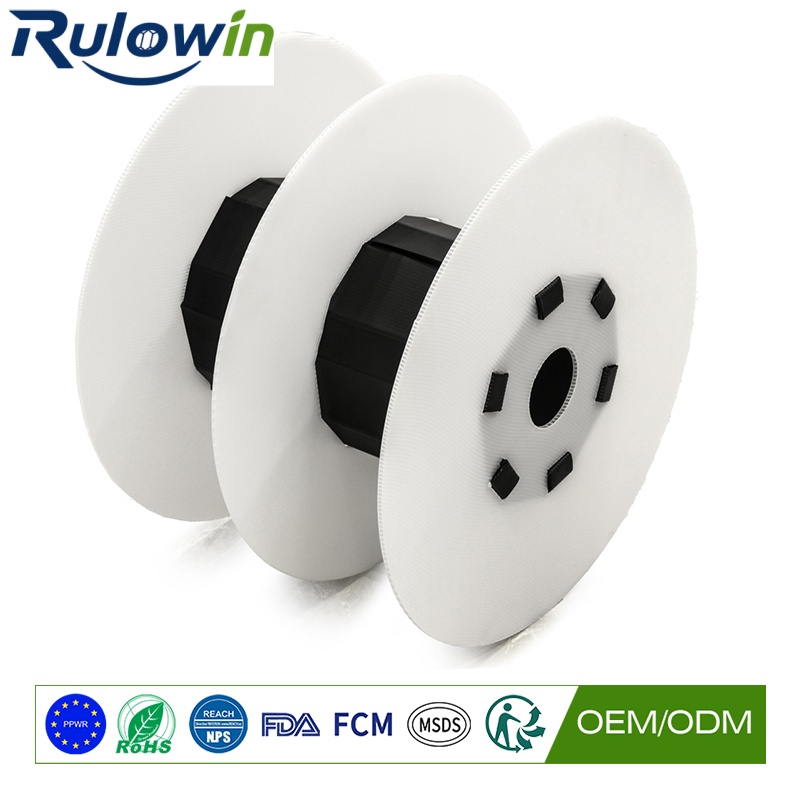
Ask a plant where their scrap comes from and the answer is often the end of the run. Not the start, not the middle — the last few layers, where the spool is nearly empty and everything about the mechanics gets less favourable at once.
This is not bad luck. Four things change as a spool empties, and all four work against you.
1. Tension rises
For a fixed braking torque, tension is inversely proportional to the radius at which the product leaves. As the radius shrinks, tension climbs — slowly at first, then steeply. Over the last few layers it can be several times the starting value.
Compensating equipment handles this well within its range. The problem is that the end of the run is where the range runs out, and where there is no margin left to absorb a transient.
2. The bend gets tighter
The product leaves the spool at a steeper angle as the effective diameter falls, and the tightest bend in the whole operation is typically at the flange on the penultimate layer. For anything with a minimum bend radius, this is the moment of maximum risk.
3. There is less product to share the load
On a full spool the outer turns are supported by everything beneath them. Near the core, the last few turns are holding themselves, and any snag or spike is absorbed by the product rather than by the pack. Dig-in and layer collapse are both end-of-run phenomena for exactly this reason.
4. The wind is least controlled there
This one is easy to miss. The first layers go onto a core that is clean, round and known. By the time the spool is nearly empty, the remaining product has been sitting under compression for its whole life, and whatever the wind did wrong — a ridge at the reversal, a gap, an uneven layer — has had time to settle into something less tidy.
What to do about it
None of these is unfixable, and the fixes are cheap:
- Flatten the tension curve with a larger core, so the end of the run is not a different process from the start.
- Keep the pack away from the flange, which opens the bend angle where it is tightest.
- Ramp down rather than stopping hard as the spool empties; the largest transient in most processes is the stop, and it lands on the product that has the least support.
- Consider a changeover point. If the last fifty metres reliably produce scrap, scrap them deliberately and earlier, at a set diameter rather than at whatever point the product happens to fail. It is the same loss with less risk of a jam.
The one that pays for itself
Logging tension through a full run is the single most useful diagnostic available. You will see where the curve steepens, where the transients are, and what diameter they start at — and that tells you whether the problem is the brake, the core diameter, the fill height, or the spool.
One afternoon with a load cell and a data logger replaces months of argument, and it usually identifies a fix that costs nothing in capital.
If you tell us the product and the spool geometry, we can tell you where we would expect the tail-end problems to start and which of the four causes is most likely in your case.