
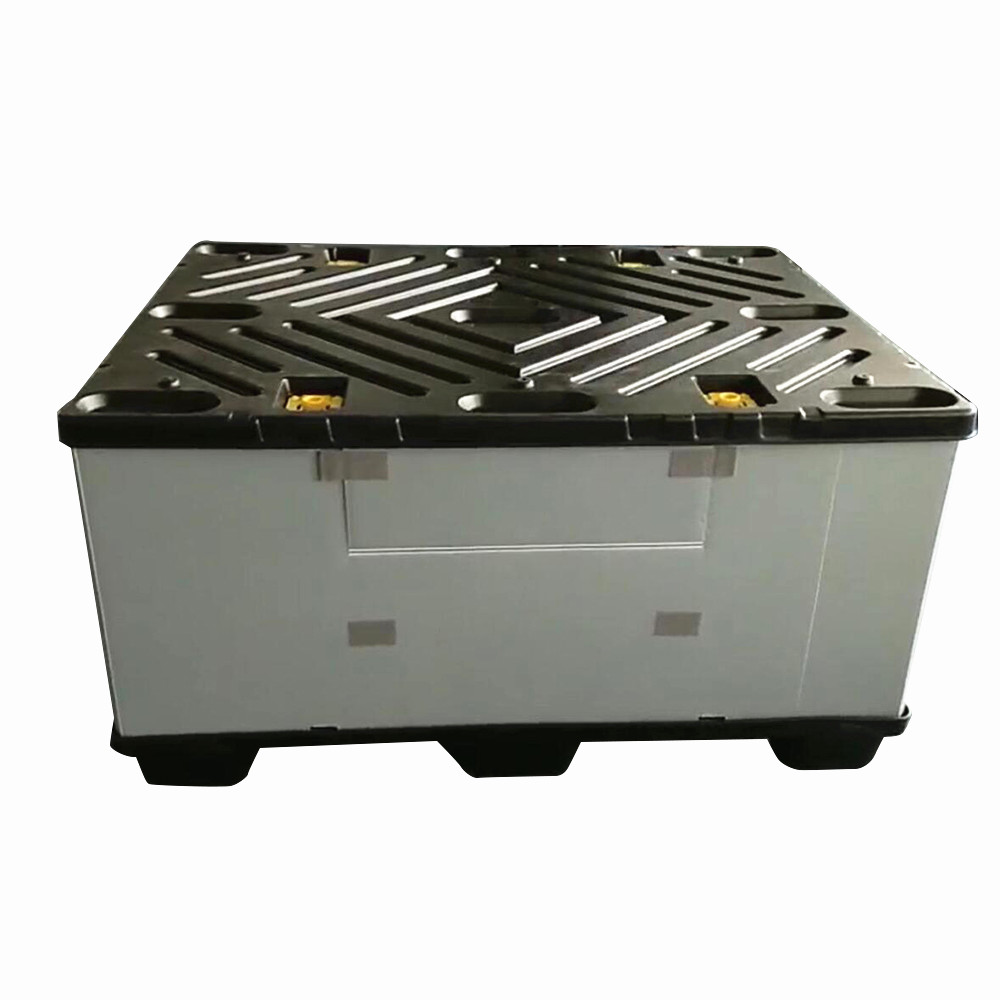
A loaded pallet sleeve that bows outward looks like a strength problem, and the instinct is to specify a heavier sheet. That sometimes works and is often the expensive answer to a question that was not asked.
What is actually happening
The contents are pushing outward on the sleeve wall. That is normal – a sleeve is a container, and loose or granular contents exert outward pressure like a liquid does. The wall has to resist that pressure, and it does so by transferring it to the corners and to any banding or external restraint.
Bulging means the wall is spanning too far between supports, or the load is not being transferred to where it can be carried.
Common causes, in order of likelihood
- No horizontal restraint. A sleeve with nothing holding it at mid-height will bow between the base and the lid. One strap at the right height does more than a thicker wall.
- Corners not carrying. The corners are the stiff part of a sleeve. If the sleeve is not properly located in the base, the corners do not engage and the walls span unsupported.
- Dense, loose contents. Granular or dense material presses hard at the bottom and outward everywhere. It needs a sleeve designed for that load, which usually means restraint rather than thickness.
- Stacking above. The layer above adds vertical load, and a wall that is already bowing buckles further.
- Heat. A sleeve left in a hot container softens, and PP loses stiffness well before it melts.
The restraint answer
A strap or band around the sleeve at the right height converts the problem from wall bending into hoop tension, which the sleeve handles much better. It is cheap, it is usually the correct fix, and it is often omitted because the sleeve “should not need it”.
Where strapping is not acceptable – because it marks the sleeve or because the contents are delicate – an external sleeve brace or a lid that clamps down over the walls does the same job.
When thickness is the right answer
When the wall itself has to be self-supporting: a sleeve that stands open while being filled, one that is handled by the wall rather than the base, or one carrying a very high outward load where restraint is impractical. In those cases thicker sheet or a honeycomb wall is the correct answer, and it is worth doing properly.
Corner construction matters more than wall thickness
The corners carry the vertical load and anchor the walls. A sleeve with well-formed, reinforced corners and a modest wall outperforms one with a heavy wall and weak corners, because the wall is not really the structure – the corner posts are. If you are comparing sleeves, look at the corners first.
How to check before committing
Fill a sample sleeve with the actual product, leave it for the actual dwell time, and measure the wall deflection at mid-height. Repeat it warm if the sleeve will travel hot. It is a simple test and it tells you whether you have a restraint problem or a wall problem.
What we supply
We build pallet sleeve boxes with reinforced corners, and we will ask about the contents and the restraint before quoting a wall thickness. If a strap solves your problem, we would rather sell you the lighter sleeve and tell you where to put it.