
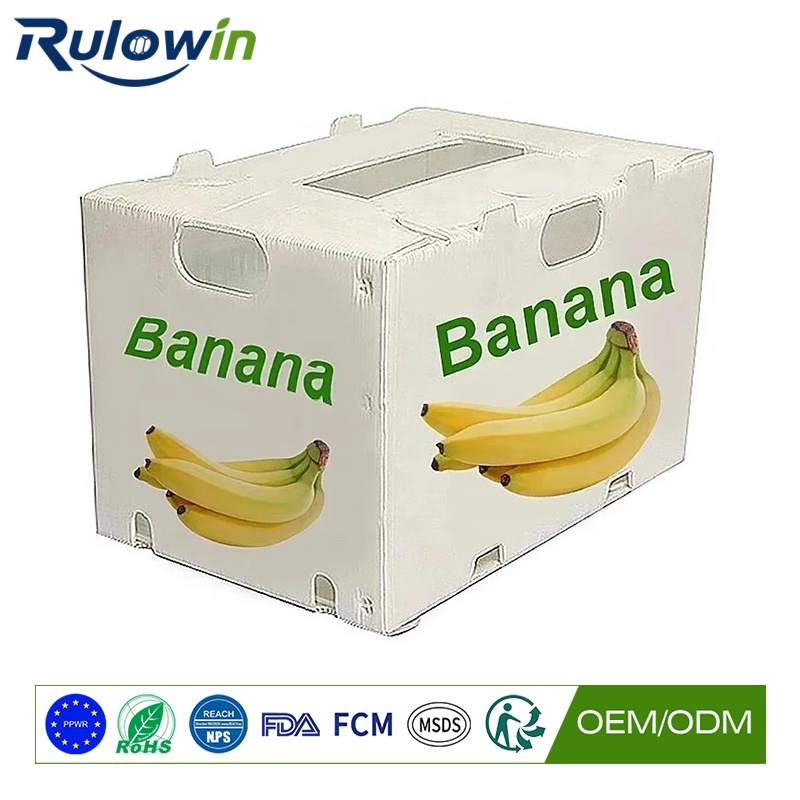
A crate that has been knocked about a field all season without trouble, then cracks in a cold room, looks like a mystery. It is not. Polypropylene loses impact strength as it gets colder, and the temperature at which that becomes noticeable is higher than most people assume – it is well inside the range a chilled store operates at.
What cold actually changes
Cold does not make polypropylene stiffer in any useful sense, and it does not make it weaker in tension. What it does is reduce the material’s ability to absorb a sudden blow. A crate that deforms and recovers at twenty degrees will crack at two degrees under the same impact. Same crate, same handling, different outcome.
So the first question is never “is it cold”. It is “is it cold and being dropped”. Cold storage on its own does not crack crates. Cold storage plus a transfer point where crates are tipped off a conveyor or dropped the last thirty centimetres onto a pallet does.
The grade question
Crates get specified for stack stiffness, because that is what shows up on a pallet. Impact-modified grades exist and are used for cold-chain work, and there is a trade: an impact-modified resin is usually slightly less stiff. If your crates are failing in a chiller, the specification was optimised for the wrong property.
We would rather discuss this before an order than after. It is a resin choice made at extrusion, not something that can be fixed later.
The other thing worth checking
Fatigue. A crate that has made two hundred trips and then cracks in the cold is often a crate that was going to crack anyway, and the cold just picked the moment. Look at where the crack is. A crack radiating from a corner or from a handle root is fatigue plus an impact. A clean break across a wall with no discolouration is a single-event impact.
If you are seeing the fatigue pattern across a whole batch at once, that is a cohort – they were all bought together and they are all the same age. We covered the lifespan side of this in how many trips a PP crate survives, which includes what to look for when a batch reaches the end of its useful life together.
What to change, in order
First, the handling point. The cheapest intervention is usually a transfer that stops crates being dropped – a roller section, a lower conveyor lip, or simply a rule about the last thirty centimetres. Most cold-room cracking is concentrated at one or two positions, and watching the line for half an hour will find them.
Second, the resin, at the next order. An impact-modified grade costs more per crate and is cheaper than a season of breakages.
Third, the acceptance criteria. Decide what level of cracking is tolerable and cull at that point rather than waiting for a crate to fail in service. A crate with a hairline crack at a corner will keep going for a while and then let go all at once, usually with produce on the floor.
What we can do
We make PP crates for produce and we will ask what temperature they will be handled at before we quote. If your cold chain goes below roughly five degrees and crates are being handled rather than just stored, tell us – the resin and the wall thickness both need to change, and it is cheaper to get right the first time.