
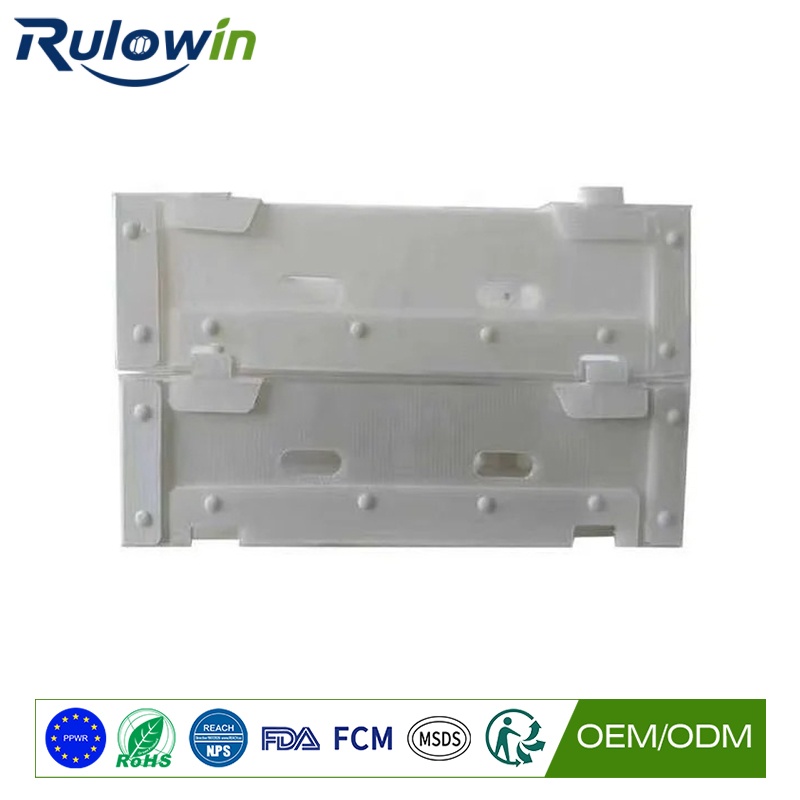
A handle tears out and the conclusion is that the handle was too thin. Usually the handle itself is intact at the point of failure and the material around it has torn, which means the load path was wrong rather than the section too small.
Where the load concentrates
A cut-out handle concentrates stress at its upper corners, because the whole carried load passes through two small radii. Increasing the corner radius is the single most effective change, and it is free – it costs nothing in material and it moves the failure point.
Most handle designs have far sharper internal corners than they need, because the shape was drawn rather than engineered.
Reinforce the panel, not the handle
Adding material to the handle aperture does very little. Adding a reinforcing band above the aperture – a welded strip, a folded section, a second layer – spreads the load into the panel and can double the service life for a few grams of material. This is the change worth paying for.
Dynamic loading is the real insult
A handle is not loaded statically. It takes shock loads when the crate is set down, swung or dropped the last few centimetres, and those shock loads are several times the static weight. Specifying handles on carried weight alone under-designs them consistently.
In practice that means designing for several times the nominal fill weight, or accepting that handles are a wear item.
Two-handed versus one-handed lifting
A one-handed lift puts the whole load on one handle and usually applies a twisting component as well, which is much worse than pure vertical load. Where operations genuinely lift one-handed – which is most of them – the handles need designing for that case, not for a two-handed lift on a drawing.
Cold and chemical effects
Impact strength drops in the cold and some cleaning agents accelerate cracking at stress points. A handle that survives in ambient and tears in a freezer is not a mystery; the material has less tolerance and the same stress concentration. Both effects were described in the tray corner diagnosis tree, and the same logic applies.
Consider whether a handle is needed
Plenty of crates are lifted by their body or their rim in practice, with the handle used only occasionally. Removing the aperture entirely makes the panel stronger, cheaper and easier to clean – arguments that are especially strong for wash-intensive applications where apertures collect residue.
The handle aperture as a hygiene problem
Any aperture in a wash-intensive crate collects residue, slows drying and makes inspection harder. In food applications the handle is frequently the last place to dry and the first place to fail a hygiene check, long before it fails structurally.
Where cleaning is the dominant constraint, an external grip feature or a rim recess is often better than a cut-out, because there is no enclosed volume to trap anything. It is a small design change with disproportionate effect on wash performance, and it usually costs nothing in material.
What we can do
We make carry crates with reinforced handle zones and generous radii, and we will ask how people actually lift them rather than how the drawing shows it. Describe the real handling and we will specify to that, including suggesting no handle at all where it does not earn its place.