
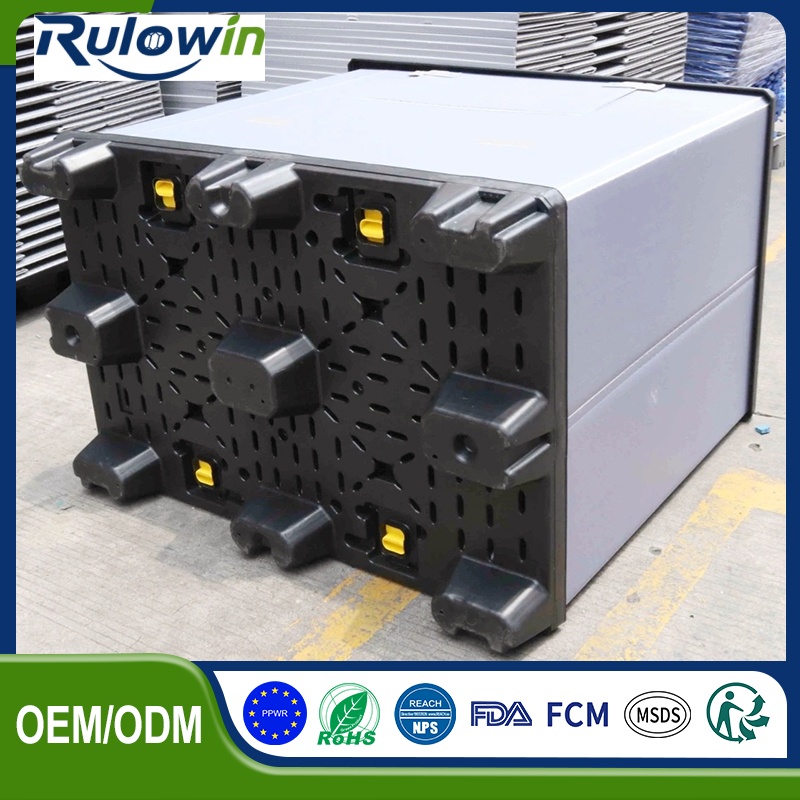
A jam is an event at a point on the line, but the cause is usually distributed. The box arrives at that point in a condition the equipment was not designed for – skewed, overlapping, too short to bridge a gap, or presenting a face the sensor does not expect – and the jam is where the mismatch becomes visible rather than where it began. Working out which of those applies is a short diagnostic, and it is worth doing before anyone orders new equipment.
Cause one: the box enters skewed
A container placed on the infeed by hand will rarely be perfectly square, and a well-designed line corrects a few degrees of skew within the first metre or two. A box with an underside that grips unevenly does not get corrected, because one corner drags while the other runs free. The box then arrives at the first narrowing – a guide rail, a merge, a sensor gate – at an angle, and its effective width is greater than its actual width. That is the classic wedge jam, and the fix is in the base finish rather than in the guide rail.
Cause two: the empty box
Empties are lighter, shorter in effective height, and often nested or stacked in a way that changes their footprint. A line tuned for fulls will frequently mishandle them: they slip on powered rollers, they do not depress the sensor flag far enough to register, and they tip in a curve where a loaded box would lean and recover. Where a line has to move empties – and most reusable-container lines do, because that is the whole point of a return loop – the empty case should be tested first, not last. See also roller spacing against the base design, where the short, light box is the same problem expressed as a geometry question.
Cause three: wall deflection in the queue
When boxes back up against each other, the driving force is transmitted through the walls. A wall that deflects absorbs travel: the box behind pushes, the wall bends, and the queue shortens by a few millimetres per box. Across ten boxes that is enough to close the gap a photo-eye needs to separate two units, and the line reads one long object instead of several short ones. The symptom is a mis-count or a mis-scan rather than a physical jam, which is why it so often gets attributed to the sensor.
Cause four: the base does not bridge a transfer
Every line has points where support is discontinuous – a belt-to-roller transition, a gap for a scanner window, a pop-up diverter, a weigh module. At each of these the box is briefly spanning, and a base that cannot span dips into the void. A shallow dip is recovered; a deep one catches on the far edge and the box stops dead with the line still driving underneath it. This is the most destructive failure mode on the list, because a driven belt under a stopped box generates heat and wear in seconds.
Cause five: the box grew
Reusable containers move through temperature ranges, and they also change shape under sustained load. A box stacked five high in a hot warehouse for a week will take a small permanent set, and a box that has been washed at temperature and cooled quickly will too. Growth of two or three millimetres on the width is enough to turn a clearance into an interference where guides are set tight. Where a fleet has been in service for a year and a line starts jamming that previously ran clean, dimensional drift is the first thing to measure.
The diagnostic that actually works
Take ten boxes from the current fleet, half full and half empty, and run them through the problem section one at a time while someone watches the underside rather than the top. Note where each one hesitates, skews or dips. A single bad box points at damage or drift; all ten behaving the same way points at the specification; behaviour that changes between full and empty points at weight and traction. Three minutes of watching the base usually settles what a week of sensor adjustment will not.
What to specify to prevent it
A base drawing with flatness and the rib pattern dimensioned, a wall stiffness figure, the dimensional tolerance the container will hold after a year in service, and the empty weight. None of these appear on a typical packaging drawing, and all four are what the equipment is actually sensitive to. Where they are supplied up front, most conveyor commissioning problems disappear before they happen. Send us the line specification and we will tell you which of our containers hold those tolerances.