
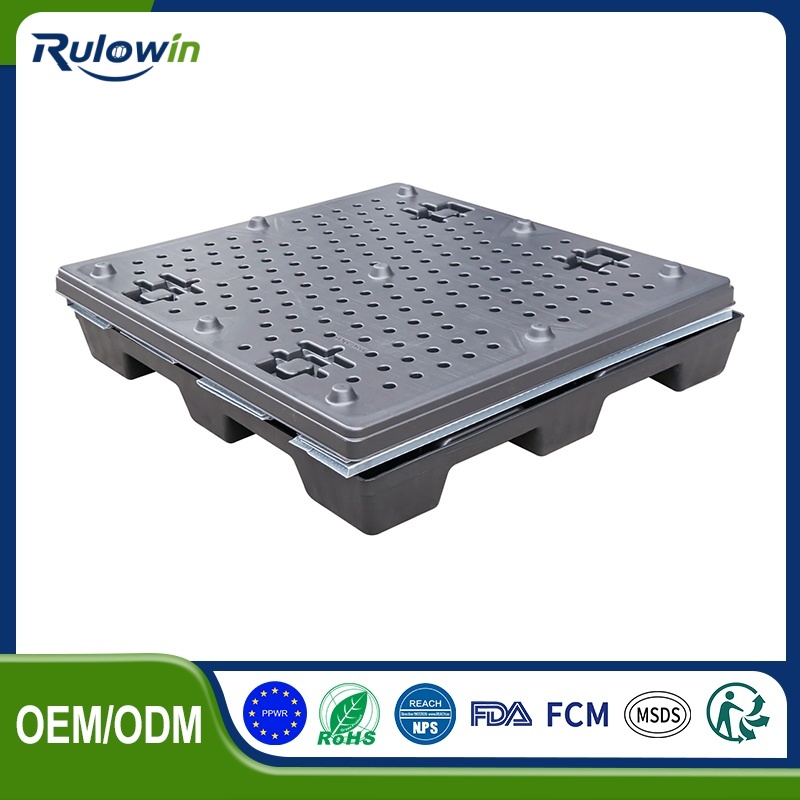
Radio frequency identification reads through most packaging material, and that property makes tag placement look like a free choice. It is not. Read range depends on what is behind the tag, on what the box is carrying, on how close other tags are, and on whether the tag survives the handling cycle. The container determines three of those four, and a tag placed without considering them will underperform for the life of the fleet.
What is behind the tag matters most
A tag mounted directly on metal loses most of its range, because the metal detunes the antenna. A tag on a plastic wall with air behind it performs well. The same tag on the same wall with a metal component inside the box performs worse, because the contents are what is actually behind it. Where containers carry metal parts – which is most industrial containers – the tag position has to be chosen with the loaded case in mind, not the empty one.
Water and the contents effect
Water absorbs at UHF frequencies, and wet or high-moisture contents reduce read range noticeably. A container of metal components reads differently from one of fresh produce, and a wet box reads worse than a dry one. Where a fleet carries variable contents, the read system has to be specified for the worst case, and the tag position should be as far from the contents as the box geometry allows – usually on an outside wall rather than inside.
Tag-to-tag coupling in dense storage
When boxes are stacked or racked closely, adjacent tags couple and the reader sees a cluster rather than individual tags. The effect is worse the closer the tags are and the more of them there are. Where containers are stored densely, spacing tags out – by putting them at different heights on different boxes, or on alternating faces – reduces the coupling. That is a placement decision made once and it costs nothing per unit.
Surviving the handling cycle
A tag has to survive washing, abrasion, impact and temperature. An embedded tag survives all of them and cannot be replaced. A surface tag is replaceable and vulnerable, particularly to the conveyor environment that wears labels generally. Where containers are washed hot, the tag has to be rated for the wash temperature and for the detergent, and that is a specification item rather than an afterthought.
Embedded, pocketed or stuck on
An embedded tag is moulded into the wall during manufacture: best protection, no replacement, and a tooling commitment. A pocketed tag sits in a recess with a cover: good protection and replaceable, at the cost of a small design change. A surface tag is cheapest and most flexible, and shortest-lived. For a fleet intended to run for years, the pocketed option is usually the right balance, and it is far easier to include at the tooling stage than to add later.
Read geometry and the portal
Most container reading happens at a portal – a door frame with antennas – or at a fixed point on a conveyor. A portal reads best when tags are on faces that pass through it broadside, which usually means the sides rather than the ends for a box travelling lengthwise. Where boxes are read in racking rather than at portals, the outward face is the one that works. Knowing where reading happens determines the face, and it should be established before the tag order is placed. The wider identification question is in which face should carry the identification.
What to specify
The contents including their worst case, the storage density, the wash process, where reading happens, and whether the tag has to be replaceable. Five questions. Given them, a placement and a mounting method can be chosen that will still be reading in three years. Given none of them, the tag goes wherever there is space, and the read rate becomes a permanent complaint.