
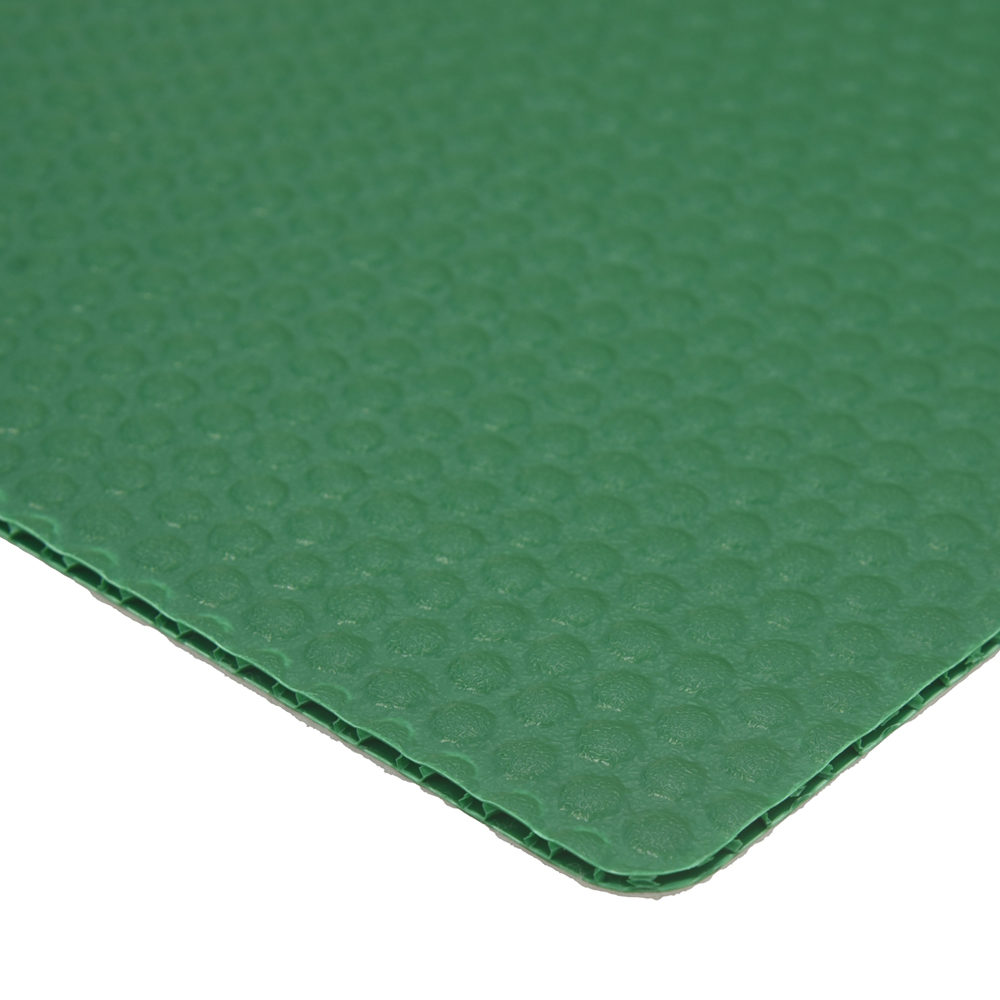
It is worth saying plainly: protection causes damage too. Four mechanisms come up repeatedly, and all four are specification or laying errors rather than product failures. Knowing them is more useful than buying a better panel.
Rocking
A rigid panel on an uneven floor or over a piece of debris rocks, and every footfall hammers the panel edge against the floor. Over weeks that produces a line of damage exactly where the panel edge sits, and it is usually worse than the damage the panel was preventing. Sweeping before laying and checking that panels sit flat is the whole fix.
Trapped moisture
A sealed cover over a floor that is drying out holds water against the finish. On stone and some coatings that produces a bloom; on timber it lifts the finish; on any floor it can leave an outline. Breathability is not a nice-to-have on a drying building, and it is the property most often missing from a cheap impermeable cover.
Printing a pattern
A hard embossed face laid face-down presses its pattern into a resilient floor under load, and in a warm room the print becomes permanent. The rule is soft against the finish, patterned face up where grip is needed. Getting the faces the wrong way round is the single most common installation error and it produces damage rather than preventing it.
Adhesive and backing transfer
Tape left too long takes the finish off. Some polymer backings plasticise against resin and vinyl and leave a permanent mark. Both are avoidable by checking what the backing is and how long the adhesive is rated for – two questions that cost nothing at specification and a great deal at handover.
How to tell it was the protection
The damage is in a pattern: along panel joints, in a repeating stud pattern, in an outline following the cover, or in a line where an edge sat. Random damage is traffic; patterned damage is the protection. Reading the pattern tells you what to fix, and it is worth photographing before the cover comes up.
How to check a cover is not causing harm
Lift one panel a month and look at the floor underneath. If there is a pattern, an outline or a mark, the cover is doing harm and it needs changing. If the floor is clean, it is working. One lift per month per area is the entire inspection regime, and it is the only way to know before handover rather than after.
What to do when it has already happened
Lift the cover in the affected area, photograph the pattern, and stop using that product there. Then check the rest of the floor for the same pattern before it develops further. The instinct is to re-cover and deal with it at handover, which converts a small local problem into a floor-wide one.
Specifying to avoid it
Three questions at enquiry prevent almost all of it: what is the finish, how long will the cover be down, and is the building drying out? Every one of the four failure mechanisms traces back to one of those answers being unknown when the product was chosen.
What we can do
We supply protection panels with a face chosen for what it touches, and we ask what the floor is before quoting rather than after. Tell us the finish, the programme length and whether the building is drying out, and we will flag the risks – including where no cover is the safer answer. Face orientation is explained in which face goes down on finished floors.