
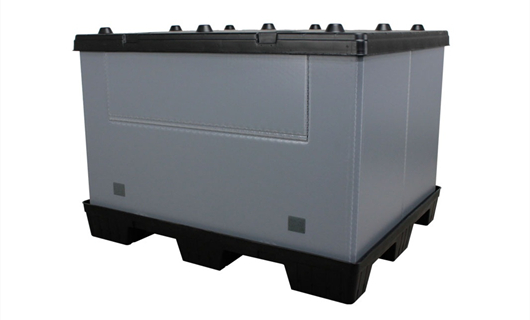
Squareness is the dimension that least often gets specified and most often causes trouble. A box can be the right length, the right width and the right height, and still not stack properly, because its corners are not at 90 degrees. The error is small at each layer and cumulative up the stack.
Why it happens
Folding a die-cut blank introduces small angular errors at each fold, and the errors do not cancel. Sheet that has been stored flat under load, or that has been cut slightly off-square, adds to it. The result is a box that measures correctly along each edge but whose diagonals differ.
How it shows up
The box sits on three corners rather than four. The lid does not seat evenly. The stack leans progressively, and by the top layer the offset is visible from the other side of the warehouse. None of this looks like a dimensional problem on a drawing.
Measuring it
Compare the two diagonals of the box mouth. The difference is the squareness error, and it is the number to specify. A blank with correct overall dimensions can still be several millimetres out here, which is enough to matter over six layers.
What tolerance is reasonable
It scales with box size, because the same angular error produces a bigger diagonal difference on a bigger box. A fixed millimetre figure applied across a range of sizes will be tight for the small boxes and loose for the large ones. Specify it in relation to the box, not as a flat number.
What it does to the load
Out-of-square boxes do not share load evenly between walls. One vertical edge carries more, and under transit loads that edge is where the wall buckles. The failure looks sudden but the cause was present at the first layer.
Where the error comes from
Folding a die-cut blank introduces a small angular error at every fold, and the errors accumulate rather than cancelling. Sheet that has been stored flat under load, or cut slightly off-square at the start, adds to it. The result is a box whose sides measure correctly and whose corners are not 90 degrees.
Measure it as a diagonal difference rather than as an angle. It is faster, it needs only a tape, and it is the form the tolerance should be written in. A box that measures square flat can still be out of square assembled, so measure assembled.
What tolerance is realistic
Tighter than about 2 mm of diagonal difference on a mid-sized box costs money and buys little. Looser than about 5 mm starts to show on a tight pattern. Where the load is stacked high or handled automatically, work at the tighter end; where it is low and loose, the standard band is fine.
How much error matters
A diagonal difference that is small relative to the box is usually harmless. The same absolute error on a small box is a real problem. Which is why the tolerance should be written relative to the box dimension rather than as a fixed number – a flat figure will be tight where it does not need to be and loose where it does.
Where boxes stack several high, the tolerance matters more, because the error accumulates layer by layer. A stack of four tolerates what a stack of twelve does not. Specifying without knowing the stack height is specifying blind.
What we can do
We build PP corrugated turnover boxes with the base and mouth held square in assembly, and we will state the squareness tolerance alongside the outer dimensions. Tell us your stack height. The tolerance side of it is in which tolerances matter on a pallet.