
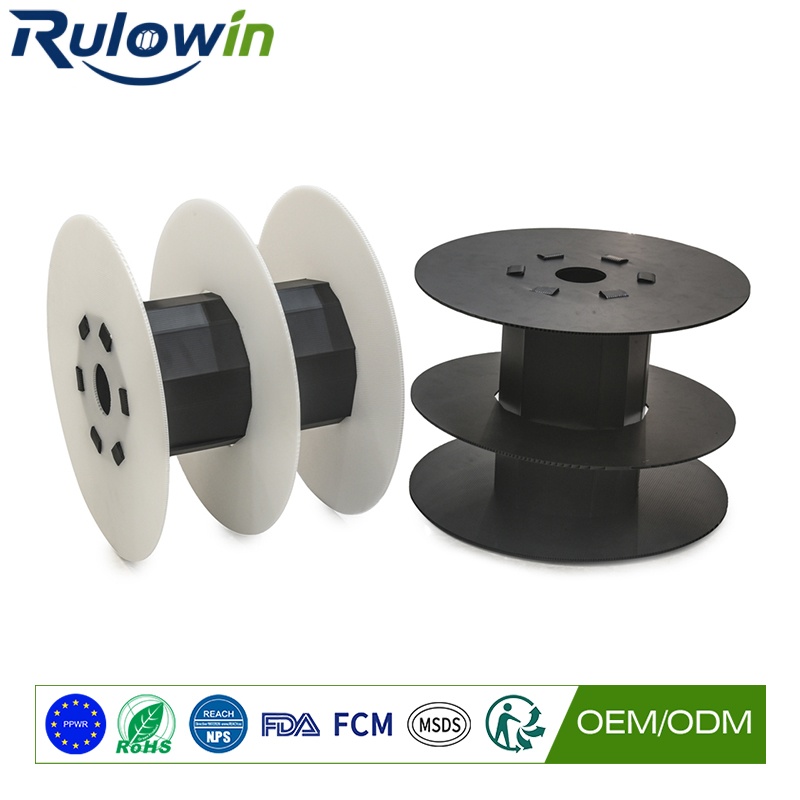
Flange diameter is usually chosen to fit a length of cable onto a reel that will fit on a truck. That is backwards. The flange has to be large enough that the first wrap around the hub does not bend the cable tighter than it tolerates, and everything else – length, weight, pallet footprint – comes after that.
Start from minimum bend radius
Every cable has a minimum bend radius, specified by the maker, usually as a multiple of the cable diameter. The innermost layer on a reel sits on the hub and is bent to the hub’s radius. So the hub diameter – not the flange – is what the cable actually feels.
If the hub is too small, the inner wraps are damaged during winding and you will not discover it until the cable is pulled and tested. This is the expensive failure mode in reel selection, and it is entirely avoidable by starting from the cable specification.
Then the flange, from the length
Once the hub is fixed, the flange diameter follows from how much cable has to fit. Cable occupies an annular volume between hub radius and the outer wrap radius, and the length that fits grows quickly as the flange grows – area goes up with the square of radius, so a modest increase in flange diameter buys a lot of length.
This is the trade to look at: a slightly larger flange often carries substantially more cable for a small increase in reel weight. Going up one flange size is frequently cheaper per metre than staying small and using more reels.
The constraint people forget
Transport and handling. A bigger flange is a bigger reel, and reels have to fit pallets, containers and doorways. There is a practical ceiling – reels much above a metre in flange diameter become awkward to handle manually and waste cubic space on a palletised load.
So the usual resolution is: hub sized to the cable, flange as large as the transport envelope allows, and length whatever that gives. If you need more length than that, the answer is more reels rather than a bigger reel.
Two other numbers worth specifying
Hub bore, to match your payout spindle – a bore that is even slightly loose produces a wobble that shows up as tension variation. And flange thickness, which governs how much radial pressure the reel takes before the flange cracks. We wrote about why reel flanges crack near the hub separately, because it is the most common way a reel specification turns out to be wrong.
Why not just make the flange larger
Because the flange is what makes the reel awkward. It sets the pallet footprint, the container utilisation and whether two people can move the reel by hand. Roughly above a metre in diameter, reels stop being hand-portable and you are into equipment for every move.
There is also a returns problem. Empty reels come back at their outer diameter, and a bigger flange means fewer empties per vehicle. If reels are reused, the flange size drives the return cost in the same way it drives the outbound one.
What we can do
We supply custom-size fiber optic cable drums and reels and we will size them from your cable’s minimum bend radius and target length. Send us the cable specification and how many metres per reel you need, and we will give you hub, flange and bore – plus an honest view on whether the flange you want will survive the winding tension.