
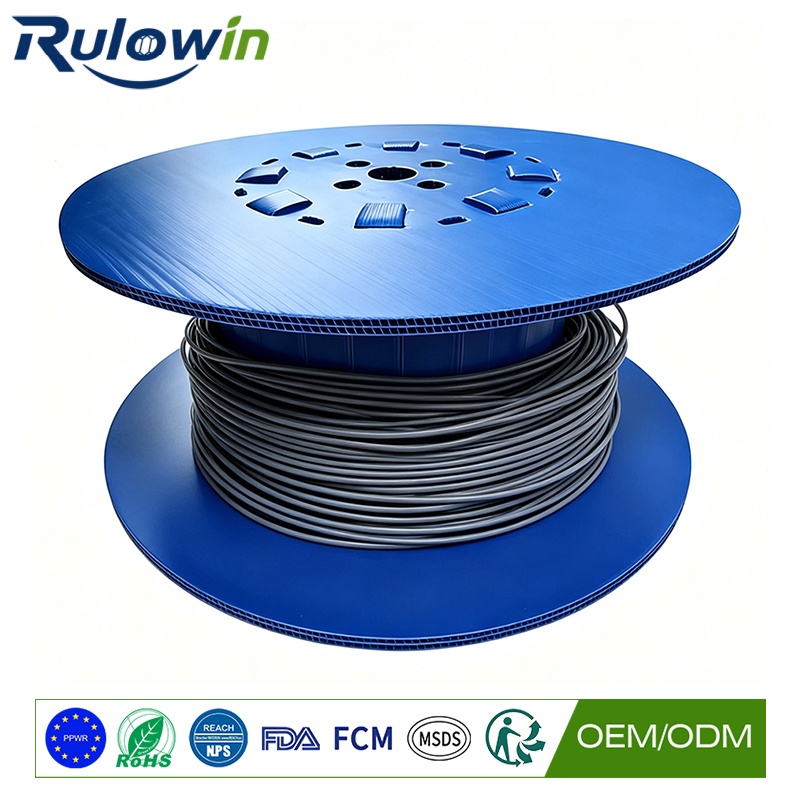
Ask most packaging suppliers for a warranty and you get twelve months against manufacturing defects, which excludes nearly everything that can realistically go wrong and can be invoked by almost nobody.
Why reusable packaging is hard to warrant
A reusable spool’s failure depends overwhelmingly on what happened to it, not on what it was like when it left:
- How many times it was dropped, and how hard
- Whether it was UV-exposed and for how long
- Whether it was loaded beyond design
- Whether anything was spilt on it
- How many trips, under which conditions
A supplier warranting the item is warranting against failures they cannot observe or control. Hence the standard wording: defects in materials and workmanship, twelve months, often excluding anything involving wear.
What that wording actually covers
Manufacturing faults that were there when new:
- A joint that was badly made
- Dimensions outside agreed tolerance — see first-article inspection
- Material defect that manifests early
- Wrong material supplied
Real, valuable, and covers maybe a fifth of what actually goes wrong. It does not cover accumulated wear, which is the majority.
What people expect it to cover
- Trip count. “Should last fifty trips” — nobody can warrant this without controlling conditions, and any number offered without conditions should be discounted accordingly.
- Damage in service. Not a warranty matter; that is handling.
- Fitness for purpose in an unusual application. Usually excluded, and legitimately so if the application was not described.
The gap between those two lists is where most disappointment originates.
What is actually worth having
Things a supplier can genuinely commit to and you can genuinely use:
- Conformance to agreed specification with stated tolerances — the single most valuable commitment, and it fits naturally into a quality agreement
- A defined response to a failed delivery: replacement, credit, timeline. Covered in our quality agreement article.
- An expected service life stated conditionally — “under these conditions, we would expect this order of magnitude”. Honest, useful, not warrantable.
- Change notification, so what you bought today is what you get next year
- Spare availability for a stated period
Questions worth asking instead of “what is your warranty”
- What do you expect this to survive, under these conditions?
- Where do you expect it to fail first?
- What have you seen fail in comparable applications?
- If this batch is wrong, what happens and how fast?
- What should we be inspecting for?
Those questions produce information you can act on. A warranty document mostly produces paper.
Warranties to be cautious about
Generous-looking warranties with heavy exclusions are worse than honest narrow ones, because they create a false sense of security and then get argued over. Anything requiring you to prove handling conditions you cannot document is, in practice, unusable.
The alternative: design it out
Rather than seeking a warranty against failure, ask the supplier what the anticipated failure modes are and whether the design can avoid them. That is a design conversation with real value, and it costs the same amount of time as arguing about warranty wording.
Much of the failure analysis in this series — cracks from the rim, joint failures, bore wear — is preventable at specification, and none of it is a warranty matter.
Our position
For our hollow board spools we will state clearly what we expect them to do and under what conditions, we will commit to specification conformance with honest tolerances, and we will tell you the failure modes we actually see. We will not offer a headline life figure, because any number we could put there would depend far more on how you handle them than on how we make them.