
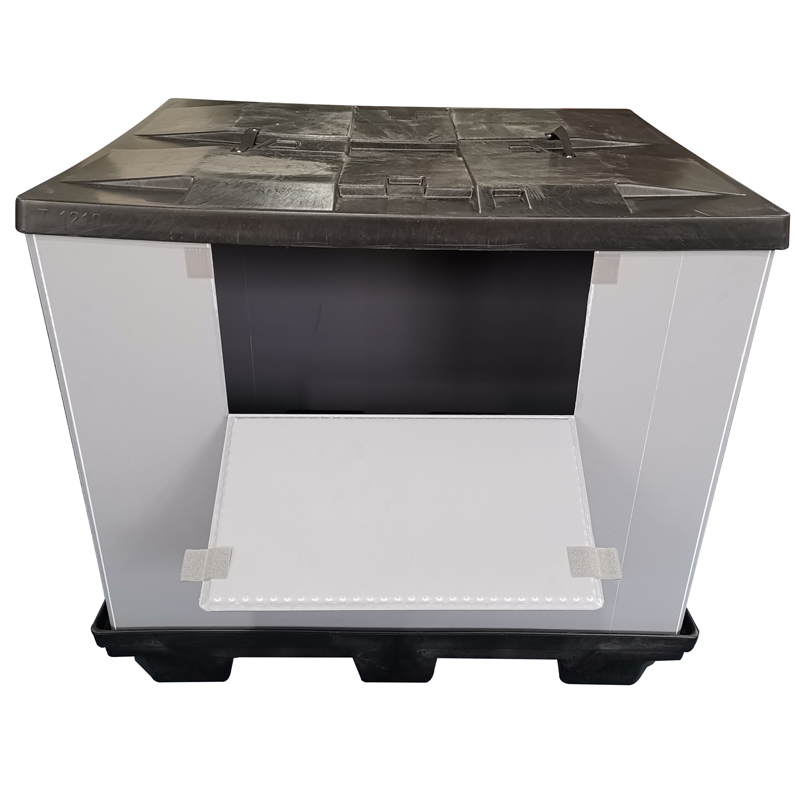
Vacuum lifting is attractive for containers because it needs access to only one face and applies no squeezing force. It is also unforgiving: the cup has to seal against the surface, and a seal requires local flatness within a fraction of a millimetre over the cup area. A base that is perfectly strong, and perfectly adequate for every other handling method, can be impossible to lift this way, and the symptom – loss of vacuum – points at the equipment rather than at the box.
What the seal actually needs
A suction cup seals by pressing a flexible lip against the surface and evacuating the space inside. The lip can accommodate small irregularities, and it cannot accommodate a step, a rib edge, or a curvature that leaves a channel open to atmosphere. The requirement is therefore local: the area under the cup has to be flat and continuous. The rest of the base can be anything at all, which is why a base with a ribbed perimeter and a flat central panel lifts perfectly well.
Where corrugated bases fail this
A corrugated PP base is a flat panel, and in principle it seals well. In practice the base usually carries a rib pattern, drain holes or a moulded stacking feature, and the cup has to land somewhere that avoids all of them. Where the flat areas are small relative to the cup, the lift becomes unreliable, and the easy fix is usually a smaller cup with more of them rather than a larger cup with fewer.
Porosity and the slow leak
Some containers are made from material that passes a little air, or have joints that do. A vacuum system with enough pump capacity will hold the load anyway, but the margin is reduced and a marginal lift becomes a dropped load when the surface is dirty or the pump is worn. Where vacuum lifting is planned, a simple hold test – lift, hold for thirty seconds, watch the gauge – tells you whether the leak rate is acceptable before the system is designed around it.
Deflection during the lift
When the cup evacuates, the base is pulled toward the cup and the load hangs from that point. The base deflects, and if it deflects enough the seal can break at the lip. This is a stiffness question again, and the boxes that fail it are the large, lightly-built ones with heavy contents. Where a vacuum lift works empty and fails loaded, deflection is the usual cause rather than leak rate. The general stiffness issue is covered in base stiffness for shuttle carriers.
Surface contamination
Dust, oil, water and release agent all break a seal. A container that lifts perfectly when new can stop lifting after a few weeks in a plant atmosphere, and the difference is usually a film on the base rather than any change in the box. Where vacuum lifting has to work in a dirty environment, either the base has to be cleaned as part of the cycle – a wipe or an air knife before the cup lands – or the system needs enough margin to lift through the film.
Cold, heat and the cup material
A cup that seals at room temperature may not seal cold, because the lip stiffens. A base that is flat at room temperature may not be flat hot, because the panel softens and curves. Where the handling happens at a temperature extreme – a cold store, or boxes coming out of a wash – both the cup and the base need to be rated for it, and the test has to be done at that temperature rather than at ambient.
What to specify
A defined flat area on the base of a stated size, in a stated position, with a stated flatness tolerance. That is the whole requirement, and it is a drawing annotation rather than a design change. Where it is included at the tooling stage it costs nothing. Where it is added later it usually means a new tool. Send us the cup size and layout and we will specify a base with sealing areas that match.