
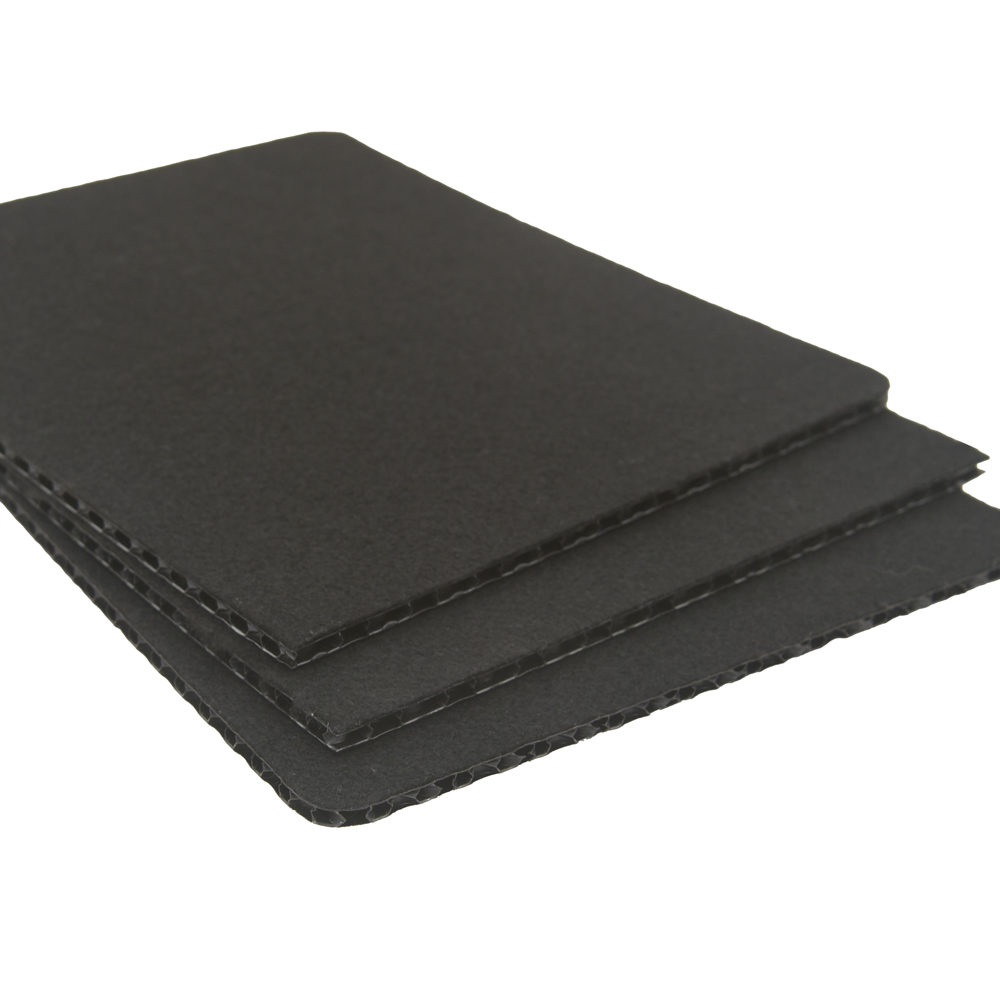
A pallet top cap is a flat sheet laid over the top layer of a load so that strapping does not cut into the boxes and so the layer above has something flat to sit on. Cardboard and corrugated plastic sheet both get used for it. Honeycomb panel is the third option and it is the one that gets overlooked, mostly because it costs more per sheet and is harder to justify on price alone.
Why honeycomb behaves differently
A top cap has to resist two things: the strap pulling down at its edges, and whatever sits on top pushing down in the middle. Corrugated sheet resists those differently depending on flute direction, which is why a sheet cut the wrong way round sags between pallet bearers.
Honeycomb has no flute direction. The cell structure carries load in both axes equally, so a cap behaves the same whichever way it is laid. On a load with an uneven top layer, that matters more than the stiffness number suggests.
The thickness question
For a top cap you are not spanning anything – the load underneath supports the sheet. What you need is enough thickness to resist the strap cutting in and enough stiffness to stop the sheet folding at the pallet edge. In practice a thinner panel does this job than people expect, because the load below is doing most of the work.
Going thicker buys puncture resistance rather than stiffness. If the load below has sharp corners or the strapping is tensioned hard, thickness helps. If it is a flat carton layer, it does not. Guidance on choosing is in what thickness honeycomb panel you need.
What wears out
The edges. A top cap gets dragged on and off, slid across the load, and caught on the pallet corner. The panel face survives; the edge crush does not, and eventually the strap starts pulling into a soft edge rather than onto a firm one.
Edge sealing helps a lot here and is worth specifying. An unsealed panel used as a cap frays at the edges within a few trips in a rough loop.
When sheet is the better buy
If the cap is single-use, or if it is being sent out with the load and not coming back, buy corrugated sheet. The durability of honeycomb is worth nothing on a one-way trip, and there is no reason to pay for it.
Honeycomb earns its price in a loop where the cap comes back. That is the whole test.
Two things to check before switching
Whether your strapping tension is set for a soft cap. A hard panel changes how the strap seats, and on some machines the setting needs adjusting – otherwise the strap is tensioned against something that does not compress and the load is tighter than intended.
And whether the cap needs to be creased or folded over the load edge. Honeycomb does not fold; it scores and breaks. If your method relies on folding the cap down the sides, this is not a straight swap.
How to tell if the cap is doing its job
Look at the strap line after the load has been strapped and moved. If the cap is creased along the strap line, the panel is too thin or the strap is too tight. If the cap is intact but the top layer of boxes is crushed, the cap is fine and the problem is the strapping.
Then look at the corners of the cap after a few trips. Rounded, crushed corners mean it is being dragged rather than lifted, and no amount of extra thickness fixes that – it is a handling issue.
What we can do
We supply PP honeycomb panels for reusable pallet top caps and will tell you honestly whether a thinner grade does the job. Tell us the load, the strap tension and how the cap comes back – if it does not come back, we will say so and point you at sheet instead.