
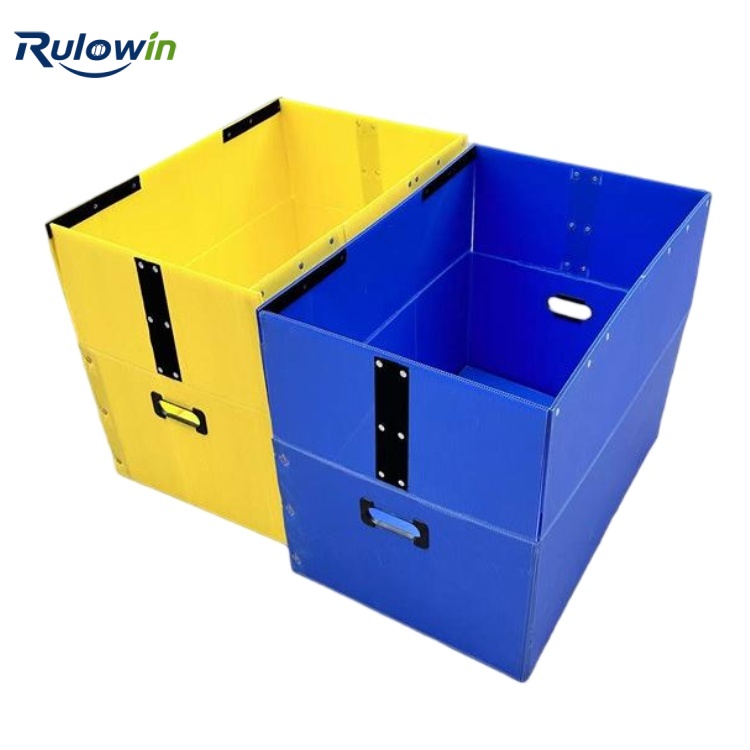
Warehouse floors are specified flat for a reason, and reusable box stacks are one of the reasons. Where a floor is uneven, or where a pallet sits across a joint or a drain, the load path through the bottom box is no longer symmetric. One pair of walls carries more than its share, the box racks slightly, and every layer above inherits the tilt.
What a tilt does to the load path
A vertical wall carries compression well. The same wall at a few degrees off vertical carries compression and bending, and bending is what a corrugated board is least good at. The effect compounds up the stack, because each layer sits on the tilted top of the layer below, so the top of a stack is always further out of plumb than the bottom.
Why reusable boxes make it worse
Returnable boxes stack on features – a lip, a recess, a corner post – rather than on a flat top. Those features assume the box below is square to the floor. Tilt the bottom box and the features engage unevenly or not at all, which removes the very thing holding the layers together.
Where the uneven floors are
Common locations: near dock levellers and bay edges, over expansion joints, in older buildings with settled slabs, outdoors on compacted ground or asphalt, and anywhere a pallet has been set down on debris. Most of these are known to the people working there and unknown to whoever wrote the specification.
Practical mitigations
Keep stacks away from the bay edge. Use a pallet in reasonable condition rather than the worst one in the yard. Where a floor is known to be poor, reduce the stack height by a layer rather than accepting the lean. And check plumb when a stack is built, not when it is moved.
Racking as an alternative
Where floor conditions are consistently bad, racking removes the floor from the equation – though it introduces a different load case, because the box then spans between beams. The point is not that racking is better but that the load case should be chosen deliberately rather than inherited from wherever the pallet ended up.
What to check
Whether the bottom box is square to the pallet, whether the pallet is sitting flat, and whether the stack is plumb before it is wrapped. Three checks, each quick, and between them they catch the great majority of leaning-stack problems before they become transit damage.
What to specify
The floor conditions the box will meet, and a base stiff enough to span the gaps that remain. Where the lane includes outdoor standing or a known rough floor, the base is the panel that has to be specified, not the wall. Most boxes fail from the bottom up, and a poor floor accelerates exactly that.
A deck liner is the cheapest mitigation and it is worth specifying where the floor cannot be fixed. It spreads point loads, bridges small gaps and keeps debris away from the base. Where a programme is being run pallet-free, it is close to essential.
Why a liner is worth more than it looks
A sheet under the load spreads point loads, bridges small gaps and keeps debris away from the base. It is the cheapest part of a pallet-free arrangement and the one most often left out of the specification, because it does not look like packaging.
Where the floor cannot be fixed, the liner is doing the job the pallet used to do. That is worth stating explicitly, because it makes the arrangement auditable rather than improvised.
What we can do
We build PP corrugated turnover boxes with bases that stay square on an imperfect deck, and we can supply the deck liner that makes a poor floor behave better. Tell us the floor conditions and we will suggest the stack height that suits them. The time-dependent part of that is in what creep does to the bottom box.