
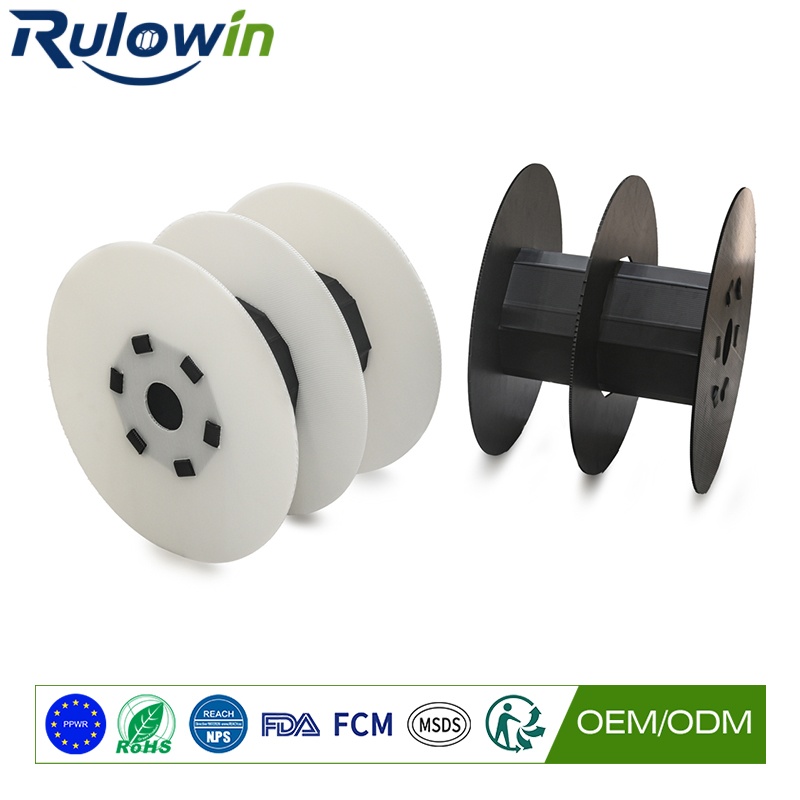
Winding looks like the simple part: turn the spool, move the product back and forth, fill it up. The settings chosen in those few minutes determine whether the spool unwinds cleanly six weeks later on somebody else’s machine, and most winding problems are set up at the winder rather than at the payoff.
Pitch: the distance per revolution
Traverse pitch is how far the product moves sideways per revolution of the spool. Set it to exactly the product diameter and turns sit neatly side by side. Set it slightly wider and you get gaps; slightly narrower and turns overlap and ride up on each other.
In practice pitch is set a little wider than nominal diameter, because real product is not perfectly round and a hard side-by-side wind jams when the product swells under tension. How much wider depends on the product: stiff, round cable tolerates a tight pitch; soft or flat product needs more slack.
What a wrong pitch looks like later
- Too tight: turns climb over each other, the pack becomes uneven, and layers interlock. On payoff, the product digs into the layer below and jams — often repeatedly, in the same place.
- Too loose: gaps between turns, and the next layer drops into them. The pack compacts unevenly and the outer layers go slack, which is how birdnests start.
- Uneven at the reversal: product piles up at the flange. This is the most common defect and the easiest to see — a ridge at each edge of the pack.
The reversal problem
At each end of the traverse the mechanism has to slow, stop, and reverse. Product keeps feeding during that moment, so it piles up slightly at the flange. Every traverse mechanism has this, and every winder has a setting to mitigate it — usually a dwell adjustment or a slightly non-linear traverse.
A flange ridge is not cosmetic. It raises the effective diameter at the edges, which changes the tension at reversal, which can produce a periodic fault down the whole length. If you can see a ridge on a finished spool, the wind was not set up correctly.
Layer count and fill height
More layers means more length on the same spool, and more places for something to go wrong. Deep packs are more prone to dig-in, because the inner layers are under more pressure from everything wound on top of them.
The usual guidance is to leave freeboard below the flange — a margin of a couple of product diameters, more for soft or easily marked product. It costs capacity and it prevents the most common cause of transit damage, which is the outer layers getting crushed against the flange or the packaging.
Spool geometry interacts with the wind
A spool with a slight taper on the flange inner face, or with a generous radius where the flange meets the core, is more forgiving of an imperfect wind. Sharp internal corners are where product catches, and the catch is what turns a minor wind defect into a jam.
If you are having unwind problems that you cannot trace to the winder, look at the corner geometry before you blame the material. A small radius in the tooling is cheaper than a new winder.
Recording what worked
When a wind runs well, write down the settings — pitch, tension, layer count, product diameter, spool type. Most winding problems are solved by recovering a setting that somebody changed and nobody wrote down. It takes thirty seconds and it is the single most useful thing on the line.