
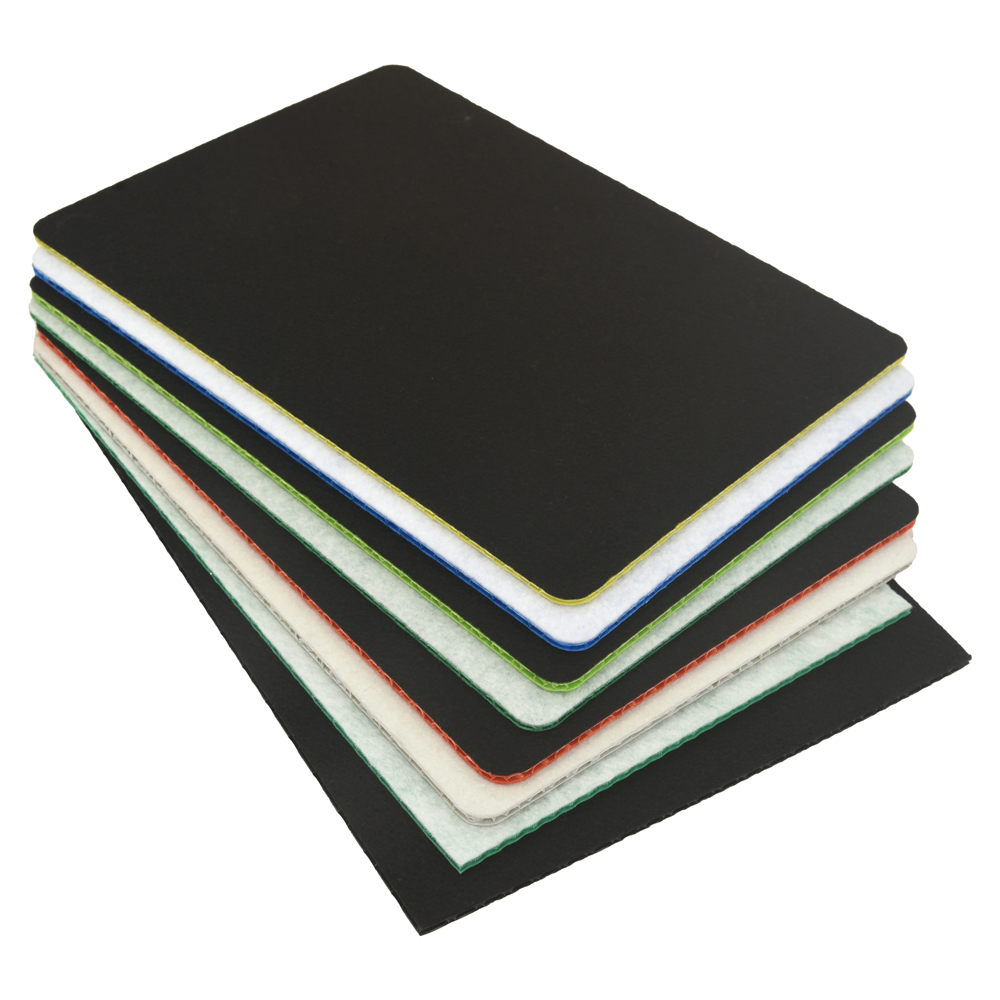
When buyers compare honeycomb panels they compare the core: cell size, density, thickness. Understandable — the core is what you can see at the edge, and it is what the datasheet leads with. But the layer that decides how a panel behaves after two hundred thermal cycles and a season in a wet warehouse is the bond line between the core and the skin.
There are two ways that bond is made in polypropylene panels, and they age differently.
Thermal fusion
In a thermally bonded panel the skins and the core are fused — melted together, usually in a continuous lamination process. There is no separate adhesive layer; the polypropylene bonds to polypropylene.
The consequences are mostly good:
- There is nothing in the joint to be attacked by water, detergent or solvents. A fused panel can go through a wash line indefinitely.
- There is no adhesive to creep. Bond-line creep under sustained load is one of the quieter failure modes in laminated panels, and fusion removes it.
- The whole panel is one polymer, which matters at end of life: it can be regranulated without separating materials.
The trade-off is process control. Fusion depends on temperature and pressure being right at the moment of bonding, and a panel made slightly cold will look perfect and underperform in peel. It also limits material choice — both faces have to be polypropylene, so you cannot fuse a different facing material directly.
Adhesive lamination
An adhesive line lets you bond almost anything to a honeycomb core: other polymers, nonwoven felts, foams, decorative films, even thin plywood. That flexibility is the reason this construction exists, and for facing materials it is usually the only option — you cannot thermally fuse a polyester felt to PP.
The cost is that the bond line becomes a component with its own properties:
- Temperature range. Every adhesive has a service window, and outside it the bond softens or embrittles.
- Moisture behaviour. Some adhesives are unaffected by water; others hydrolyse. If the panel sees wet service, this is the question to ask.
- Cycle life. Repeated flexing and thermal cycling work a bond line harder than a static load ever does.
Which one for which job
A reasonable decision rule: if the panel is a structural or protective component in a reusable system — dunnage, layer pads, racking decks, pallet sleeves — fusion is the default, because the panel’s life depends on the bond surviving hundreds of handling cycles.
If the panel needs a functional facing — a soft contact surface for a Class-A part, an antibacterial layer, a decorative skin — then adhesive lamination is the way to get it, and the specification conversation shifts to the adhesive: what is it, what is its service temperature, and how was the peel strength measured.
Questions worth asking a supplier
- How is the skin bonded to the core, and at what line speed and temperature?
- What peel strength is achieved, and on what test?
- Has the bond been tested after conditioning — wet, hot, frozen — not just as-delivered?
- For adhesive panels: what is the adhesive, and does it suit my wash process or my temperature range?
That third question is the one that separates panels that stay in service from panels that delaminate in month four. A bond measured on a fresh sample tells you about the factory; a bond measured after conditioning tells you about your warehouse.
End of life and the circularity argument
There is a regulatory angle that is becoming harder to ignore in the EU. A mono-material polypropylene panel can be regranulated into new sheet with minimal sorting. A panel with a dissimilar facing and an adhesive line is a composite, and composites are harder to recycle economically — they get downcycled or disposed of.
Under the EU packaging and packaging waste rules, recyclability is moving from a virtue to a requirement. For anything that will live a long service life and then need a home at end of life, mono-material construction is quietly becoming the safer specification, and thermal fusion is how you get it.
If you tell us the application, the wash regime and the facing you need, we can tell you which construction fits — and where a fused panel will do the job at lower cost.