
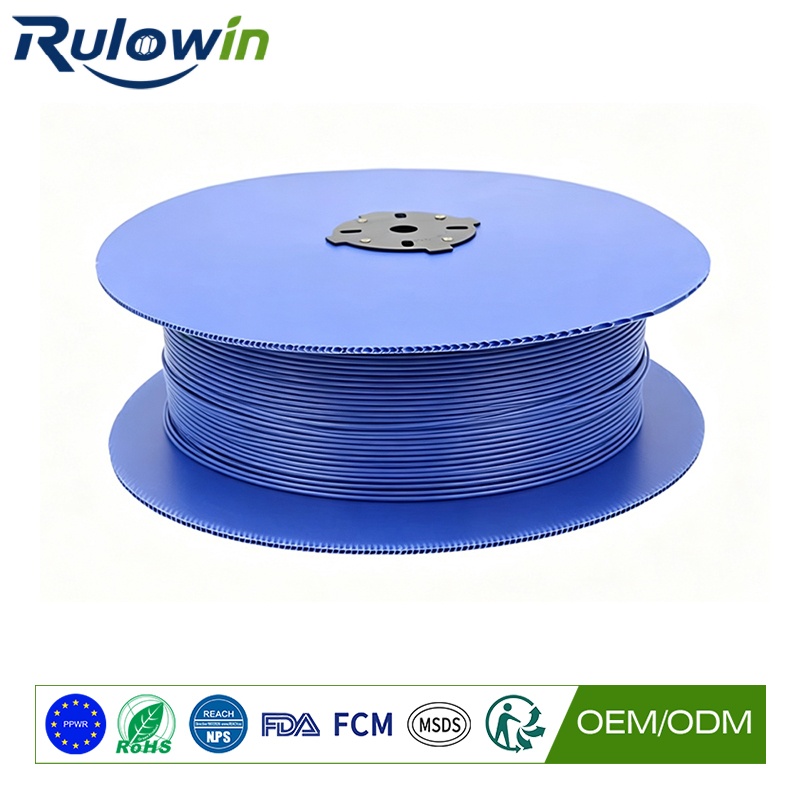
A finished spool looks uniform. It is not. The layers sitting directly on the core are doing several jobs that later layers do not, and most unwind problems trace back to how they were put on rather than anything that happened afterwards.
Why the first layers are different
Everything above them has something to press against. The first layers have the core, and the core is hard and unforgiving. This means:
- They take the full radial compression of everything wound afterwards. Later layers share load with whatever is beneath them; the first layers have nowhere to pass it.
- They set the shape of everything above. An irregularity in layer three propagates roughly outwards, amplified, through fifty subsequent layers.
- They determine grip on the core. If the first layers slip, the entire pack can slip, and a slipped pack damages itself against anything it rubs.
Anchoring
The first layer has to be anchored to the core somehow — a clamp, a slot, tape, a mechanical start, whatever suits the product. Get it wrong and the whole pack rotates slowly relative to the core, which produces progressive damage nobody can see until the spool is unwound.
The specific failure is subtle: with a pack that slips slightly, tension at payoff varies in a way that looks like a machine fault. People spend weeks adjusting dancers before anyone unwraps far enough to see scoring on the core.
The lump problem
A product that enters the core at an angle, or that is thicker at one point, creates a localised high spot. By layer three that high spot is maybe a few tenths of a millimetre. By layer fifty it has multiplied.
This is why experienced operators watch the first few turns closely and will cut back rather than build on a bad start. It is also why traverse pattern from the very start matters as much as it does later.
Tension through the first layers
There is a persistent belief that the first layers should be wound loose. Usually the opposite is true: they generally want firm tension, because everything above them will compress them further and anything loose at the start gets looser.
But winding the first layers too tight can crush soft product against the core, or drive it into whatever anchor feature is there. So it is a window, not a direction — and where exactly the window sits depends on the product.
The transfer point
Where the leading end transitions from anchored position to normal lay is a discontinuity. Every spool has one. It is a place where:
- A step exists that later layers bridge over rather than into
- A mark can be pressed into the layer beneath
- The subsequent layer can dig in
Tapering the start, or using a lead-in that builds thickness gradually rather than stepping, substantially reduces this. It is the kind of detail that separates a wind that behaves from one that mostly behaves.
The core surface matters more than you would think
A rough or uneven core prints through to the first layers, and through them to subsequent ones. A seam ridge on a wound core, a burr at a joint, a damaged spot — all of it telegraphs. This is part of why our article on core construction matters beyond pure strength.
Inspect cores before winding, particularly reused ones. A core that has taken a knock will produce a bad first layer regardless of how competent the winding is.
What to watch
Practical checks during the first minute:
- Is the lay even across the width, or is it ridging at one side?
- Is anything stepping rather than laying flat at the transfer point?
- Is there any sign of the pack rotating on the core?
- Does the first layer cover the anchor cleanly, or is there a hump?
Thirty seconds of attention at the start saves more than any amount of correction later, because by then there are forty layers on top of whatever went wrong.
Where we come in
We cannot fix your winding settings. But if you are seeing problems at the start of an unwind rather than the middle, the first layers are the first place we would look — and if the cause is the core surface or the anchor geometry rather than the process, that is a spool design question we can help with. Our hollow board spools can be specified with different core finishes for exactly this reason.