
Textiles solved the winding problem long before the cable industry did, and solved it differently. Yarn goes onto a package — often a simple tube with no flanges at all — because that is what the product needs. There are three lessons in there worth borrowing, and one thing textiles do that industrial spooling should not copy.
Lesson one: no flanges if you do not need them
A yarn package is a tube. It works because yarn is wound with a precision traverse that builds a stable, self-supporting package with tapered ends, and because the yarn is paid off over the end at very high speed without tangling.
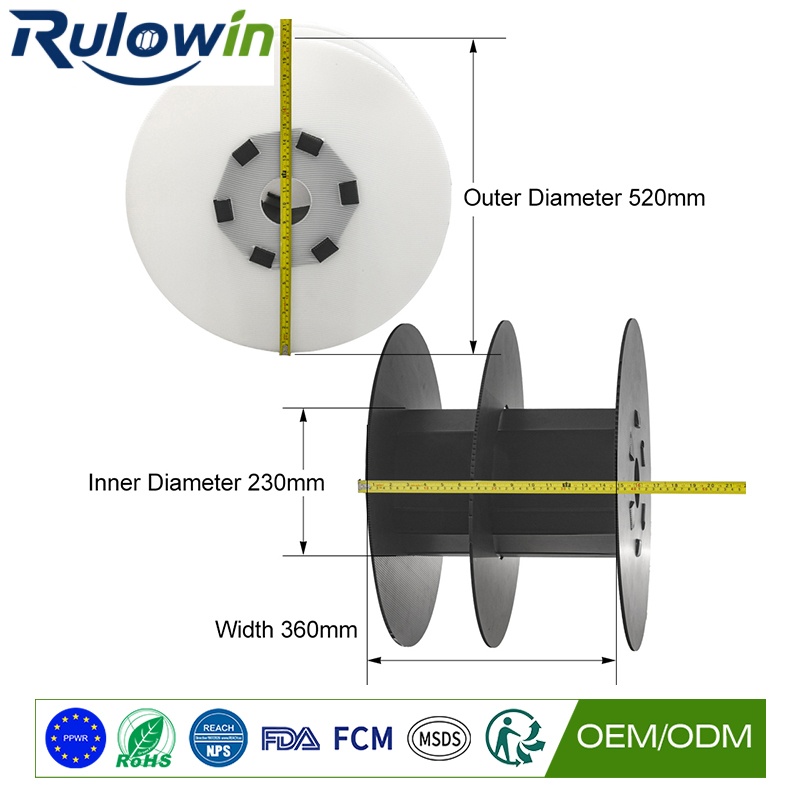
Industrial spools have flanges because industrial product is stiffer, heavier, and cannot be relied on to hold a self-supporting shape. But the flange is not free — it adds weight, volume, and a surface the product can catch on. Where the product will tolerate it, a flangeless or reduced-flange design is lighter and cheaper to ship.
Lesson two: the traverse does the work
Textile winders control the traverse precisely, because the package geometry is everything. Industrial winding is often cruder — a traverse that is approximately right and a tension that is approximately constant — and most dig-in and layer-collapse problems trace back to that.
The fix is not expensive precision equipment. It is setting the pitch correctly, holding tension constant, and writing the settings down. Textiles do this because they have to; industrial winding should because it works.
Lesson three: pay off the way you wound
Yarn pays off over the end at enormous speed. It can do this because the package was designed for it. Industrial product generally should not — paying off over the flange adds a twist per turn, which for most cable is tolerable and for some is fatal.
The lesson is not “copy textiles”. It is that the payoff direction has to be designed in, not chosen by whoever is standing there.
The thing not to copy
Yarn packages are consumable. They are wound once, used once, and discarded or recycled. That is the correct answer for yarn, because the package costs less than the handling to return it.
Industrial spools should not work that way, and mostly do not — but the habit of treating the spool as a consumable is worth watching for. If spools are being discarded after one trip, either the return loop is broken or the spool is too cheap to bother returning, and both are fixable.
Where industrial spooling differs, properly
Industrial product is heavier, stiffer, and less tolerant of bend radius. It is stored longer, shipped further, and handled more roughly. And it is frequently paid off into a process rather than consumed at the point of use.
That is why industrial spools have flanges, why they are built to survive transport, and why they are reusable. The two worlds are solving genuinely different problems, and the useful borrowing is in the winding discipline, not the hardware.
Practical takes
- Set the traverse pitch deliberately and record it
- Hold winding tension constant through the whole wind, including the end
- Do not add flanges you do not need — they cost weight and volume
- Design the payoff direction in, and mark it on the spool if there is any doubt
Four things, none of them expensive, and between them they prevent most of the winding problems that end up blamed on the spool.