
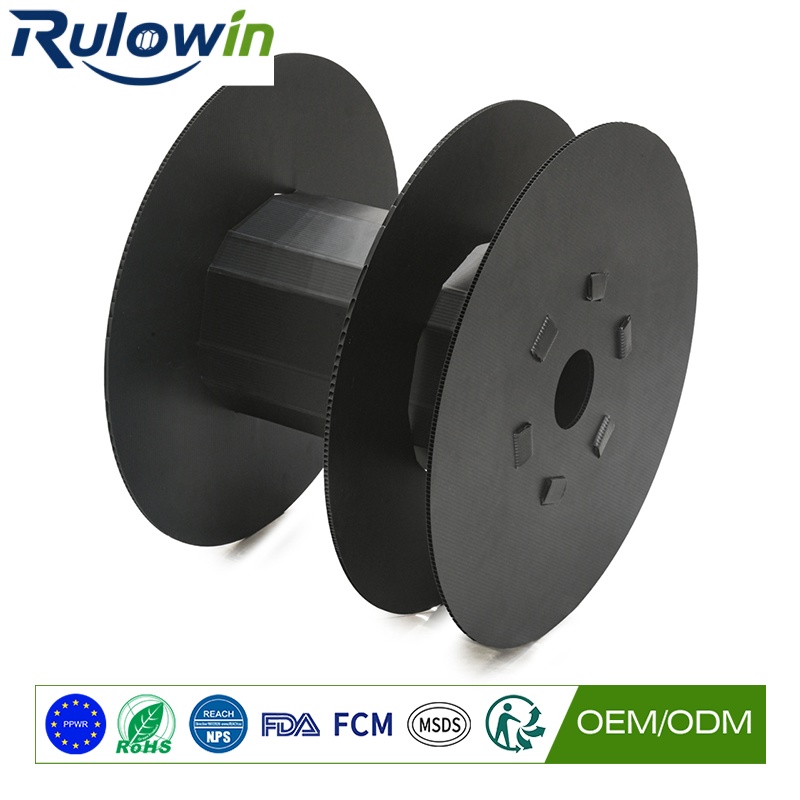
There are two broad ways to build a hollow board spool: the flanges are permanently fixed to the core, or they can be separated from it. The separable version ships flat and can transform the economics of getting empties back. It also puts the most likely failure point right where the load is.
What take-apart buys you
Volume, mainly. A nested stack of flanges with the cores alongside takes a fraction of the space an assembled spool occupies, which changes the arithmetic on every return trip. If you are running a reverse loop over a long distance — covered in more detail in our article on return loops — that saving compounds every cycle.
Secondary benefits: damaged components can be replaced individually, so a spool with one cracked flange is a flange replacement rather than a whole-spool write-off. And storing empties takes less yard space, which matters more than people expect.
What it costs you
The joint. Every take-apart design has some mechanism holding flange to core, and that mechanism sees the full hoop load of the wound pack, vibration in transit, and the prying loads of being handled. It is the most common failure on these designs, and it fails in the least forgiving way — suddenly.
Three things go wrong:
- Creep in the joint. Sustained load deforms plastic slowly. A joint that is tight on assembly is slightly less tight after months under load, and slightly less again after a year. This is discussed in the context of the whole spool in our piece on long-term wound storage; the joint is where it shows first.
- Wear at the interface. Any movement between flange and core, even minute, wears the seating. Repeated assembly and disassembly accelerates it.
- Incomplete assembly. The human failure mode. Somebody does not seat it fully, the joint is not properly engaged, and the flange comes off under load. No design is immune to this, and it is why clear assembly indication matters more than it sounds.
What one-piece buys you
Eliminates the joint question entirely. There is nothing to come loose, nothing for an operator to half-assemble, and generally better concentricity because nothing needs re-locating each cycle. In practice one-piece spools get retired for external damage rather than for internal failures.
They are also simpler to specify and simpler to quote, and there is less to go wrong in quality terms.
What one-piece costs you
Return freight and storage volume. A one-piece spool occupies the same space empty as full, which is the opposite of what you want when shipping air. This is the trade covered from the freight side in our article on nested versus assembled shipping.
How to decide
Two questions do most of the work:
How far do empties travel, and how often? A short local loop with frequent collections barely notices the volume difference; the joint risk is not worth taking for a small saving. A long international loop with infrequent collection is where nesting pays, sometimes decisively.
Can you inspect? Take-apart designs need someone looking at the joints periodically. If your empties come back and go straight onto a machine with no inspection step, the joint risk multiplies. If there is a natural inspection point, it is manageable.
What we would say honestly
A lot of take-apart spools are sold to people who would have been better served by a one-piece spool, because the freight saving was compelling in the pitch and the reliability cost showed up later. We have also seen the opposite — programmes that were marginal on freight becoming viable once spools could nest.
If you tell us the round-trip distance, the collection frequency and whether empties get inspected, we can usually say quickly which way your case falls. Our spool range includes both constructions, so we are not steering you toward whichever we happen to stock.
If you go take-apart
Ask what the joint looks like after fifty cycles, not on day one. Any design can be made to feel solid when new; it is what it does after repeated assembly that decides whether it works.