
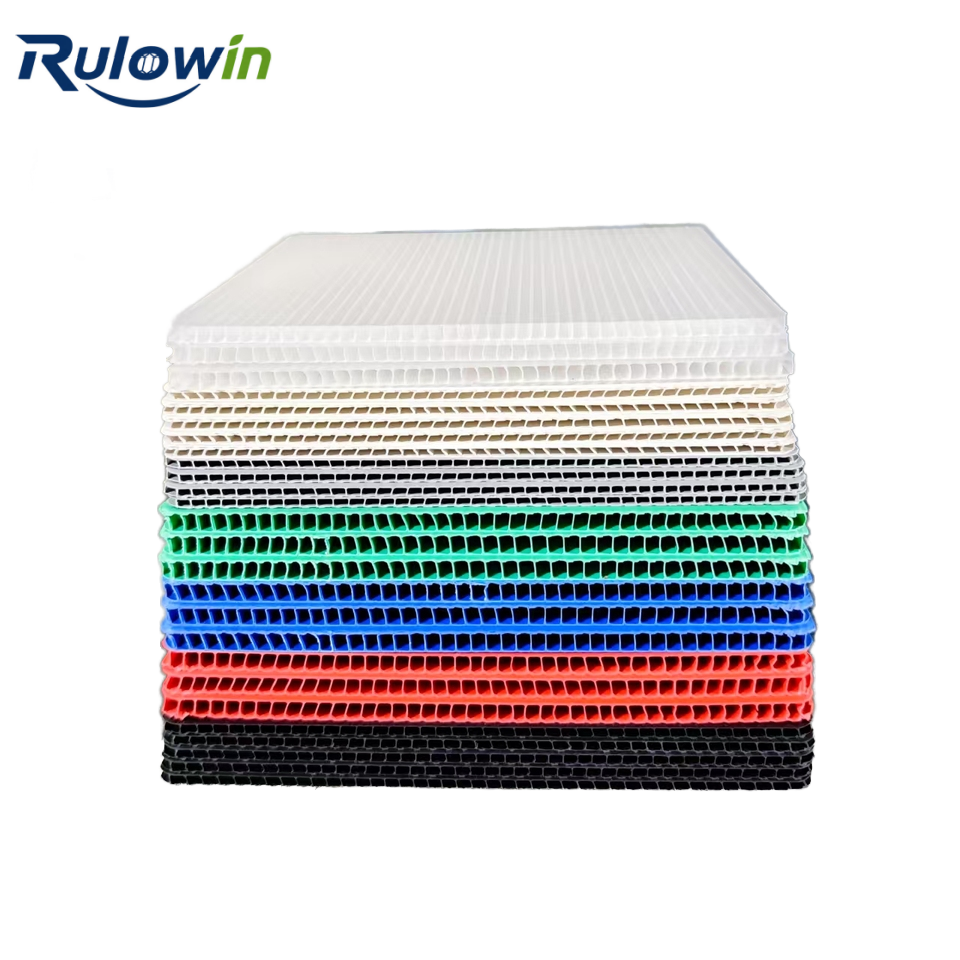
Board is often bought as a commodity: the same nominal specification from whichever source is available. When the source changes, the material on the drawing is the same and the material in the plant may not be, because a specification describes what a board must achieve rather than how it is made.
What actually differs between sources
- Flute or cell geometry. Two boards at the same thickness and gram weight can have different internal structure and therefore different stiffness.
- Skin distribution. The same total material can be arranged with thicker skins and a lighter core, or the reverse.
- Pigment and additives. Colour shifts, and UV or antistatic performance can differ even when the label is the same.
- Residual stress. Affects flatness, warp and how the board behaves when machined.
- Surface treatment. Whether the board is corona treated, and how long ago, changes how it prints or bonds.
None of these show up in a dimensional check, and all of them can change how a finished part performs.
When change control matters
It matters most where the board is qualified as part of an assembly – a panel that has to bond, a part that has to fit a fixture, a component in a product that has been tested and approved. It matters least where the board is a shelf or a spacer and any reasonable board will do.
Being proportionate matters here. Full change control on a commodity spacer is bureaucracy; no change control on a bonded structural panel is a risk.
What a workable process looks like
- Qualify the application, not the material. Test a sample in the real service condition – bonded, loaded, warm, wet – so the qualification is about performance rather than about numbers.
- Keep a retained sample per source. Then a change is visible rather than a matter of recollection.
- Re-test on change. Any new source, and any significant change from an existing one, gets the same qualification as the original.
- Write the reason down. If a change is accepted because the alternative was a line stoppage, record that. Otherwise the next person assumes it was qualified.
The cheap version
Where full qualification is disproportionate, there is a middle route: compare a sample of the new board against the retained sample of the old one, on the specific property that matters. Peel a bonded joint. Flex a strip. Weigh a known area. Look at them side by side under the same light.
It takes an hour and it catches most of the changes that would have caused a problem. For most non-critical applications it is the right level of effort.
What to keep, and how little effort it takes
Change control sounds like a documentation project. The useful version is smaller than that and takes about twenty minutes a quarter.
Keep one retained panel or sheet from every delivery, labelled with the date and the order reference, in a corner of the store where nothing will be thrown away. Keep the delivery documents alongside them. If a problem appears eighteen months later, you can often find the batch and see whether the material that failed differs visibly from the material that did not. That single habit resolves more investigations than any certificate does.
Ask your supplier two questions when you place a repeat order: has anything changed since last time, and will anything change before the next one. Suppliers who cannot answer are telling you something. Suppliers who volunteer an upcoming line move are worth keeping.
When a change is genuinely not a problem
It is worth saying clearly that most changes never reach the customer. A resin lot moving within specification, a screw barrel replaced with the same type, a shift in extrusion speed inside the validated window – these happen continuously and produce no measurable difference in the part.
Change control exists to catch the small minority of changes that do matter, not to freeze everything. Where people get into trouble is applying the same heavy process to every product regardless of consequence. A divider inside a tote does not need lot traceability. A load-bearing panel inside a qualified assembly might. Scaling the effort to what is actually at risk is what makes the programme survive its first year.
What we can do
We supply corrugated PP sheet from a controlled supply and will tell you if a change is coming – a formulation, a line, a source. If your application is qualified around a specific board, tell us what was tested and we will make sure the qualification still applies before we ship.