
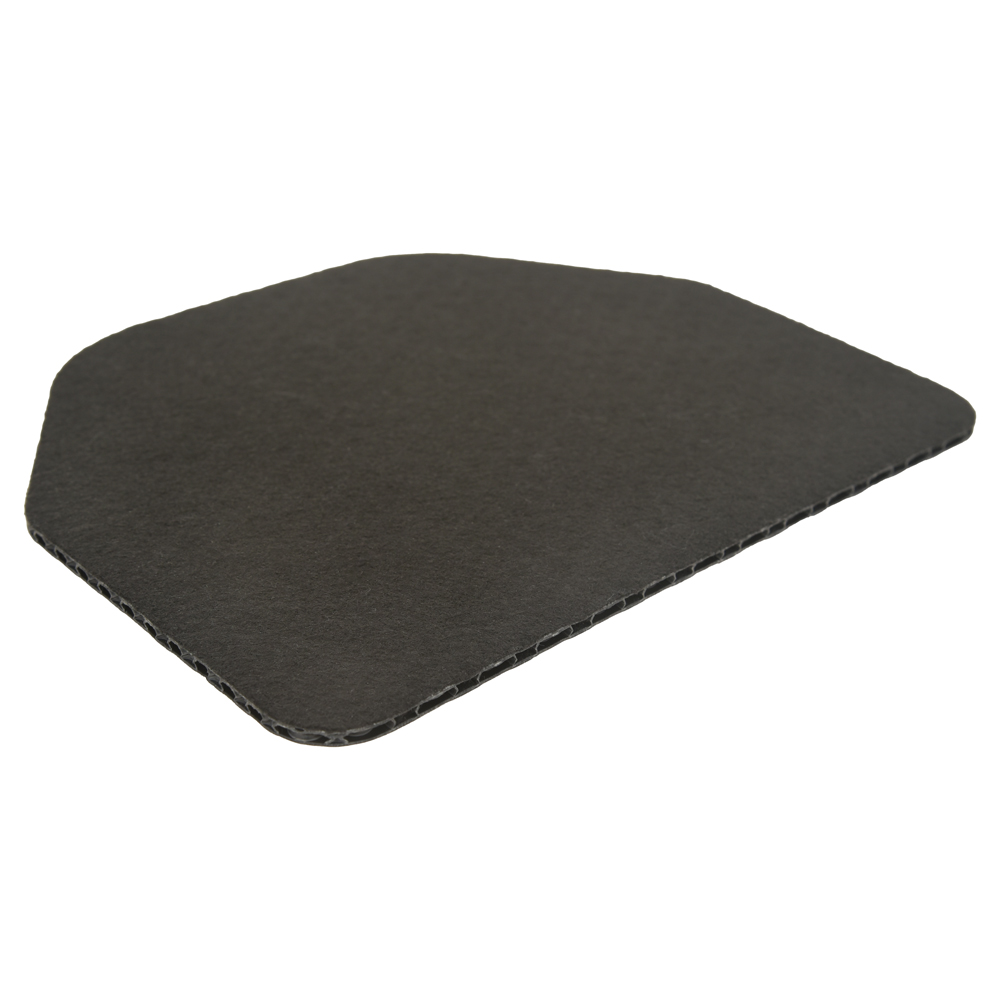
The instinct with sheet material is to stand it on edge to save floor space, and with honeycomb panel that instinct is wrong for long-term storage. Panels standing on edge, leaning, deform at the bottom edge where the whole weight sits on a narrow line.
Flat, and why
Stacked flat, the load is distributed across the whole face, which is what the panel is built to carry. A stack of panels lying flat can sit for years without any change.
Two conditions. The stack has to be on a flat, level surface – a stack on an uneven floor takes a set along the unsupported line – and it should not be so tall that the bottom panel is carrying an unreasonable weight. A metre or so of stacked panel is fine; three metres is not.
On edge, when it is acceptable
Short-term, upright in a rack that supports the panel along its bottom edge rather than letting it lean. A proper sheet rack with a sloping back is fine. Leaning a stack against a wall is not, because the load concentrates on the bottom edge of the panel nearest the wall and that one deforms first.
If you are storing on edge, rotate the stock. The panels at the front of a lean are the ones that suffer, and using them first spreads the wear.
What deformation looks like
A panel stored on edge too long comes out with a soft, slightly compressed bottom edge and a permanent bow. Laid flat afterwards it will not sit flat, and it will rock. That is the test – lay it down and see whether it sits.
Off the floor
Panels stored on a concrete floor pick up moisture at the bottom of the stack, and the bottom panel is the one that gets dirty and scuffed. A pallet or a simple bearer under the stack costs nothing and keeps the whole stack clean and dry.
Also worth keeping the stack covered if it is outdoors, for UV reasons rather than water reasons – PP does not absorb water but it does degrade in sunlight.
Interleaving
Not necessary for PP. Panels do not stick together and do not need paper between them, which is one of the small advantages over some other sheet materials.
If the faces are printed, though, interleaving protects the print from abrasion within the stack. Printed panels face-to-face rub, and the print goes first.
How many per stack
Limited by handling rather than by load. A stack you can lift or access safely is the right height, and that usually means lower than the structural limit. Tall stacks of sheet material are a manual handling problem before they are a material problem.
Panels as delivered
Panels arrive banded in bundles, and a bundle standing on edge for a week before it is opened is already deforming at the bottom edge. Break the banding and lay the bundle flat as soon as it is convenient – the delivery condition is a transport state, not a storage state.
Check panels on arrival for edge crush from the banding too. A tight band on a stack corner does damage before you have unpacked it.
What we can do
We supply PP honeycomb panels and will tell you what stack height suits your storage and how long panels can stand on edge in your conditions. Ask us if you are planning a rack – the answer changes what makes sense.