
A pallet spreads load, provides a stiff base and gives something to wrap against. Those three jobs do not disappear when the pallet does; they transfer. Most pallet-free problems are not box problems but the result of one of the three having no replacement.
The load-spreading job
Without a pallet the box base has to distribute the stack load across whatever it is standing on. Where the box has a flat, reinforced base this is straightforward. Where the base has ribs, feet or a recess, the load concentrates at those features, and the surface below determines what happens next.
The stiffness job
A pallet provides a rigid platform across gaps and over debris. A box base spanning the same gap has to carry the load across it on its own. This is the requirement that most often catches out a fleet designed for palletised use and then used pallet-free.
The wrap-anchor job
Wrap pulls against the pallet at the bottom of the load. Without one, the bottom of the wrap has nothing to grip, and the containment force is applied entirely to the boxes. The load can then be tightly wrapped and still free to walk, because nothing is tying it to the deck.
What replaces each one
Load spreading: a base panel with a flat underside, plus a deck liner on poor floors. Stiffness: either a reinforced base or reduced stack height. Wrap anchoring: a strap that passes under the load, or a hood that covers the top and grips the base. Each has a cost, and each is cheaper designed in than added later.
Where the risk concentrates
At the transfer points, not on the road. A pallet-free load that survives a long drive can come apart at a cross-dock where it is set down on a rough floor and picked up by a different truck. Knowing where the load will be handled is more useful than knowing how far it will travel.
What to check on arrival
Whether the load is still square to the deck, whether the bottom box has abraded through, and whether the wrap or strap is still under tension. All three are visible in seconds and together they say whether the pallet-free arrangement is holding. The containment options are compared in strapping without crushing corners.
What to check before committing
Build one load, strap it, and move it three times with the equipment that will actually be used at each end. Then look at it. Most pallet-free problems are visible after the second move – a base that has abraded, a stack that has walked, a strap that has cut in.
Where nothing has moved after three handlings, the arrangement is probably sound. Where something has, the correction is usually specific rather than general: a liner, a strap position, or one fewer layer.
What to record on arrival
Whether the load is square to the deck, whether the base has abraded, and whether the containment is still tight. Three checks, seconds each, and between them they distinguish a floor problem from a containment problem from a specification problem.
What we can do
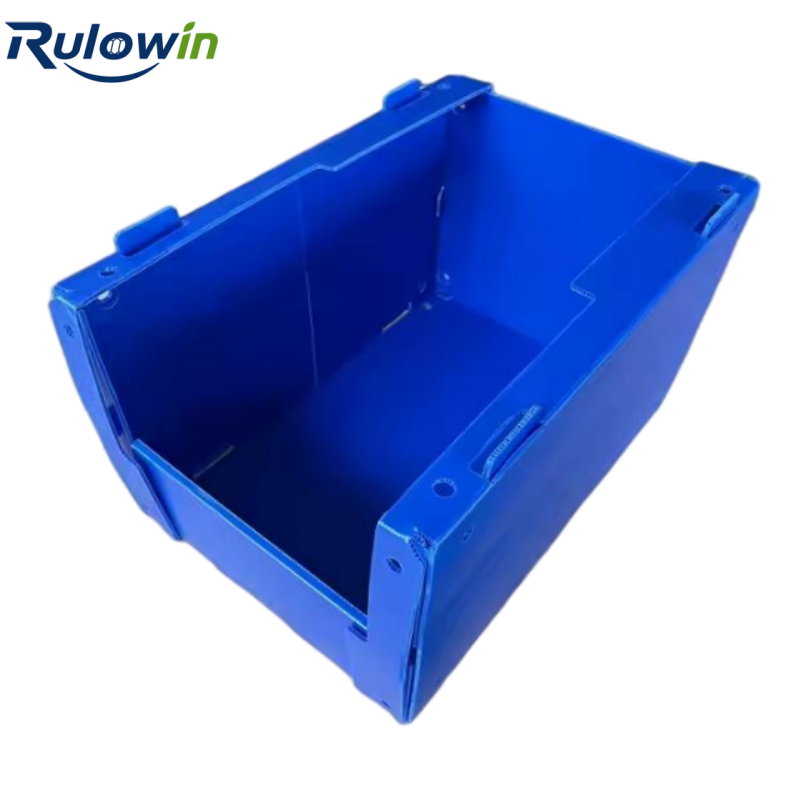
We build PP corrugated turnover boxes with flat reinforced bases and can supply the hoods, pads and deck liners that make a pallet-free load behave. Tell us the route and we will say what it needs.