
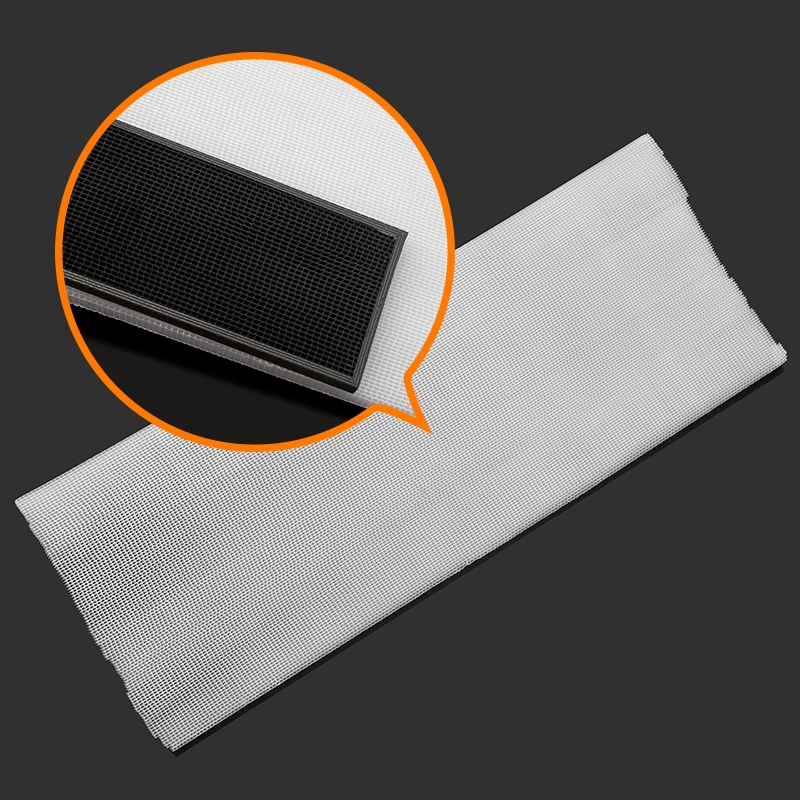
When a filter screen is going into equipment you manufacture, it stops being a consumable and becomes a component. That changes what has to be specified: not just what it filters, but how it fits, how it varies, and how it arrives. Most OEM filtration problems are specification problems that existed before the first part was made.
What belongs on the drawing
Dimensions with tolerances, not nominal sizes. A panel specified as “300 x 300” will arrive somewhere near that, and whether it fits depends on what “near” means. State the tolerance band, and state it in the direction that matters – a panel that has to slide into a channel needs a different band from one that presses onto a gasket.
Material, with the grade and any additive requirements: UV stabilised for outdoor exposure, a specific colour, a flame performance grade if the end product needs one. Flammability ratings are worth stating explicitly because they are often implied rather than written.
Thickness and cell geometry, because both affect performance and both are invisible once the part is installed. And the airflow and pressure drop the assembly has to achieve, so the geometry can be checked against something.
Packaging and presentation
Often overlooked and frequently the cause of assembly-line problems. How are parts packed, are they interleaved, are they labelled, and can an operator tell the front from the back? A filter element that can be installed backwards will be, and for asymmetric structures that matters.
Quantity per pack and pack labelling belong in the specification where the line has a kitting process. This is unglamorous and it is where a lot of delays originate.
What to ask the supplier early
Whether the geometry is available at your volume, what the tooling lead time is if it is not, and what happens on repeat orders – specifically whether the second batch will match the first. Repeatability is the thing that causes trouble a year in, and it is worth pinning down before the first order rather than after.
Flammability and compliance
Where the end product has a flammability requirement, the filter element inside it usually inherits that requirement, and discovering this late is expensive. State the rating needed and the standard it is tested to, rather than a general description like “flame retardant”.
Ratings are achieved with additives that affect material cost and, sometimes, mechanical behaviour and colour options. Knowing early means the rest of the specification can be built around it instead of reworked.
Samples and first article
Ask for samples before committing, and inspect the first production parts rather than the pre-production samples. They are made differently often enough to be worth the check.
Where the element is structural – holding its shape in an assembly – assemble and run a unit with production parts before signing off. A filter that fits and filters can still rattle, and rattling is discovered on the line or, worse, at the customer.
What to do about tolerances you do not need
Specifying a tight tolerance on every dimension is a common way to make parts expensive for no benefit. Identify which dimensions actually determine fit and function, tolerance those properly, and leave the rest open.
On a filter panel that is usually the two dimensions that locate it and the thickness that sets performance. The overall length of a non-critical edge rarely matters, and tightening it costs money on every part.
What we can do
We supply OEM and ODM PP honeycomb filter screens to your specification – thickness, size, colour and cell geometry from your drawings or samples. Send us the drawing and the volumes and we will tell you what is available and what needs developing.