
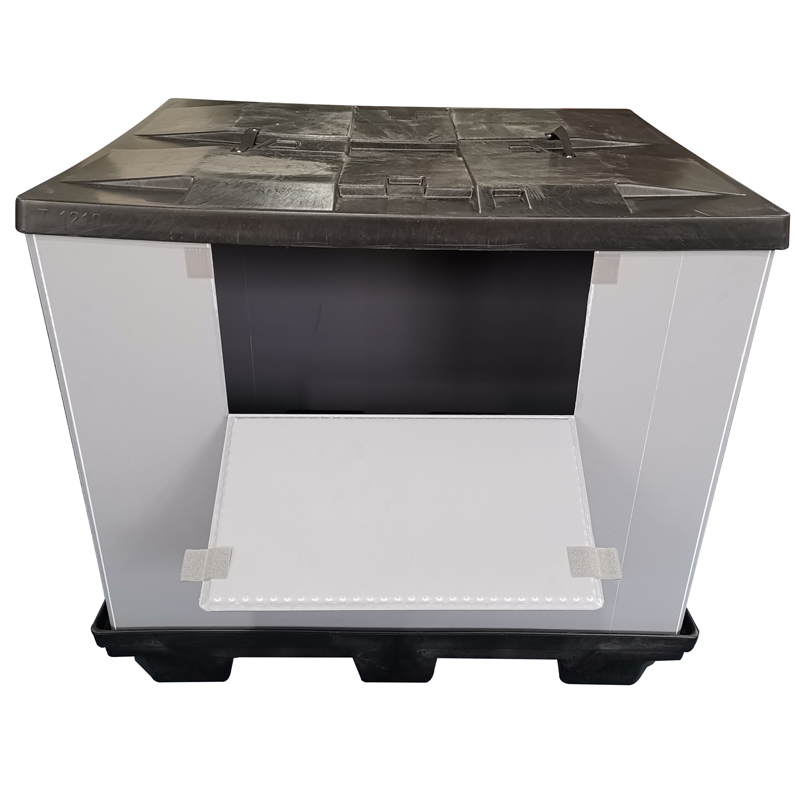
Most containers are scrapped for the loss of a small part rather than for damage to the container itself – a broken handle, a missing catch, a lost divider. Those parts are cheap, they are usually available from the container supplier, and stocking them converts a replacement cost into a small repair. The question is which parts and how many, and that comes from the fleet’s retirement data.
Which parts fail
Handles, because they are grabbed constantly and they take impacts. Catches and clips, because they are cycled every trip. Label holders and card sleeves, because they are exposed on the outside. Dividers and internal fittings, because they are handled and they get lost between trips. And lids, where the container has one, because they are the part most often separated from the container.
How many to stock
From the failure rate, which is the number of containers retired or repaired for that part per year, plus a margin for the batch size the supplier sells in. Where a fleet is large and the part fails on five per cent a year, the annual requirement is easy to calculate and the stock level is a few months of it. Where the data does not exist, a year of recording is what produces it.
Availability matters more than price
A spare part that takes eight weeks to arrive is not a spare part, it is a lead time. Where a fleet depends on a supplier’s lead time for consumable parts, the effective stock level has to cover that lead time plus the reorder interval – which on an imported part can be a quarter of the annual usage. That is often a larger stock than the failure rate alone would suggest.
Standard parts versus container-specific
A generic handle or catch that fits several container types is far easier to manage than a bespoke one, and it is usually cheaper. Where a fleet is being specified, asking whether the wearing parts are standard items is worth doing – it determines the spare parts cost for the life of the fleet, which over ten years can exceed the container cost.
What to do when a part is discontinued
It happens, particularly with older container designs. The options are to buy a lifetime supply when the discontinuation is announced, to find a compatible generic part, or to retire the affected containers progressively. The first is cheapest where the announcement comes early enough, which is a reason to ask suppliers about parts availability at the point of purchase rather than at the point of failure.
Fitting the parts
A repair that needs a tool, or two people, or more than a couple of minutes, will not get done during a shift. Where spare parts are stocked, the fitting method matters as much as the part: a snap-in component gets fitted, and one that needs a press or a special tool does not. Asking how a part is fitted is a reasonable question at the specification stage.
Where the parts live
With the containers, not in a store across the site. A spare part that is a five-minute walk away will not be fetched during a busy shift, and the container goes into the scrap pile instead. A small bin of the four or five common parts, next to where containers are inspected, gets used; a well-organised store does not.
Recording usage
The usage of spare parts is a direct measure of what is failing in the fleet, and it is the cheapest source of that information available. Where a repair log records which part was used, the failure pattern that emerges is the same one described in the damage modes that end a container – and it points at what to change in the next order.