
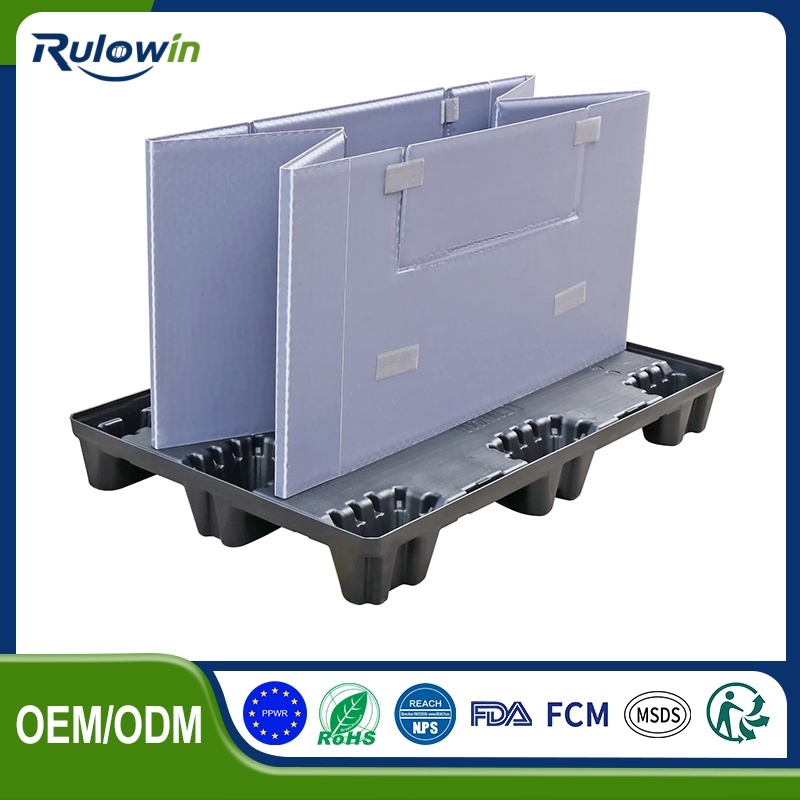
A box that ships flat takes a fraction of the cube of the same box assembled, and on an inbound container from a distant factory that difference is the largest single saving available in the purchase. It is also the cheapest saving to get wrong, because the assembly step and the fold lines are where a flat-shipped box fails.
How much cube it saves
A collapsible or flat-packed box typically ships at a fifth to an eighth of its assembled volume. On an inbound container that is the difference between one container and four, and it applies to every reorder, not just the first. If the box is expensive to make and cheap to ship assembled, the flat option still usually wins on total landed cost – but run it, because the assembly labour is real and it recurs.
The fold line is the wear point
A box that is folded flat and assembled repeatedly puts every cycle through the same fold lines. Those lines have to be designed as hinges – a scored or thinned section in the PP sheet, or a purpose-made hinge – because a fold line that is just a crease in a full-thickness wall will crack within a few dozen cycles. If the box will be collapsed and rebuilt weekly for years, the hinges are the single most important detail in the specification.
Assembly labour, honestly costed
Assembling a collapsible box takes thirty to sixty seconds. Across a fleet of a thousand boxes that is a day of labour on the first build, and a recurring cost if boxes are collapsed for every return. Compare it against the freight saving over the expected number of inbound shipments. For a one-off fleet purchase it is almost always worth collapsing; for a loop where boxes are collapsed and rebuilt weekly, the labour can exceed the freight saving on short routes. The assembled-versus-flat trade-off on a different product is worked through in shipping nested versus assembled.
When flat is the wrong answer
If the boxes are assembled once and never collapsed again, flat shipping saves money once and costs a fold-line detail that will never be used. If the boxes are collapsed and rebuilt constantly, the hinges need to be specified for that duty and the assembly step needs to be in the process. And if the box has fixed dividers, collapsing is usually impractical anyway – dividers and collapsibility are in direct conflict.
Assembly quality is where flat-shipped boxes fail
A box assembled at site by whoever has five minutes is not the same box as one assembled on a jig at the factory. Corners get folded short, welds get missed, and dividers get fitted the wrong way round. The result is a fleet with a wide spread of dimensional accuracy, and the outliers are the boxes that do not stack properly and get retired early.
Two mitigations. Make the assembly obvious – asymmetric features so a box cannot be folded the wrong way, and a visible marker at each corner that has to be closed. And validate the first fifty assembled boxes dimensionally rather than assuming. Where a fleet is large, a simple assembly jig at site pays for itself in consistency: it is a frame that holds the box square while the corners are closed, and it removes the variation between whoever assembled it on the day.
Packaging the flat shipment
Flat-packed boxes need to arrive undamaged, and the bundle they ship in is what protects them. A stack of flat blanks strapped to a pallet with edge protection survives a container leg; a shrink-wrapped bundle without edge protection arrives with crushed corners on the outer blanks, and a crushed corner on a blank is a corner that will not fold correctly.
Specify the outbound packaging of the flat shipment as part of the order: palletised, strapped, edge-protected, and with the blanks laid flat rather than on edge – a stack of sheet on edge will curl under its own weight over a long leg, and a curled blank does not feed through a folding jig cleanly. Where collapsible boxes ship part-assembled, check whether they ship with the hinges unstressed, because a hinge held folded under load for six weeks takes a set.
What we can do
We supply PP corrugated boxes in rigid, fold-flat and fully collapsible builds, and we will price the landed cost both ways for your inbound route. Tell us how often a box will be collapsed and rebuilt and we will specify the hinge for that cycle count rather than for a demonstration.