
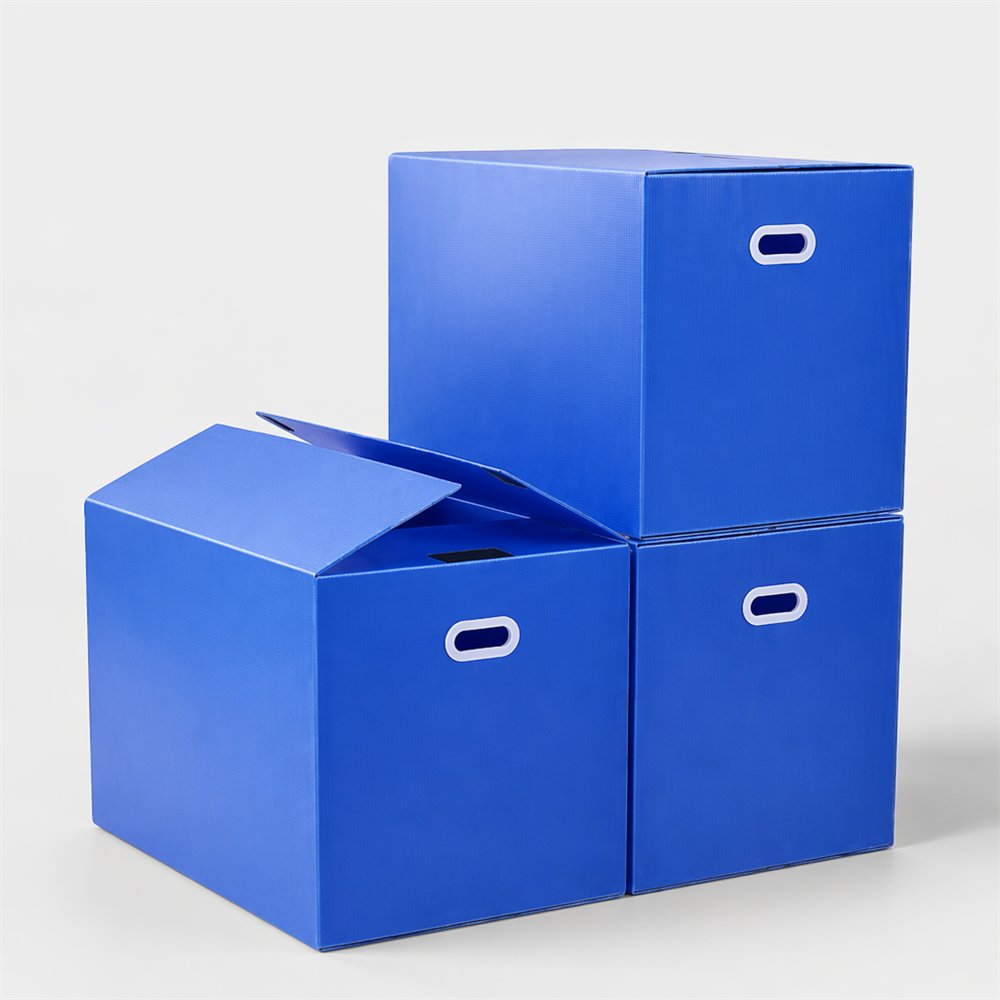
When a plant decides to automate tote handling, the specification conversation usually starts with lift capacity and ends with arguments about pallet patterns. Neither is what actually breaks the project. What breaks it is dimensional consistency – whether box number nine hundred behaves like box number one when a gripper closes on it.
Tolerance is the whole problem
A moulded plastic tote comes out of a tool with its footprint controlled to a millimetre or better. A corrugated polypropylene turnover box is cut and creased from sheet, and sheet thickness varies. Over a run that gives you a spread of a few millimetres across the footprint and more across the top opening, because the walls lean.
A parallel gripper set to the mean will overtighten on the fat end of the spread and drop, or fail to grip, on the thin end. Compliance in the gripper absorbs some of this. Absorbing all of it is a bigger engineering job than most teams budget for.
What to specify, in priority order
Footprint tolerance at the base, because that is what locates the box on a conveyor, in an AGV frame or on a shuttle. State a range, not a nominal, and get the supplier to commit to inspecting against it.
Base flatness. A corrugated base supported only at two runners will bow slightly under load, and on roller conveyor that reads as a box that will not track straight. More bearing surface, or a design that sits on its full perimeter, behaves much better.
Wall rigidity near the top edge, which is where most grippers and vacuum heads engage. Reinforcing the top hem costs little and changes the automation outcome noticeably.
And colour contrast for optical sensing. A mid-grey box against a grey floor defeats a lot of cheap sensors; black boxes are worse. This is the kind of detail we keep coming back to whenever turnover boxes move between operations by anything other than hand.
Where corrugated loses outright
High-speed sortation with tight photo-eye timing, automated storage and retrieval with millimetre-clearance shelves, and any gripper that relies on a precise lip geometry are all poor fits. In those cells a moulded tote wins on predictability, costs more per unit, and is the right answer. We would rather say that up front than sell board into a cell that cannot hold it.
Conversely, in cells running below roughly a few hundred cycles an hour with mechanical compliance in the end effector, corrugated board works fine and is much cheaper to replace after damage.
Handling of empties is harder than fulls
Everyone specifies the loaded case. Empty boxes are lighter, bounce, vary more in shape, and often get handled at higher speed by the machine that nests them. Test the empty handling before you commit – this is where most retrofits discover their assumptions were wrong.
Identification
Decide early whether the cell reads barcodes, RFID or nothing. Barcodes on corrugated PP need the right label stock and a flat, reinforced area to sit on, or read rates collapse after a few wash cycles. RFID embedded in the wall survives much better and costs more per unit; the tag placement has to avoid the gripper contact zones.
Trial properly
Buy thirty boxes from the real production process, not samples, and run them through the actual cell for a week. Record every misgrip and why. If the failure rate is above roughly one in a few hundred after tuning, the tolerance budget is wrong, not the operator.
What we can do
We supply PP turnover boxes and can hold a tighter manufacturing tolerance for automated cells, though it costs more and honestly we will tell you when a moulded tote is the better buy. Send the gripper drawing and the cycle rate and we will give you a straight answer rather than a quotation.