
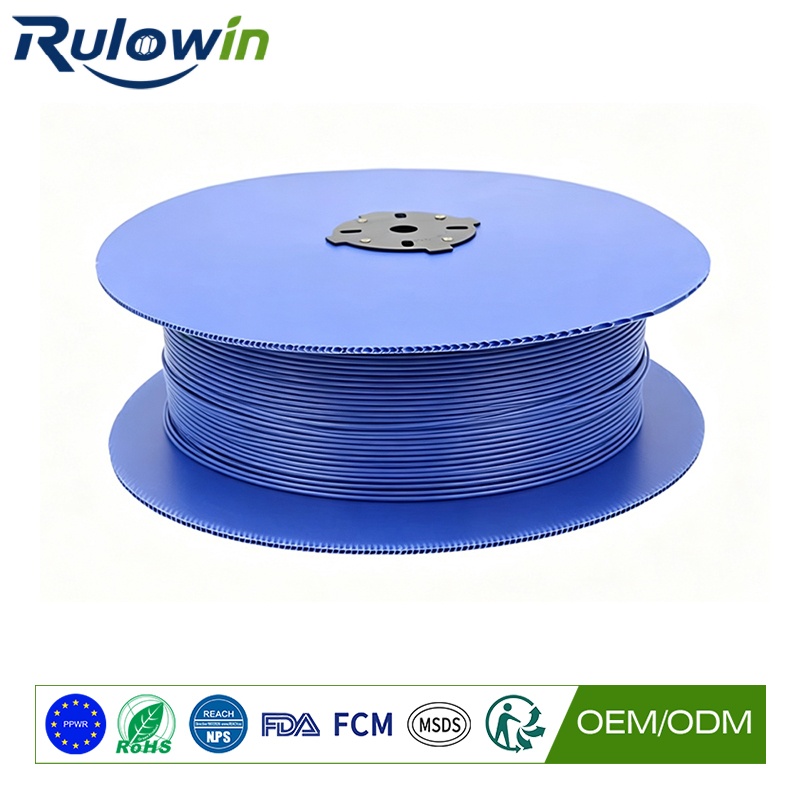
Wind a flat tape onto a spool and it behaves nothing like round product. It has an edge that can be damaged, a width that can telescope sideways, and a tendency to ride up on itself that round product does not have. Most of the problems are solved at the traverse, not at the spool, but the spool geometry sets how much room for error you have.
Telescoping
Telescoping is the sideways sliding of layers so the pack ends up cone-shaped rather than flat-sided. It happens when the layers are not held firmly enough against each other, and it is much more likely with flat product because there is less friction between smooth faces than between round turns.
Two causes, two fixes: winding tension too low, in which case increase it; or the pack being too wide relative to the flange support, in which case narrow the pack or increase the flange stiffness at the rim.
A pack that has telescoped in transit will usually jam on payoff, because the edge of the tape catches on the flange it has slid against.
Edge damage
The edge of a flat product is where it is most vulnerable, and on a spool it is exposed at the outer layers. Contact with the flange, with adjacent spools, or with packaging all show up as a damaged edge — which for tape, webbing, or any narrow material is often a reject condition on the whole length.
Keep the pack below the flange, use a generous radius where the flange meets the core, and make sure the flange inner face is smooth. A burr on a flange face will damage edges for as long as that spool is in service, and it is the kind of defect nobody thinks to look for.
Riding up
Flat product will climb over the turn beside it if the traverse pitch is too fine. Unlike round product, which tends to sit in the valley between turns, a tape laid slightly overlapping will ride up and build a ridge. That ridge then becomes a hard spot that telegraphs through every layer above it.
Pitch should be very slightly wider than the product width — not narrower. This is the opposite of the instinct for round product, and it is the most common setup error with flat materials.
Flange design for flat product
- Stiffer at the rim than a round-product spool, because the pack pushes outward rather than pulling inward
- Smooth inner faces, with no parting line or step at the product contact zone
- Generous radius at the flange-to-core corner
- Some flange taper helps release and reduces edge contact
Tension for flat product
Lower than you would use for cable of similar width, and — importantly — constant. Flat product under varying tension will shift sideways, because a slack moment gives the layer an opportunity to move and it will not move back.
If telescoping is a recurring problem, look at tension consistency before changing the spool. A winder that dips tension at the end of the wind produces spools that telescope in storage, which is why the fault often appears weeks after winding.
What to specify
Product width and thickness, whether the edges are critical, the winding tension, and the payoff method — particularly whether the product is pulled off sideways, which is common with tape and puts lateral loads on the pack that a round-product spool never sees.
Tell us those and we can recommend a flange geometry and tell you what traverse settings to start from — and, when the answer is that the product is better served by a reel or a pad pack, we will say that too.