
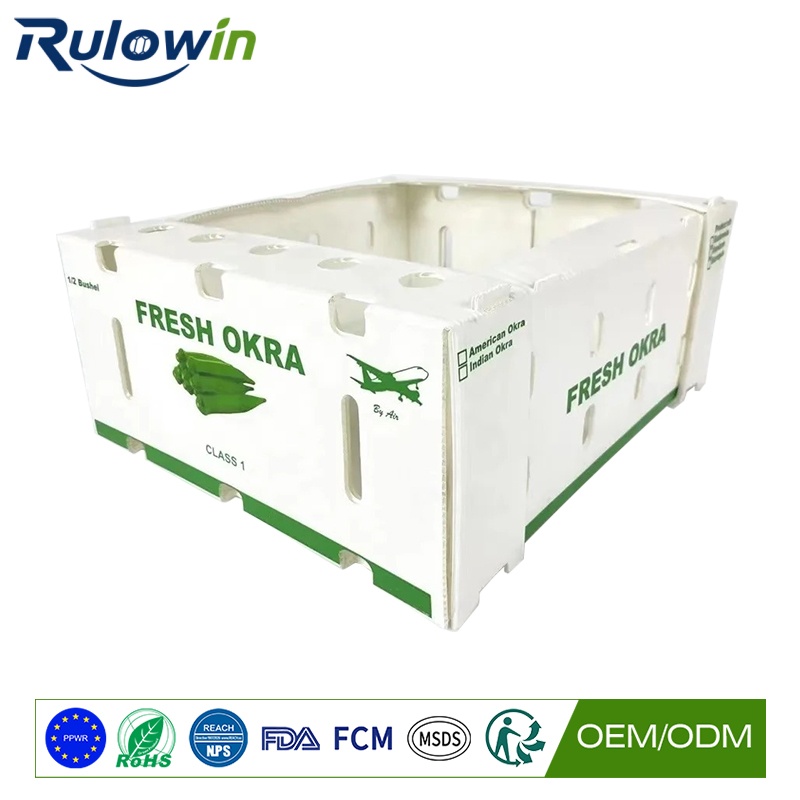
Every reusable packaging business case depends on the boxes coming back, and the return leg is consistently the part that gets least attention at the design stage. It is also where most of the avoidable cost lives.
Why returns leak
Nobody owns them. The boxes are delivered with the product, and once they are unloaded they are somebody else’s problem. Without a named responsible party at the receiving end, they accumulate and then get treated as waste.
There is no backhaul. If the delivery vehicle goes back empty, the return is free. If it does not, someone has to pay for a dedicated collection, and that cost appears in a budget nobody allocated.
They are dirty. Boxes coming back from a retail environment need washing, and if there is no washing capacity the returns become a problem rather than an asset.
Nobody counts them. Without a count at each transfer, losses are invisible until the fleet has quietly halved.
They are the wrong shape to stack empty. Boxes that nest well come back cheaply. Boxes that do not take a trailer each.
Design decisions that help returns
- Nesting or collapsing. The single biggest lever on return freight cost. Ask what the collapsed height is as a ratio of the built height.
- Durability at the handling points – handles, rims and corners, because empty boxes get handled worse than full ones.
- Identification that survives, so ownership is not arguable. Embossed or moulded rather than printed.
- A standard footprint if there is any chance of a pooled arrangement, because pooling only works with standard sizes.
Process decisions that help more
Design matters less than process. Three things do most of the work:
- A named owner at every point in the loop who is accountable for the count
- A count at transfer, even a rough one, so losses are visible while they are still small
- Backhaul discipline – the vehicle that delivered is the cheapest way back, and it needs to be a rule rather than a request
What a good return rate looks like
Well-run closed loops achieve very high return rates, well above ninety percent. Open loops where boxes pass through several hands with no pooling arrangement run much lower. If you are planning a business case, use your realistic number rather than the good one – the difference usually changes the answer.
Pooling as an alternative
If your own return leg does not work, a pooled arrangement may. It only functions with a standard footprint and a third party willing to manage the washing and redistribution, and it converts a capital purchase into a per-trip fee. Whether that is better depends entirely on your volumes and routes.
When boxes go missing
Some loss is unavoidable. The question is whether it is visible. A fleet that loses two percent a month and nobody notices will be down by a fifth within a year, and the shortfall shows up as a rush order at the worst possible moment.
The cheapest control is a count at transfer. It does not need to be a scan – a tally on a delivery note is enough – and it converts an invisible leak into a number someone can act on.
Where losses concentrate tells you what to fix. Losses at one customer point at a process problem there. Losses spread evenly point at the fleet simply being too small for the volume, which is a different and more solvable problem.
What we suggest
Before you buy reusable produce boxes, work out who brings them back and what it costs. If that answer is unclear, buy a small quantity, run the loop for a season, and measure the return rate. It is a much cheaper way to learn than a full fleet.