
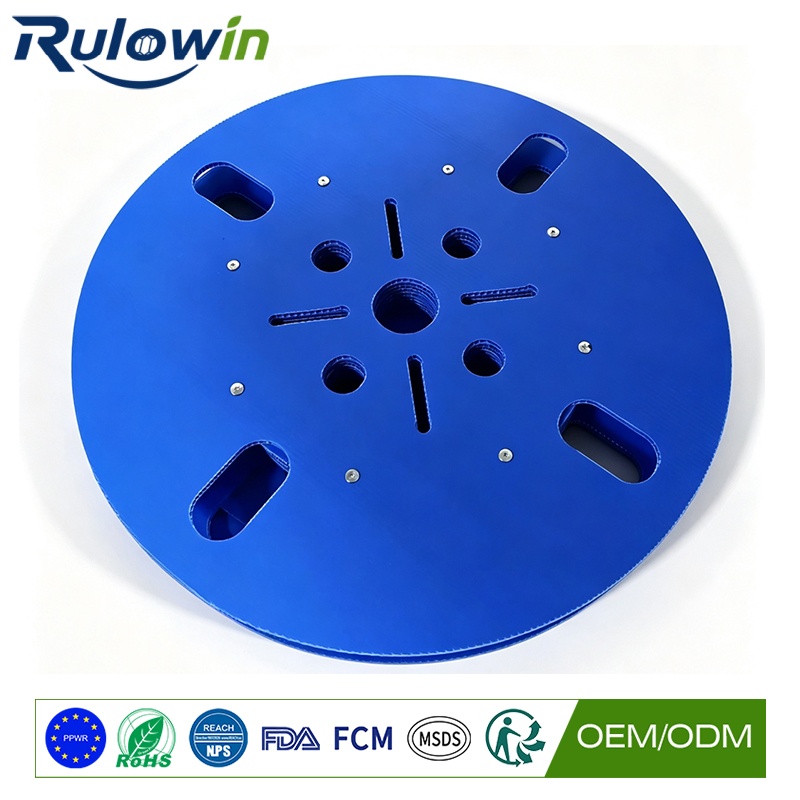
Reel specifications use three words constantly, and they are worth understanding separately because each one governs a different thing that goes wrong. A reel can be right on two of them and fail on the third.
Hub
The cylinder the cable is wound onto. Its diameter sets the tightest radius the cable is ever bent to, which makes it the most important dimension on the reel from the cable’s point of view.
It should be chosen from the cable’s minimum bend radius – a figure the cable maker publishes, usually as a multiple of cable diameter. Choosing it for any other reason is how cable gets damaged during winding and discovered only when it is tested after installation.
In practice the hub is often whatever the tooling came out at. That is worth asking about.
Flange
The disc at each end that contains the cable. It takes the outward radial pressure exerted by the wound cable, and that pressure is highest at the inner wraps – which is why flange failures start at the hub rather than at the rim.
Flange diameter sets how much cable fits: the volume available grows with the square of the radius, so a modest increase in flange diameter buys a lot of length. It also sets the pallet footprint, the handling and the return volume, which is why reels are not simply made as large as possible. Sizing is set out in what flange diameter you need.
Bore
The hole through the middle that locates the reel on a payout spindle. It is the interface with your equipment and it is the one dimension with no tolerance for error – a bore that is slightly loose wobbles, and a wobbling reel produces periodic tension variation that shows up on sensitive cable.
Measure your shaft, not the drawing. Shafts wear, and a stand that has been in service for years may be a millimetre under nominal.
Two more that appear on drawings
Flange thickness, which governs how much radial pressure the reel takes before the flange cracks. Worth asking about specifically, because it is the dimension most often reduced to save material.
Traverse, the width between the flanges – effectively how many layers of cable sit side by side. It sets the reel’s capacity alongside the flange diameter and it affects how evenly the cable winds.
What to do with this
When you next get a reel quote, check that all three are stated with tolerances, and that the hub has been chosen from your cable’s bend radius rather than from a standard tool. That is a two-minute check and it prevents most of what goes wrong.
What to write on a purchase order
Hub diameter, flange diameter, bore diameter with tolerance, traverse width, and the length and diameter of cable the reel is rated for. Five numbers, and a supplier who receives all five can quote accurately.
Missing from most orders are the bore tolerance and the rating for your specific cable – the two that cause the most trouble later. Both are easy to state and both are worth stating in writing rather than agreeing verbally.
Also worth asking for a sample before the container. Fifteen minutes with a reel on your own equipment settles everything the drawing cannot.
What we can do
We supply PP fiber cable reels for optical communication and specify hub, flange and bore with tolerances as standard. Send us the cable specification and your spindle size, and we will specify the reel – including telling you when a standard tool does not suit your cable.