
A communal concrete stair in a residential block is a different proposition from a finished internal stair. It is hard enough to shrug off almost any single impact, it is used by everyone including people carrying furniture and bikes, and it stays in use for the whole programme because residents still need to get to their flats.
What concrete actually suffers from
Not dents. Concrete stairs fail by abrasion and by edge damage. The walking line wears and polishes, which on a power-floated or sealed surface shows as a dull traffic lane against the unworn edges. And the nosings chip, because concrete nosings are the thin, exposed, unreinforced part of a stair and everything carried up the flight eventually catches one.
Why volume beats severity here
A fit-out stair might see twenty people a day for six weeks. A communal block stair sees every resident, every delivery and every removal – hundreds of passes a day for months. The protection that matters is the one that survives volume rather than the one that survives a single heavy event, which argues for a wearing surface that does not abrade through and for edges that do not lift.
Keeping the route open
Residents are using this stair throughout. That rules out anything that creates a trip edge, anything that has to be lifted and re-laid daily, and anything that smells or produces dust when it is cut. It also means the protection has to be fixed, because a cover that moves on a stair used by elderly residents is a genuine incident waiting to happen.
Nosings are the specification
On a concrete communal stair, the nosing is where almost all of the visible damage happens and it is the only part that is expensive to put right – a chipped nosing needs a repair mortar and it rarely matches. A cover that wraps the nosing, fixed rather than laid, handles the risk. The tread surface behind it matters much less.
Where protection is a waste
If the stair is scheduled for a new finish – a coating, a new nosing system, a full refurbishment – after the main works, then protecting it is pointless and the money goes on the temporary route instead. Plenty of blocks do exactly this and it is the right call. Ask what the stair scope is before ordering anything for it.
Communal stairs and the residents
Residents will tell you quickly if a cover moves, and they are usually right. Putting a contact number on the stair and re-checking the flight the same day a complaint comes in keeps a small problem from becoming a formal one. It also gives early warning of a fixing detail that is not holding, which is more useful than any inspection regime.
Fire strategy in a communal block
A communal stair is the escape route for the whole block, and anything on it has to be considered against the fire strategy – including combustibility and whether it reduces the width. Check with the responsible person before specifying. Where the answer is that nothing can go on the stair, the alternative is routing works traffic elsewhere and that should be planned rather than improvised.
Lighting in a communal stair
These stairs are often poorly lit and the lighting is frequently being replaced as part of the works. Damage and loose covers go unseen. Temporary lighting on the flight during the programme is what makes a daily visual check actually possible rather than nominal.
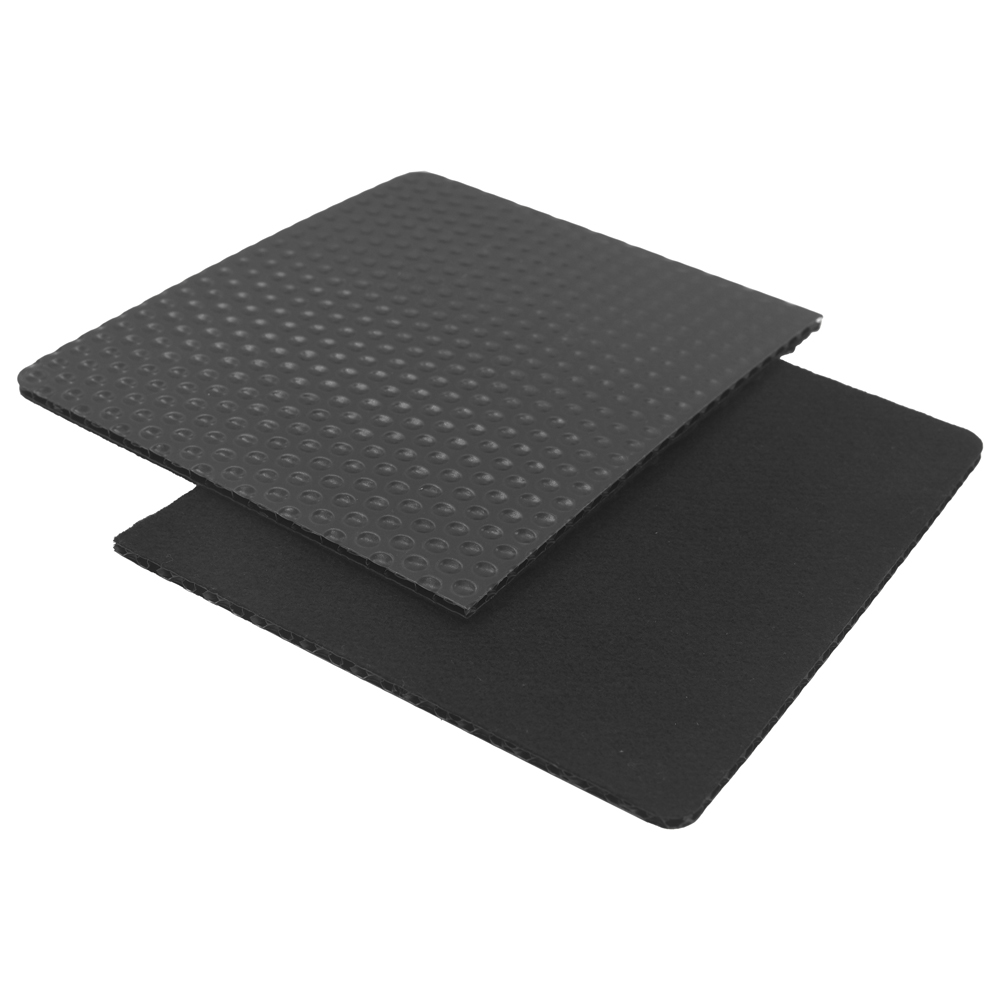
What goes on a communal flight is a PP honeycomb panel with a wrapped nosing, fixed rather than laid. Corrugated PP sheet slides on concrete and lifts under this volume of traffic.
What we can do
We supply PP honeycomb tread and nosing covers for communal stairs, fixed rather than laid, with a wearing face that survives volume traffic. Tell us how many flights, what the traffic is like and whether the stair is being refurbished anyway, and we will say whether covering it pays. The general stair argument is in why stairs need different protection from flat floors.