
A supermarket refit is a well-understood and brutal format: the store closes, a strip-out and re-fit happens in hours, and it reopens the next morning with a floor that has to be perfect. There is no snagging period and no second chance, which makes the protection decision more important than on almost any other job type.
What the floor is
Most stores are polished concrete or a hard tile, both chosen for durability under roll cages and pallet trucks. Neither scratches easily and both chip at edges and at joints. The risk in a store is not foot traffic, it is wheeled traffic at thresholds and at the junction between the sales floor and the back-of-house.
Roll cages and pallet trucks
A roll cage is a concentrated load on four small castors and it gets pushed, not steered, down the aisles. That destroys soft protection and catches at every joint. What survives is a stiff board with a hard wearing face, laid with tight joints along the aisle route and ramped at every threshold. Protecting the whole sales floor is unnecessary; protecting the aisle route is essential.
The overnight programme
Everything happens in one shift, which means the protection has to be laid quickly by a small crew and lifted just as fast. Stock sizes, one grade, and a layout agreed in advance – not cutting on site. The boards also have to be stored somewhere on site between shifts, which is a real constraint in a working store.
Buying across a store estate
Supermarkets refit continuously across an estate, so the same specification is used dozens of times a year. That is worth setting up as a standing order with agreed pricing and held stock, and it is worth standardising on one size so crews know what they are laying wherever they are.
Where to spend nothing
The back-of-house areas with a structural floor, the loading bay, and any area being re-floored. Store refit budgets are tight and the temptation is to protect everything; the aisle route and the thresholds are what matter.
Thresholds into the back-of-house
The junction between the sales floor and the back-of-house is the worst detail in a store: a change of level, a door, and the route that every roll cage takes. It is also where the floor most often gets chipped. A ramped cover over that threshold, fixed outside the door swing, is the single highest-value item in a store refit protection set.
Refits that run while the shop trades
A supermarket refit rarely closes the whole store. Work happens in aisles at night or in a section screened off while trade continues a few metres away. That puts three requirements on the protection: it has to go down and come up quickly, it has to be safe for customers walking past, and it must not leave a residue on a polished floor that will be back in service the next morning.
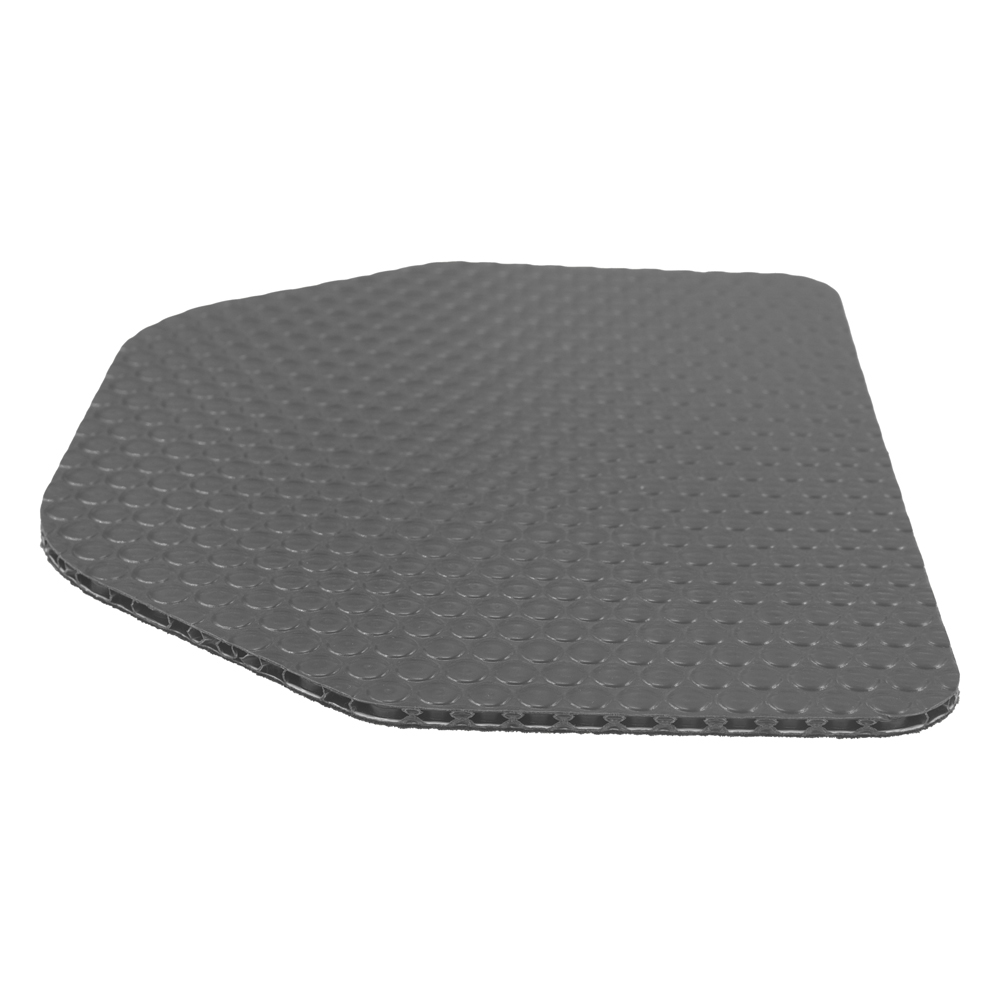
Speed points to a panel light enough for one person to carry and lay without tools. Customer safety points to anti-slip – the studded face down on a polished floor gives grip that a smooth sheet does not, and the panel edge has to be low enough not to catch a trolley wheel or a shoe. Residue is the real risk: cloth tape on a supermarket floor leaves a mark that shows under the lighting and takes solvent to remove. Use low-tack tape at the perimeter and weight the field joints. The pattern of phasing described in phasing protection across a live building applies directly here.
What we can do
We supply PP honeycomb protection board in stock sizes with ramped threshold transitions, suited to overnight laying by a small crew. Tell us the store format, the floor type and the shift length, and we will size the set. Threshold behaviour is covered in protecting door thresholds and transition strips.